 简体中文
简体中文 繁體中文
繁體中文 English
introduction:Why is "buying an SFC licensed company" more complicated than "applying for a new license"?
In the Hong Kong financial services market,Acquisition already heldHong Kong Securities and Futures Commission (SFC) licensecompany,Often seen as reducing time to market、Strategic path to quickly build business channels。Especially for those who want to lay out asset management、Securities trading、For institutions providing advice on securities or regulated activities related to virtual assets,M&A looks like a 'shortcut'。
But the reality is,"The license is in the company" does not mean "the business can be transferred seamlessly"。The core focus of SFC supervision has never been "transfer of shell companies",RatherIs the actual controller qualified?、Whether the responsible officer (RO) continues to perform his duties?、Whether customer assets are safely migrated、Whether internal control is effectively continued。therefore,Whether the acquisition of a Hong Kong SFC licensed company was successful or not,Not on the day of signing,And whether the regulatory logic can be completely satisfied。
This article will focus on three high-frequency and high-risk links:RO retention mechanism、Client Asset Transfer Arrangements、The whole process of approval and filing with the China Securities Regulatory Commission。If you are evaluating an acquisition target,or have entered the transaction negotiation stage,This article can be used as a practical roadmap。
one、First clarify the nature of the transaction:Are you buying a "license plate shell"?,Or buy "sustainable operating capabilities"?
Many buyers only focus on three indicators at first:License plate type、Historical years、Quotation level。But in the Hong Kong SFC merger and acquisition scenario,What really determines the value of the transaction,are the following four dimensions:
- regulatory dimension:Is the license plate status normal?、Is there any disciplinary action?、Are there any open investigations or requests for supplementary documents?;
- Personnel dimension:RO、licensed representative、Compliance officer、Is the MLRO (if applicable) stable and sustainable?;
- business dimension:Customer structure、source of income、Product Compliance、Is cross-border business development healthy?;
- Operational dimension:Internal Control Manual、Risk control process、IT system、Account records、Are audits and annual reviews continuing and complete?。
In other words,What the buyer acquires is not “a certificate”,Rather, it is a regulated entity that can be continuously trusted by the SFC.。The sooner you understand this,The less resistance there is to subsequent approval。
two、Due Diligence before transaction:70% determines the success or failure of M&A
1. Licensing and regulatory record due diligence
The first step is to verify the type of regulated activity held by the target company (e.g. Category 1、Category 4、Category 9 etc.),and confirm the following matters:
- Is the license plate valid?;
- Are there any license conditions attached?;
- Has it been condemned in the past?、fine、Restrict business;
- Is there any uncompleted rectification?、Ongoing reporting obligations。
2. Due diligence on equity and control structures
Acquisitions usually trigger"Change of substantial shareholder"Relevant regulatory requirements。If the buyer obtains key control rights directly or indirectly,Requires prior approval or notification to SFC (depending on actual triggering rules)。therefore,Be sure to check thoroughly:
- Ultimate Beneficial Owner (UBO) Chain;
- Whether offshore SPV and multi-layer holdings are involved;
- Whether the shareholder’s background involves high-risk jurisdictions;
- Is there any betting?、Hold on behalf of、implicit control arrangements。
3. Compliance system due diligence
The thing that is most likely to be "exploded" after an acquisition is not finance.,But compliance。Focus on:
- Are KYC and customer risk ratings truly implemented?;
- Transaction monitoring、Are the suspicious transaction reporting records complete?;
- staff training、Compliance testing、Is the internal audit report continuous?;
- Customer asset isolation、Reconciliation、Are hosting arrangements traceable?。
If the target company only has a “paper system” but no evidence of implementation,The buyer needs to fully discount the price in the valuation,And reserve rectification costs and time。
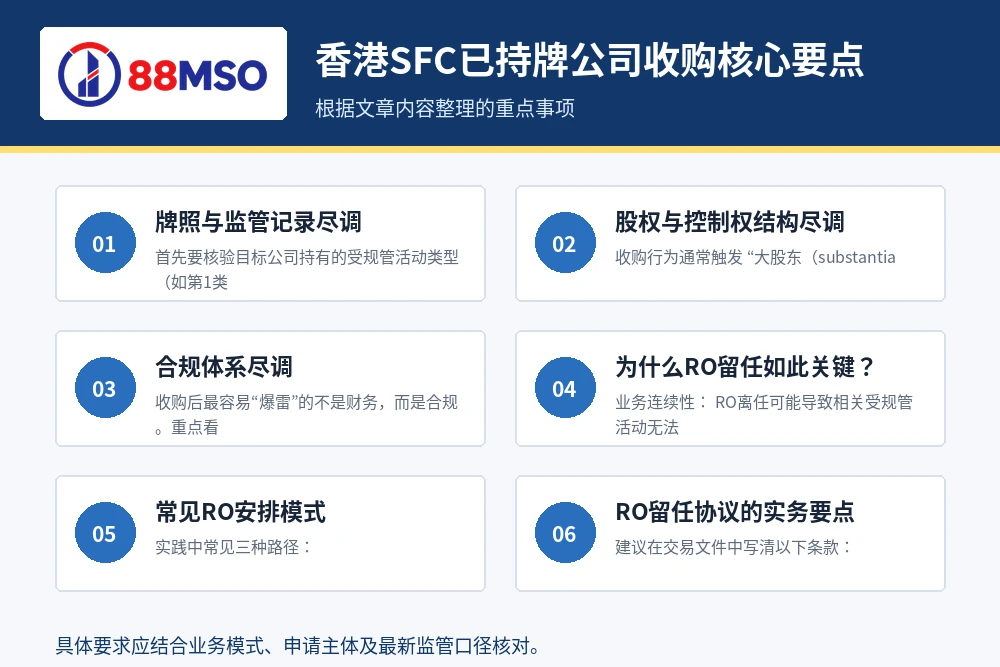
three、RO remains in office:"Core variables" in acquisition approval
Under the Hong Kong SFC regulatory framework,RO is not an optional position,Rather, he is a “key person” for the continued conduct of regulated activities.。Many transactions are stuck,Precisely because buyers underestimate the regulatory weight of RO stability。
1. Why is RO retention so critical?
- business continuity:The departure of the RO may result in the inability of the relevant regulated activities to continue operating.;
- regulatory trust:SFC will assess whether management has sufficient experience and integrity;
- Approval rhythm:If RO replacement and equity change occur at the same time,Significant increase in review complexity。
2. Common RO arrangement models
There are three common paths in practice:
- Former RO short-term retention transition:Assist with regulatory transition and business handover 3-12 months after closing;
- New and old RO parallel:Add buyer nomination RO,Forming a transitional dual RO architecture;
- Obtain new RO approval before delivery:Reduce the risk of business interruption caused by “no RO available” after closing。
3. Practical Essentials of RO Retention Agreements
It is recommended that the following terms be clearly stated in the transaction documents::
- Minimum retention period and notice period for departure;
- Scope of Responsibilities and Regulatory Communication Obligations;
- Performance and Compliance Responsibility Boundaries;
- Early departure alternatives and default arrangements。
hint:If the buyer’s core team does not yet have candidates who can be approved for RO,"RO solution" should be considered as one of the transaction prerequisites (CP),Rather than making amends after delivery。
Four、Customer asset transfer:Legally feasible ≠ Regulatory feasible
The transfer of customer assets is the most underestimated aspect of mergers and acquisitions and the most likely to trigger complaints and regulatory attention.。Especially when it comes to escrow accounts、Client Securities、Fund shares、margin、Third-party payment method,Any breakdown in processes can create material risks。
1. First make an “asset map”
before official migration,A complete asset map needs to be created:
- Bank/custodian institution where client funds are located;
- Asset Class (Cash、securities、Funds、Structured products, etc.);
- Transfer Authorization Clause in Customer Agreement;
- Is there a freeze、pledge、Disputed assets。
2. Customer Notification and Consent Mechanism
Different business lines have different customer notification obligations.,But it is generally recommended:
- Provide clear migration notice in advance,Explain time、Impact and Customer Rights;
- Obtain written consent or supplementary agreement from the customer when necessary;
- Provide a barrier-free exit mechanism,Avoid "passive migration" controversy;
- Set up dedicated customer service and complaint handling channels。
3. Critical control points in migration execution
- House-to-house reconciliation of balances before and after migration;
- Double review of account permission switching;
- Key node traces (email、System log、Approval records);
- Issue customer confirmation and internal audit reports after migration is completed。
For SFC,The focus of customer asset transfer is:Customer rights are not compromised、Asset isolation does not destroy、Records are traceable、Responsibilities can be defined。
five、The whole process of approval and filing with the China Securities Regulatory Commission:From before signing to after delivery
Stage A:Transaction structure design and regulatory trigger analysis
Before signing any binding document,First determine whether the transaction is triggered:
- Major shareholder change approval/notification;
- director、Responsible person、Changes in core functional personnel;
- Adjustment of business scope or business address;
- Eligibility review triggered by changes in ultimate beneficial owner。
The goal of this step is to determine a “regulatory roadmap”,Avoid signing a contract only to find out that the approval conditions cannot be met。
Stage B:Pre-communication and material preparation
For complex transactions, regulatory pre-communication is usually recommended (depending on the case)。Materials generally include:
- Buyer and UBO background information、Funding source description;
- Post-acquisition governance structure、Responsibilities division chart;
- RO and key personnel arrangement plan;
- Business continuity and customer asset migration solutions;
- Compliance improvement plan and timetable。
Stage C:Formal submission and inquiry response
After submission,The SFC may issue supplementary inquiries on the following issues::
- Whether the buyer’s financial industry experience and management capabilities are sufficient;
- Whether the proposed management actually participates in daily management;
- Does cross-border business involve license obligations from other jurisdictions?;
- How to cut off and repair historical compliance issues。
Inquiry responses should adhere to two points:The facts are consistent、Evidence closed loop。The same question is stated inconsistently in different documents,is a common cause of delays。
Stage D:conditions met、Delivery and subsequent filing
After approval,Delivery does not mean the end。It is usually necessary to complete the:
- Appointment of directors and management implemented;
- Bank Account Authorization Update;
- Reissue of internal policies and procedures;
- Switching between system permissions and data governance;
- Fulfill follow-up notification and regular reporting obligations on time。
six、How to write transaction documents,Can we truly prevent risks?
M&A legal documents should “contractualize” regulatory key points。It is recommended to focus on:
- Prerequisites (CP):Regulatory approval、RO arrangement、Key customer stability rate、No material adverse changes;
- Representations and Warranties:license plate status、Historical compliance、Customer Asset Integrity、No risk of hidden penalties;
- Indemnity clause:Fines due to historical violations、Customer claims、Attribution of rectification costs;
- Post-closing commitments:seller assistance period、Personnel cooperation、Data and document handover integrity;
- price adjustment mechanism:Based on AUM、net capital、Set price adjustment terms such as retaining key customers。
Experience,in regulatory-intensive transactions,The more "business + compliance" the contract terms are,The less controversy there will be。
seven、Common failure scenarios and coping strategies
Scene 1:RO suddenly left after signing the contract
response:Pre-installed RO list;Set up RO retention CP and replacement triggering mechanism in SPA。
Scene 2:Customer asset migration encounters high proportion of opposition
response:Communicate with key customers in layers,Provide smooth transition plan and fee reduction,Set migration buffer period。
Scene 3:SFC inquiry cycle lengthened
response:Unified external caliber,Establish a “problem-evidence-responsible person-deadline” tracking table,Avoid duplicate patches。
Scene 4:Historical compliance black hole discovered after delivery
response:Initiate an independent compliance review immediately,Proactively correct deviations and formulate rectification routes,Conduct self-examination and disclosure when necessary。
eight、100-day post-acquisition integration plan (Post-Merger Integration)
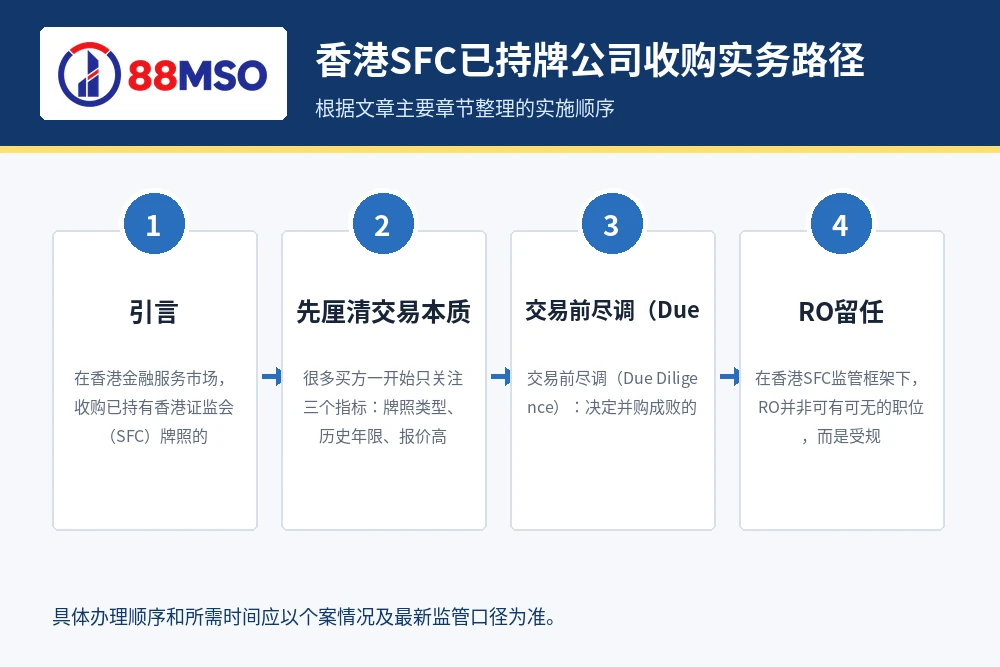
The real regulatory test usually comes after closing。It is recommended to proceed with the “100-day plan”:
- Days 1-30:Stable personnel、Permission switching、Comforting key customers、Key reporting completed;
- Days 31-60:System unity、KYC supplementary documents、Risk model calibration、Supplier review;
- Days 61-100:Internal audit sampling、Closed loop of rectification、Board Compliance Report、License maintenance plan for next year。
For institutions entering the Hong Kong market for the first time,Usually requires an outside professional team to work in legal、Compliance、audit、Collaborative advancement in license plate maintenance。Service teams like 88MSO and its 88MSO that have long been involved in Hong Kong’s financial compliance custody services,The value is often reflected in "breaking complex regulatory actions into executable steps",And reduce time and communication costs at key nodes,rather than simply handling documents。
Conclusion:Put regulatory logic in front,This is the real “speed up” for SFC licensed mergers and acquisitions
Difficulties in the acquisition of licensed SFC companies in Hong Kong,It’s never “can’t buy it”,But "Will it be stable after buying it?"、quick、Run legally”。RO retention determines business continuity,Transfer of customer assets determines reputation and liability boundaries,The China Securities Regulatory Commission’s approval determines whether the transaction has truly completed the regulatory closed loop.。
If you design these three things before trading,,Acquisitions can be an accelerator for efficient entry into Hong Kong’s capital markets;on the contrary,No matter how nice the price is,,You may also fall into the dual pressure of compliance repair and customer loss after the closing.。
One sentence summary:Let’s do regulatory feasibility first,Let’s talk about transaction certainty again;Do compliant delivery design first,Do valuation optimization again。
FAQ:The 5 most frequently asked questions in practice
1. Is it necessarily faster to acquire an SFC licensed company than to apply for a new license?
uncertain。If the target company’s history is clean and compliant、RO stable、Clear ownership structure,usually faster;If there are historical issues,On the contrary, it may be slower and more expensive。
2. Does the RO have to stay permanently?
Not necessary,But staying on during the transition period is usually better for approvals and business continuity。The key is to ensure that regulatory requirements for responsible persons are met at any point in time。
3. Does the transfer of client assets require the consent of each client?
Subject to business agreement、Depends on asset type and arrangement。In practice, the bottom line should be “full notification + necessary consent + traceable records”。
4. How long does the approval cycle usually take?
Depends on transaction complexity、Material integrity、Inquiry response quality。The more prepared you are,The more controllable the cycle。
5. What are the most overlooked compliance matters after closing?
"Actual implementation" and evidence retention after system update。Many organizations have new handbooks,But lack of training、Missing spot checks、Missing records,The problem will eventually be exposed during the annual review or inspection。
Application documents should explain how the business actually operates
When preparing for the acquisition of a Hong Kong SFC licensed company,The business plan should not only list the license name。The source of customers should be explained item by item、Products and transaction processes、Whether to hold client assets、Order placement and valuation arrangements、Outsourcing services、Conflict of interest handling and abnormal incident reporting path,and let the organizational structure、Personnel biographies and financial forecasts match each other。
The responsibilities of responsible personnel and core functional managers need to be implemented in daily decision-making and supervision records。Financial resources must continue to be monitored after being licensed、personnel changes、Business scope、Client Assets and Regulatory Reporting;Acquiring a licensed company does not mean that the license is automatically and unconditionally transferred with the transaction.,Changes in control and key personnel should be checked against notification or approval requirements。
Industry references:Hong Kong Securities and Futures Commission:Licensing Manual。
Read more:Hong Kong SFC responsible officer (RO) configuration:Key points for recruitment and qualification review of licensed institutions、Mainland securities firms go overseas to Hong Kong:SFC No. 1 and No. 2 license application requirements。