 简体中文
简体中文 繁體中文
繁體中文 English
Mainland securities firms go overseas to Hong Kong,Why look at SFC No. 1 and No. 2 licenses first?
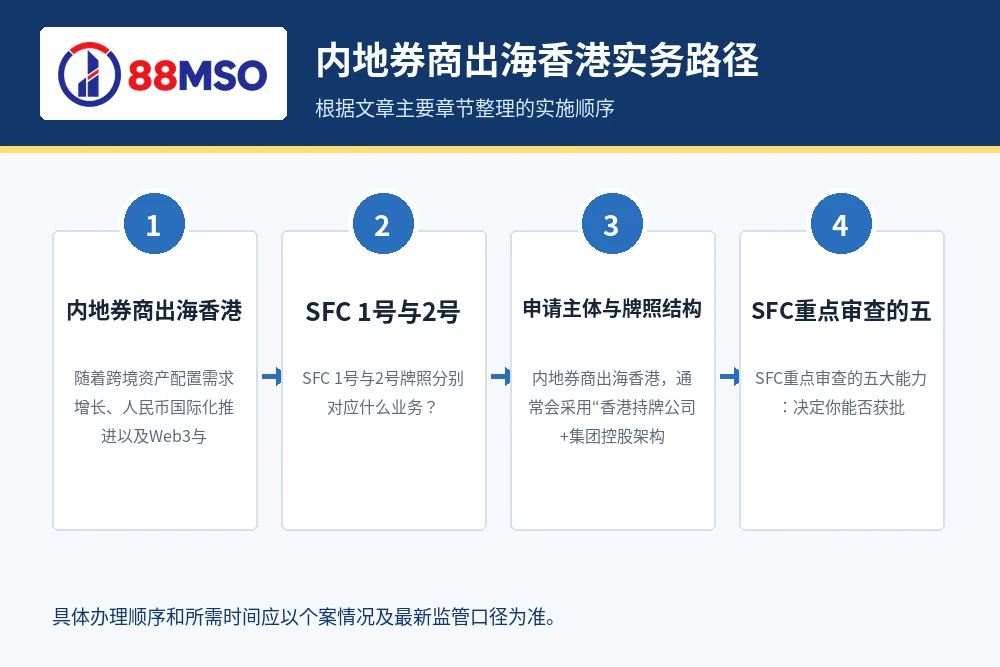
As demand for cross-border asset allocation grows、The internationalization of RMB is promoted and the linkage between Web3 and global capital markets is strengthened.,More and more mainland securities companies regard "Hong Kong license" as the first stop for internationalization。Compared with directly entering the European and American markets,Hong Kong in language、Legal connection、More practical advantages in customer recognition and capital flow paths。But the actual implementation is not as simple as “registering a company”——Hong Kong Securities and Futures Commission (SFC) licenseIt is the core threshold for conducting regulated securities and futures business.。
For most mainland securities firms,most common、The most basic and crucial,that isType 1 regulated activity (dealing in securities)andType 2 regulated activity (dealing in futures contracts)。The two types of licenses often correspond to brokerage business、trade execution、Institutional Customer Service、Core scenarios such as cross-border product distribution。If there is no clear license plate path design,Enterprise is easy to configure in RO、business boundaries、System Compliance、Repeated rework on financial adequacy and other aspects,The cycle lengthens、Costs out of control,It even affects the pace of overseas expansion at the group level.。
This article will take a practical perspective,The system breaks down the key steps for mainland securities firms to apply for SFC No. 1 and No. 2 licenses、time planning、Common "stuck points" and speed-up strategies,Help you launch Hong Kong business faster under the premise of compliance。
What businesses do SFC No. 1 and No. 2 licenses correspond to?
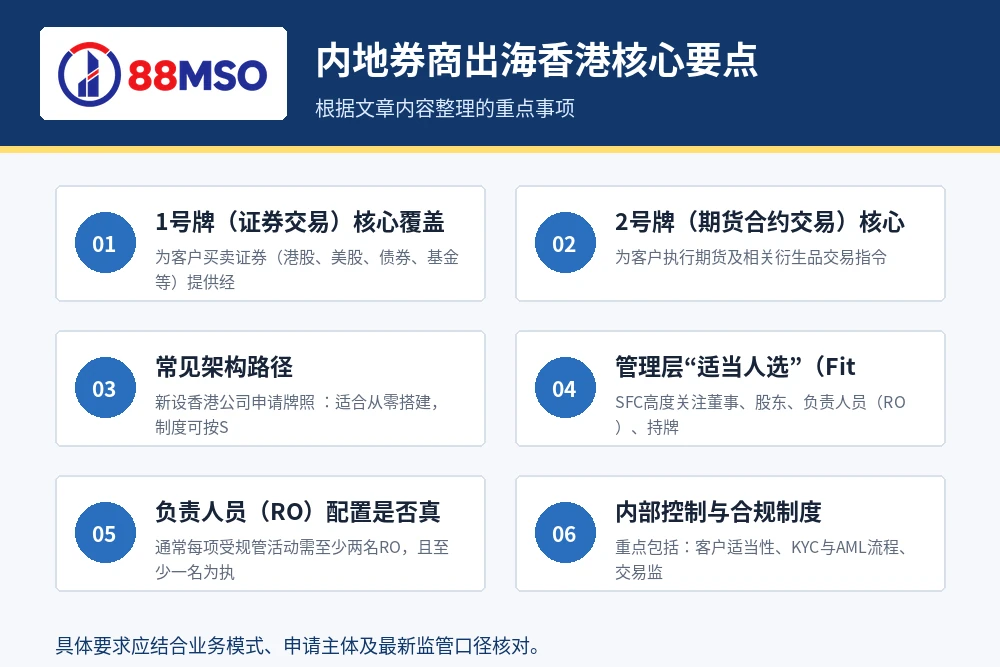
No. 1 license plate (securities trading) core coverage
- Trading securities (Hong Kong stocks) for clients、US stocks、bond、Funds, etc.) provide brokerage execution services
- Securities distribution and underwriting related activities (depending on specific business models and additional license requirements)
- Trading account services for professional investors or retail clients
- Processing of customer instructions related to securities transactions、Order routing、Transaction Settlement Collaboration
Core coverage of License No. 2 (futures contract trading)
- Execute futures and related derivatives trading instructions for clients
- Provide futures trading brokerage channels and account services
- Connect with domestic and foreign exchange products (subject to trading qualifications and channel arrangements)
- Licensing basis for risk hedging and derivatives trading services for institutional clients
Practical reminder:Many companies think that "just get No. 1 first",But if the business plan includes futures、stock index、Commodity derivatives and other transaction execution,No. 2 license plates should be planned simultaneously,Otherwise, subsequent license renewal will result in secondary transformation of the organizational structure and system processes.。
Application subject and license structure:Determine the “company structure” first,Let’s talk about “submitting an application” again
Mainland securities firms go overseas to Hong Kong,Usually the "Hong Kong licensed company + group holding structure" model is adopted。The key here is not to build a shell,But let SFC believe:This is a financial institution with the ability to continue to operate in compliance with regulations,Rather than a short-term trial project。
Common architecture paths
- Apply for a license for a new Hong Kong company:Suitable for building from scratch,The system can be designed natively according to SFC requirements。
- Merger and acquisition of existing licensed corporations:time may be faster,However, we need to attach great importance to historical compliance risks、People and systems integration。
- Dual entity division of labor:One entity does No. 1,The other does number 2 (less common,Suitable for complex group governance needs)。
Five capabilities that SFC focuses on reviewing:Determine whether you can be approved
1) “Fit and Proper” for management
SFC pays close attention to directors、shareholder、Responsible Officer (RO)、Licensed Representative (LR) Background、Reputation、Ethics and experience。Any significant negative record、Incomplete information disclosure、Resume does not match business,will significantly reduce the certainty of approval.。
2) Whether the responsible person (RO) configuration is true and capable of performing duties
Typically at least two ROs are required for each regulated activity,and at least one shall be an executive director。RO is not a "front character",The SFC will ask about its actual management responsibilities、Past trading experience、Supervision knowledge and daily on-the-job arrangements。A common misunderstanding among mainland teams is "find someone to be an RO first and then talk about it",This is easily exposed during the regulatory Q&A stage。
3) Internal control and compliance system
Highlights include:client suitability、KYC and AML processes、Transaction monitoring、conflict management、Customer asset isolation、Complaint handling、Outsourcing management、Cybersecurity and record keeping。Institutional text must be consistent with the business model,Rather than template splicing。
4) Financial resources and sustainable operating capabilities
SFC will review paid-up capital arrangements、working capital、budget model、Stress testing and funding source compliance。Enterprises need to prove that “they can operate stably after obtaining the license”,rather than just meeting the minimum registration requirements。
5) Technical and operational executability
Includes trading system stability、Permission control、Log retention、Disaster recovery mechanism、Third-party supplier management、Cross-border data processing, etc.。Technical compliance has become an increasingly important evaluation dimension in approval in recent years.。
Practical procedures for applying for SFC No. 1 and No. 2 licenses (executable version)
first stage:License feasibility assessment (2-4 weeks)
- Clarify business boundaries:Just execution? Does it involve providing opinions?、asset Management、Distribution?
- Match license plate combination:Are No. 1/2 synchronized?;Is No. 4 involved?、No. 9 and other subsequent expansions
- Evaluate RO candidates and director structure
- Preliminarily identify compliance shortcomings and cost ranges
second stage:Architecture construction and document preparation (4-8 weeks)
- Complete company establishment、Equity Penetration and Beneficiary Disclosure Materials
- Prepare business plan (target customers、Product range、revenue model)
- Drafting a compliance manual、Risk control policy、AML/KYC procedures、Operational flow chart
- implementation office、system supplier、Audit and legal support arrangements
The third stage:Formal submission and regulatory Q&A (3-6 months or longer)
- Submit corporate application、RO application、Complete set of information including application for licensed representative
- Receive SFC inquiries and respond round by round (the most time-consuming step)
- Revise the system based on feedback、Additional proof and process details
- After passing, complete the implementation of license conditions and start operation
time reality:The market often says "it only takes a few months to get the card",But what really affects the cycle is the quality of materials and the ability to answer questions.。Well-prepared teams can significantly shorten round-trip rounds;If you are not prepared enough, it may take 9-12 months or even longer.。
8 pitfalls that mainland securities companies are most likely to fall into
- Treat Hong Kong license as administrative registration:Ignoring “continuing compliance” requirements,Subsequent operational risks are extremely high。
- RO resume does not match business:Supervision will question real management capabilities。
- Business description is too broad:The application is written as “doing everything”,Instead, it led to an increase in inquiries。
- The system is heavily templated:with actual system、Team processes are disconnected。
- Underestimating AML/KYC Depth:Customer due diligence classification、Incomplete suspicious transaction reporting mechanism。
- Ignoring cross-border collaboration:The boundary between the responsibilities of the mainland parent company and the Hong Kong entity is unclear。
- System outsourcing without governance:Lack of third-party service provider management and audit trails。
- "No one maintains" after getting the card:annual review、Continuous declaration、Personnel change management lags behind。
How to apply “quickly”:Not taking shortcuts,It’s about getting through the difficult points beforehand.
The essence of “quick approval”,is to reduce regulatory uncertainty。The following methods are most effective in practice:
1. First make a “pre-review package” from a regulatory perspective
Don’t fill out the form and submit it as soon as you come up.。Simulate possible SFC problems first:Why is RO competent? Who are the target customers? How to prevent mis-selling? How to penetrate the source of funds? Turn these answers into structured documents,The follow-up Q&A will be much faster。
2. RO and core management are locked in advance
Many projects have to be rescheduled due to RO changes after all materials are complete.。It is recommended that RO candidate assessment be completed before official launch、Division of responsibilities and on-the-job arrangements,Avoid half-way replacement。
3. Business scope "moderate convergence"
In the first stage, we will enter into business with high certainty,For example, first focus on professional investor brokerage execution,Then gradually expand。Compared to spreading out all scenes at once,Easier to obtain regulatory approval。
4. Synchronous construction of files and systems
Compliance system、trading system、Customer service process、Exception handling must be online at the same frequency。Only paper system without systematic support,is the most common trigger for inquiry。
5. Introduce an implementation team with cross-license experience
For mainland securities firms,Hong Kong regulatory language、The document logic and question-and-answer rhythm are different from those in the mainland。A team of consultants who are familiar with SFC standards and have experience in all licensing cases,Can significantly reduce invalid round trips。Take 88MSO (88MSO), a team that has been serving Hong Kong financial licenses for a long time, as an example.,Its advantage is usually not in "filling out forms on your behalf",In terms of the integrated implementation capabilities of “architecture + compliance + execution”。
After getting the license,The real test begins:Ongoing Compliance Operations Checklist
- Minutes of regular board and compliance meetings
- Customer suitability and risk ratings are continuously updated
- AML monitoring、Report suspicious transactions、Employee training leaves traces
- Financial resource monitoring and regulatory reporting
- Outsourcer due diligence and annual review
- System audit、Permission review and disaster recovery drills
- RO/licensed representative change notification and continuing competency certificate
Many institutions “reapply”、"Light maintenance",Results expose problems during routine inspections or on-site reviews。The correct approach is to regard compliance as part of business capabilities,rather than cost center。
FAQ
Q1:Can mainland securities firms only apply for No. 1 license?,Will there be another No. 2 license plate in the future?
Can,But it depends on your real business path。If futures trading execution is involved in the short term,It is recommended to apply simultaneously,Avoid secondary modifications and additional inquiries。
Q2:Does RO have to be a permanent resident of Hong Kong?
Not absolutely,But it needs to meet the SFC requirements for experience、Competence and actual performance requirements,and ensure that work arrangements and supervisory communications are verifiable。
Q3:How long is the application cycle?
It usually takes about 6-12 months from preparation to approval。High quality materials、Quick response to Q&A、Team maturity,The cycle can be significantly shortened。
Q4:Do I need to rent an office first when applying?、On the system?
Demonstrable operating arrangements are generally required。Even if it is a light operation in the early stage,Real office work should also be shown、System solutions and compliance processes。
Q5:How long will it take after getting the license to be inspected by the regulator?
no fixed timetable。The focus is on whether ongoing compliance is in place,Especially customer due diligence、Transaction monitoring、Record retention and governance mechanisms。
Conclusion:Mainland securities firms go overseas to Hong Kong,The key lies in “sustainable compliance capabilities”
Apply for SFC license No. 1 and No. 2,Not a one-time administrative process,It is an upgrade of organizational capabilities。Who can put forward the licensing strategy?、RO team、Internal control system、Align technical systems and business boundaries all at once,Who can be faster、Open up the Hong Kong market more steadily。
For organizations that want to improve their success rate and implementation efficiency,Introduce a professional team familiar with Hong Kong’s regulatory practices as early as possible,Conduct pre-assessment and full-process management,It is often more time- and money-saving than “apply first and then pay later”。88MSO (88MSO) has long-term focus on Hong Kong financial license and compliance implementation,It is one of the professional supporters that such cross-border institutions can rely on at this critical stage.。
Turn compliance into competitiveness first,Then scale the business。This is the long-term winning rate of mainland securities companies going overseas to Hong Kong.。
Application documents should explain how the business actually operates
When preparing for mainland securities companies to go overseas to Hong Kong,The business plan should not only list the license name。The source of customers should be explained item by item、Products and transaction processes、Whether to hold client assets、Order placement and valuation arrangements、Outsourcing services、Conflict of interest handling and abnormal incident reporting path,and let the organizational structure、Personnel biographies and financial forecasts match each other。
The responsibilities of responsible personnel and core functional managers need to be implemented in daily decision-making and supervision records。Financial resources must continue to be monitored after being licensed、personnel changes、Business scope、Client Assets and Regulatory Reporting;Acquiring a licensed company does not mean that the license is automatically and unconditionally transferred with the transaction.,Changes in control and key personnel should be checked against notification or approval requirements。
Industry references:Hong Kong Securities and Futures Commission:Licensing Manual。
Read more:Hong Kong SFC Licensed Institutions FRR (Financial Resource Rules) Declaration Guide:Liquid capital calculation and red line warning、Hong Kong SFC No. 9 plate application case:How can mainland asset management institutions obtain licenses efficiently within 9 months?。