 简体中文
简体中文 繁體中文
繁體中文 English
Comprehensive interpretation of the EU MiCA Act:Profound impact on stablecoin issuers and cryptoasset service providers (CASPs)
past few years,The crypto asset industry has experienced a critical transition from "barbaric growth" to "strong supervision"。EU Markets in Crypto-Assets Regulation,abbreviationMiCA) takes effect,Widely considered a milestone in the history of global crypto regulation。It not only provides a unified regulatory framework for EU member states,It also de facto sets a new compliance benchmark for the global market.。
For businesses,MiCA is not a “Europe-only” law,Rather, it is a set of stablecoin issuance models that will profoundly affect、Trading platform operation logic、The institutional system of cross-border payment paths and investment and financing structures。Especially stablecoin issuers and cryptoasset service providers (CASP),Will face the license plate directly、capital、Information disclosure、Customer asset isolation、A comprehensive set of compliance requirements including anti-money laundering and ongoing supervision。
For those who are planning global business、And for institutions that use Hong Kong as a springboard for international compliance,Understand MiCA early and complete regulatory mapping,Will become a watershed in competitiveness in the next 2-3 years。Like the customer groups served by 88MSO,Many companies have adopted "Hong Kong license + EU compliance docking" as a dual-center strategy,To reduce cross-border regulatory uncertainty。
one、What is MiCA? Why will it become a global benchmark for encryption regulation?
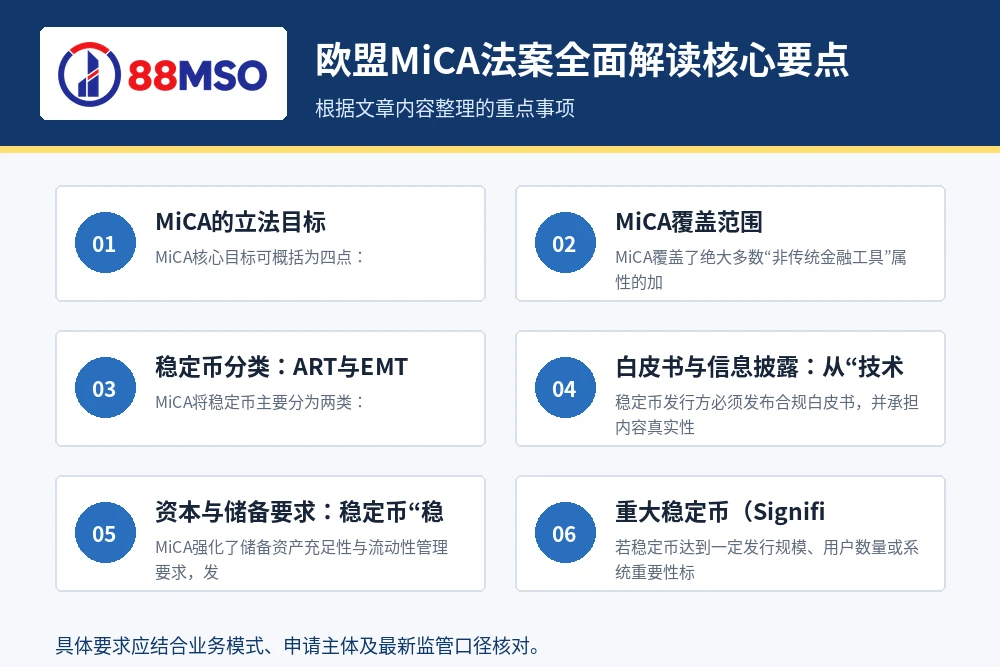
1. MiCA’s legislative goals
The core goals of MiCA can be summarized into four points::
- unified rules:Eliminate the problem of different regulatory standards for crypto assets among EU member states。
- protect investors:Improve the transparency of information disclosure,Limit misleading marketing。
- Maintain financial stability:Establish a more rigorous reserve and redemption mechanism especially for stablecoins。
- drive innovation:Reduce corporate compliance uncertainty through clear rules。
2. MiCA coverage
MiCA covers most crypto assets and service activities with “non-traditional financial instruments” attributes,Highlights include:
- Asset Reference Token (ART)
- Electronic Money Token (EMT)
- Issuance and trading services of other crypto assets
- Operational Behavior of Crypto Asset Service Providers (CASP)
In short,As long as you issue the relevant tokens to the public in the EU,or provide hosting、trade、exchange、Execute order、Investment advice and other services,very likely to fall intoMiCA regulatory framework。
two、Stablecoin issuer:"High Voltage Compliance Zone" under MiCA
1. Stablecoin classification:ART and EMT are not the same regulatory logic
MiCA divides stablecoins into two main categories::
- ART(Asset-Referenced Token):Value anchored to a basket of assets (fiat currency、goods or other assets)。
- EMT(E-Money Token):Value anchored to a single fiat currency,Functionally closer to electronic money。
This distinction is very crucial,Because EMT is usually issued by an authorized credit institution or electronic money institution,The regulatory threshold is closer to the traditional payment financial system。
2. White paper and information disclosure:From "technical narrative" to "legal responsibility"
Stablecoin issuers must publish compliance white papers,and assume responsibility for the authenticity of the content。MiCA requires disclosure of more than project vision,but involves:
- Legal identity and governance structure of the issuing entity
- Reserve asset composition and custody arrangements
- Rights of holders (especially redemption rights)
- Risk factors and conflict management mechanisms
This means that many project developers who previously relied on marketing narratives,The law must be completed、Accounting、audit、Risk control and compliance document system。
3. Capital and Reserve Requirements:The "stability" of stablecoins will be verified through penetration
MiCA strengthens reserve asset adequacy and liquidity management requirements,The issuer needs to ensure:
- Reserve assets match token liabilities
- Assets are kept independently and segregated from own assets
- Create executable、Verifiable redemption arrangements
- Report regularly and be subject to regulatory review
In the past, “nominal anchoring” in the industry、The model of “substantial mismatch” will be unsustainable。For the issuer,Financial structure and liquidity management capabilities will become the life and death line。
4. Additional Regulation of Significant Tokens
If the stablecoin reaches a certain issuance scale、Number of users or system importance criteria,May be recognized as a “major token”,and trigger higher levels of supervision,Includes tighter capital buffers、Governance mechanism and data reporting requirements。
This will significantly increase the compliance costs of head projects,It also prompts companies to build compliance and risk control platforms in multiple places around the world in advance.。
three、CASP (Crypto Asset Service Provider):Licensing、institutionalization、Continuing regulation
1. What is CASP?
Under MiCA,CASP includes but is not limited to the following services:
- Cryptoasset custody and management
- Operate trading platform
- Fiat currency and crypto asset exchange
- Exchange between crypto assets
- Execute customer orders、Valet transaction
- underwriting、Distribution、Investment advice, etc.
Many Web3 projects used to consider themselves "technology platforms" rather than "financial institutions",Will be recharacterized and included in licensing supervision under the MiCA framework。
2. CASP Core Admission Requirements
Obtaining CASP authorization usually requires meeting:
- Entity requirements:Setting up a legal entity in the EU。
- Governance requirements:Clarify board responsibilities、three lines of defense、internal control system。
- Personnel requirements:Management is “fit and proper”。
- capital requirements:Meet the minimum own capital threshold and maintain it continuously。
- Compliance requirements:Set up AML/KYC、Market Abuse Prevention and Control、Complaint Handling and Operational Resilience Mechanism。
3. Client Asset Protection and Conflict of Interest Management
MiCA explicitly requires CASPs to segregate client assets from their own assets,and establish clear custody responsibilities、Accounting Records and Compensation Arrangements。For trading platforms,Proprietary transactions also need to be processed、market making arrangements、Token listing standards、Potential conflicts of interest between disclosures。
This means that the high-conflict business model of "exchange + self-operation + currency listing fees + associated market making",Will face stronger regulatory constraints in the EU。
4. passport mechanism:Get a license in one place,Multi-national exhibition business
An important attraction of MiCA is the "EU passportization" - after a company is approved by a member state,,Services may be provided to other Member States subject to fulfillment of notification procedures。For institutions wishing to enter the European market,This mechanism significantly improves the scale effect of compliance investment。
Four、MiCA’s real impact on the industry ecosystem:Rising costs,But the certainty increases
1. for start-up projects:Financing thresholds and compliance thresholds have both risen
Early projects need to invest in legal affairs earlier、Audit and Compliance Budget,Financiers will also pay more attention to whether the project has a licensing path that can be implemented.。short term,Rising costs of starting a business;long term,“Pseudo-innovation” projects are expedited。
2. For medium and large platforms:Shift from growth orientation to “pay equal attention to growth + risk control”
Platform companies will reallocate resources:Iterate from pure products,Go to "Product、Compliance、Risk control、Data reporting、Audit" parallel。This will push the organizational structure closer to traditional financial institutions。
3. Application of cross-border payment and stable currency:Compliance will lead to institutional-level adoption
MiCA imposes strict requirements on stablecoins,In the short term, restrictions will increase,But in the medium and long term, it will help banks、payment institution、Cross-border trading companies can adopt compliant stablecoin solutions with greater confidence。For cross-border payment scenarios,This is "standardize first、"post-expansion" path。
five、Linkage with Hong Kong’s regulatory environment:How should enterprises achieve "dual-jurisdiction compliance"
Many Asian companies will ask:Since the business base is in Hong Kong,Why should we pay attention to MiCA? The answer is straightforward - funds、user、Partners、Liquidity and brand credit both flow globally。EU rules often spill over and affect global cooperation thresholds。
in practice,Enterprises can adopt the "Hong Kong + EU" dual-jurisdiction strategy:
- Hong Kong as Asia-Pacific operations and compliance hub,Improve local licensing and AML systems;
- Undertake European users and business as an EU licensed entity;
- Unifying group-level KYC、Transaction monitoring、Sanctions Screening and Suspicious Transaction Reporting Standards;
- Establish a cross-jurisdictional internal audit and regulatory communication mechanism。
This kind of architectural design needs to take into account the license attributes、tax arrangements、Capital flow path and personnel management。Like 88MSO and the people behind it, 88MSO has long served in Hong Kong’s financial licensing and compliance implementation,Ability to provide companies with license feasibility assessments、Full case support from organizational structure establishment to continuous compliance operations,Help companies strike a balance between "business expansion" and "regulatory sustainability"。
six、A 7-step practical checklist for companies to deal with MiCA
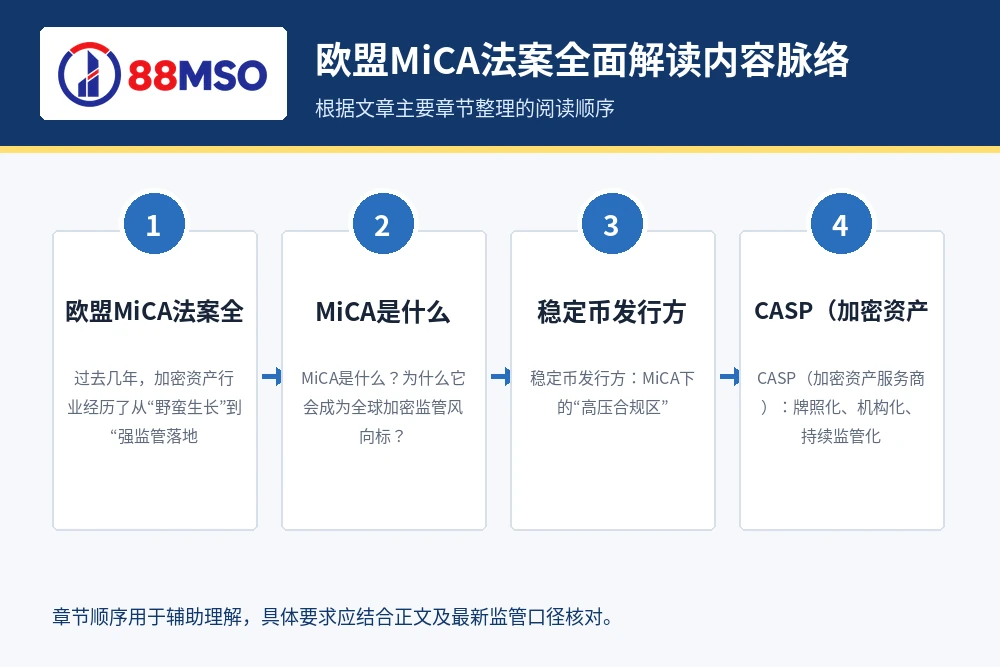
Step 1:regulatory qualitative
Make it clear that your tokens belong to ART、EMT or other crypto assets;Whether your business triggers CASP activity definition。
Step 2:License plate path design
Determine the EU landing country、Legal structure、Management configuration、Capital Arrangements and Timetables。
Step 3:White paper and legal document reconstruction
Upgrading the "product instructions" to a legally responsible disclosure document,Establish a version management mechanism。
Step 4:AML/KYC system upgrade
Improve customer due diligence、Transaction monitoring、Report suspicious activity、Sanctions list screening、High Risk Customer Review Process。
Step 5:Asset isolation and custody governance
Establish a separate account of customer assets、Permission hierarchy、Cold/hot wallet management system and disaster recovery strategy。
Step 6:Operational Resilience and Outsourcing Management
Sorting out key outsourcers (cloud services、hosting、Risk control tools、payment channel) and establish alternative mechanisms。
Step 7:Ongoing compliance and regulatory communications
Compliance is not “getting a card once and for all”,but continuous reporting、Continuous audit、The process of continuous improvement。
seven、Common Misunderstandings and Risk Tips
- Myth 1:Do business first,Replacement license。
MiCA era,The fault tolerance space for operating first and complying later is shrinking sharply.。 - Myth 2:Just read the legal provisions,No operational transformation。
The real risk often lies in the process、system、Permissions and personnel execution layer。 - Myth 3:Treating MiCA as a “local European problem”。
Cross-border partners will use MiCA's compliance capabilities as a due diligence threshold,Influence global financing and channel cooperation。
Conclusion:MiCA is not the end,It is the starting point for the “institutionalization” of global crypto finance.
The meaning of MiCA,It’s not just about adding regulatory provisions,It’s more about reshaping industry competition rules:The winners of the future are not just those with fast technology、A platform with strong traffic,But be able toCompliance capabilities、Risk control ability、Capital capabilities and cross-border execution capabilitiesPackaged as an institution with a long-term moat。
For stablecoin issuers,Reserve transparency、redemption executable、Accountable governance will become the fundamental;For CASP,Licensed operation、Customer asset protection、Anti-money laundering and continuous reporting capabilities will be the ticket to entry。The sooner you act,The better you can take the initiative in the new cycle。
If the company is in the critical stage of "Hong Kong licensed layout + EU market entry",It is recommended to carry out dual jurisdiction gap assessment and license roadmap design as soon as possible,To avoid missing strategic opportunities during the regulatory window period。
First confirm the current system and transition arrangements
When dealing with a comprehensive interpretation of the EU MiCA Act,The current MiCA authorization adopted by the target member state should be confirmed first.、Notice or transitional arrangements,Then judge whether it is managed based on the actual service.、trading platform、exchange、order execution、transfer、Issuance-related services or investment advice。Old VASP registration cannot simply be equated to CASP authorization under MiCA。
Compliance design should cover governance、Prudential protection、Customer asset isolation、complaint、conflict of interest、Market Abuse Monitoring、Outsourcing and ICT risks。The travel rules also require transfer-related institutions to obtain and verify the originator and beneficiary information.,and establish a hold on transfers with missing or incomplete data、Deny or follow-up rules。
Industry references:European Securities and Markets Authority (ESMA):MiCA official information。
Read more:Lithuania VASP Cryptocurrency License:Why has it become a popular compliance choice for European Web3 companies? (Updated 2026)、Coping with the Cryptocurrency “Travel Rule”:VASP Licensed Exchange Compliance System Interface Guide。