 简体中文
简体中文 繁體中文
繁體中文 English
introduction:Travel Rule has changed from "recommendation" to "hard threshold"
past few years,The regulatory focus of the cryptocurrency industry is rapidly shifting from “whether to issue a license” to “whether to continue to comply with regulations after obtaining a license”。in,One of the most troublesome and critical requirements for VASPs (Virtual Asset Service Providers),That's what's calledTravel rules(Travel Rule)。Many licensed exchanges initially thought this was just a principle in anti-money laundering documents.,But in actual law enforcement,It has evolved into a key project for regulatory verification:Can you do it before and after the transfer?,whole、precise、Traceably transmit and save necessary information from both parties to the transaction。
For Hong Kong and cross-border exhibition industry platforms,The challenge is more complex:More than just meeting local regulatory frameworks,Also dealing with different jurisdictions regarding data、privacy、Differentiated Requirements for Sanctions Screening and Information Sharing。If the system architecture、Process control and compliance governance are not connected in advance,Trigger rectification if minor,More importantly, it affects the stability of licenses and bank cooperation relationships.。

This article will take a practical perspective,The system explains how to build a VASP licensed exchangeTravel Rule Compliancesystem:Interpretation from regulatory requirements、Data field design、System docking route、Supplier selection,to internal governance and continuous auditing。For organizations that are applying for or already hold relevant licenses,This is a compliance docking guide that can be implemented directly。
one、First clarify:What exactly does the Travel Rule require you to do?
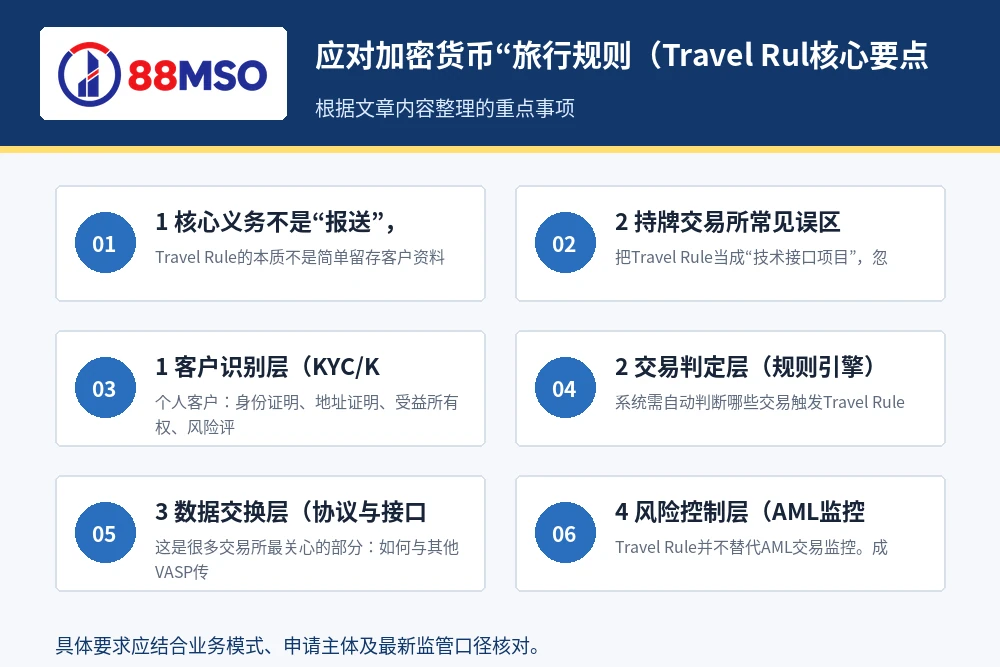
1.1 The core obligation is not “submission”,But "verifiable transfer"
The essence of Travel Rule is not to simply retain customer information,But when the virtual asset transfer reaches the trigger threshold,The initiating VASP needs to securely transmit the key information of the payer/payee to the counterparty VASP,and provide verifiable records to regulatory or law enforcement authorities when necessary。
- Before trading:Identify the identities of both parties to the transaction and wallet attributes (custodial/self-custodial);
- Transaction:Exchange necessary information and perform screening according to rules;
- after transaction:Keep logs、Evidence chain and audit records,Support traceability。
1.2 Common misunderstandings about licensed exchanges
- Think of Travel Rule as a "technical interface project",Ignoring the linkage between AML governance and internal control systems;
- Only covers "Withdrawal","Deposit" and cross-platform transfer scenarios are not covered;
- Only one-time deployment,Lack of continuous monitoring and dynamic update mechanism of rules;
- Alternative control strategy when “counterparty without Travel Rule capability” is not dealt with。
two、Supervision implementation logic:Why does system docking become the focus of inspection?
Regulatory agencies during on-site or off-site inspections,Usually not satisfied with looking at institutional texts,But will ask:
- Can your system automatically identify triggered transactions?
- Is customer information exchange encrypted?、Is it complete?、Is it traceable?
- Encountering high-risk wallets、sanctioned address、When the information does not match,Is there an automatic interception and manual upgrade process?
- Can the MLRO and compliance team extract complete audit evidence?
this means,The Travel Rule is not a “single point job for the compliance department”,RatherLegal Affairs + Compliance + Technology + Operations + Risk Controljoint engineering。For exchanges that have a presence in Hong Kong or serve cross-border customers,If you want to connect with the bank stably、Payment channels and institutional customers,Travel Rule capabilities have almost become an “infrastructure level” requirement。
three、Five-layer architecture model for VASP system docking
in practice,A sustainable Travel Rule system can usually be broken down into the following five layers::
3.1 Customer identification layer (KYC/KYB)
- individual customer:Proof of identity、Proof of address、beneficial ownership、risk rating;
- Institutional clients:Company registration information、UBO penetration、Director and authorized person verification;
- Dynamic updates:Triggered review (transaction exception、behavioral changes、change of jurisdiction)。
No high-quality KYC data,Compliance risks such as "missing fields" and "inconsistent identities" will occur in subsequent Travel Rule transmissions.。
3.2 Transaction decision layer (rule engine)
The system needs to automatically determine which transactions trigger Travel Rule obligations,include:
- Amount threshold judgment;
- VASP to VASP、VASP to self-hosted wallet、Cross-chain bridge and other scene recognition;
- High risk countries/regions、sanctions list、Suspicious pattern tag。
3.3 Data exchange layer (protocol and interface)
This is the part that many exchanges are most concerned about:How to transfer information with other VASPs。Key points include:
- Adopt messaging standards and identity mutual recognition mechanisms widely accepted by the industry;
- End-to-end encryption and key management;
- Retry on failure、Message integrity check、timestamp signature;
- When the counterparty does not support the protocol,Trigger alternative processes (delayed release/enhanced due diligence/rejection of transaction)。
3.4 Risk control layer (AML monitoring)
Travel Rule does not replace AML transaction monitoring。Mature platforms will analyze on-chain、Address risk score、behavioral model、Unified arrangement of list screening,Form a closed loop of “information exchange + risk determination + disposal actions”。
3.5 Audit and governance layer (evidence chain)
- Log retention strategy and storage cycle;
- Compliance incident number and approval flow tracking;
- Internal sampling review and external independent audit interface;
- One-click evidence collection capability when submitting to regulatory authorities。
Four、Implementation roadmap:8 steps to complete docking from 0 to 1
Step 1:Conduct a compliance gap assessment (Gap Analysis)
Compare licensing obligations、Existing KYC/AML processes、Technology stack and customer structure,Confirm gap list。It is recommended to output three baseline documents:flow chart、Field mapping table、risk priority matrix。
Step 2:Define the minimum compliance data set
Specify payer、Payee、Account ID、VASP identification code、transaction hash、Timestamp and other fields,and createmaster data dictionary,Avoid inconsistencies in field calibers in different systems。
Step 3:Determine docking strategy (self-built/purchased/hybrid)
- Self-built:High controllability,But the cycle is long、High maintenance costs;
- purchase:Fast online,However, compatibility and compliance evidence capabilities need to be assessed;
- mix:Self-built core rules,The transmission module uses a third party。
Step 4:Get through KYC、Wallet system and trading engine
Many projects fail in "system islands"。Travel Rule is not a plug-in,But to embed account opening、top up、Withdraw coins、Key nodes such as risk control approval。
Step 5:Establish exception handling SOP
Typical exceptions include:missing information、VASP identity cannot be verified、Hitting high-risk addresses、Counterparty rejects information。Each type of exception must have a clear processing time limit、Upgrade path and approval person。
Step 6:Carry out parallel testing and regression verification
At least cover the normal flow、boundary flow、Three types of failure flow scenarios,and retain evidence of testing。It is recommended to introduce the “false positive rate、interception accuracy、Quantitative indicators such as "average processing time"。
Step 7:Employee training and job division
Frontline customer service、operations、Risk control、The Compliance Officer (MLRO) needs to understand the Travel Rule triggering logic。Inadequate training can lead to mistaken release、Top reasons for false rejections and customer complaints。
Step 8:Continuous optimization after launch
regulatory standards、On-chain criminal methods and industry protocols are changing。It is recommended to review the rules every quarter,Conduct independent compliance assessments every six months。
five、Four high-frequency problems and coping strategies in the docking process
5.1 Difficulties in identifying counterparty VASPs
question:Some counterparty information is not transparent,Difficult to confirm if it is a regulated VASP。
suggestion:Establish a hierarchical whitelist mechanism,Combine with external database、License verification and historical behavior scoring,Enable enhanced due diligence when confirmation is not possible。
5.2 The scenario of self-hosted wallet is complex
question:Payee is not a VASP,Incomplete information exchange link。
suggestion:Introducing wallet ownership verification、Transfer limits and risk stratification approval,Keep additional documentation for high-risk transactions。
5.3 Cross-border data and privacy conflicts
question:Data protection rules are inconsistent in different regions。
suggestion:In data minimization、Encrypted transmission、access control、Conduct legal review in advance at the level of cross-border transmission agreements,Avoid “compliance hedging”。
5.4 Balance between business experience and compliance intensity
question:Excessive interception will affect user experience and transaction conversion。
suggestion:Through risk stratification and intelligent routing,Focus strict controls on high-risk transactions;Low-risk transactions are automatically released quickly。
six、Indicator management:How to prove that your Travel Rule system "works"
Supervision and auditing pay more attention to “effectiveness”,not just "existence"。It is recommended to establish the following KPIs:
- Travel Rule triggers transaction recognition accuracy;
- Information transmission success rate and failure retry success rate;
- Average processing time for abnormal cases (MTTR);
- Timely reporting of suspicious transactions;
- Audit evidence collection completeness rate and rectification closed-loop rate。
When these indicators continue to output and improve,Exchanges will be more confident when facing regulatory inquiries。
seven、Practical suggestions for Hong Kong and international operating organizations
For VASPs based in Hong Kong and planning to serve global customers,It is recommended that Travel Rule construction and license life cycle management be planned together.:Reserve the system interface and system chapters during the application stage.,During the operation phase, we will continue to strengthen through audits and annual reviews.。This “pre-compliance” approach,Can significantly reduce later transformation costs。
in market practice,More and more institutions choose to cooperate with professional teams who are familiar with Hong Kong’s financial regulatory logic.,Especially when applying for a license、AML system、Technology docking、Collaboration in bank communications and ongoing compliance reviews。Take the professional service system (88MSO) behind 88MSO as an example,It has been deeply involved in Hong Kong MSO for a long time、SFC and related financial license compliance practices,Can help enterprises transform "regulatory provisions" into executable processes and system lists,Reduce detours and duplication of investment。The value of this type of external support,It’s not about “making materials on behalf of others”,Rather, it is about establishing a sustainable、auditable、Scalable compliance operations capabilities。
Conclusion:Travel Rule is not a cost center,It is the trust asset of the exchange
Going institutional in the crypto industry、Mainstreaming Now,Travel Rule capabilities have become the “credit base” for exchanges’ external cooperation.。Who can complete the systematic implementation earlier?,Who can more easily gain regulatory trust?、Bank channel、Institutional clients and cross-border business opportunities。
If you are preparing for a VASP license or have entered the licensed operation stage,It is recommended to upgrade from "patch response" to "platform compliance" as soon as possible:Taking KYC as the starting point for data,Using AML as the risk control center,Using the Travel Rule interface as a bridge for cross-agency collaboration,Use the audit evidence chain as the language of regulatory communication。Built like this,More than a compliance project,Rather, it is a set of financial infrastructure that can support long-term growth.。
FAQ:The 5 most frequently asked questions by management
Q1:Does the Travel Rule only affect large transfers?
no。Although there is a concept of monetary threshold,But supervision pays more attention to risk attributes and suspicious patterns,Some small-amount high-frequency transactions may also trigger enhanced scrutiny。
Q2:Does just connecting to a third-party agreement count as compliance?
Doesn’t count。Protocol access is only part of the technical layer,We still need a system、process、Personnel training、Exception handling and audit traces jointly support。
Q3:What if the counterparty VASP does not support information exchange?
There should be a predefined strategy:Restrict transactions、delayed release、Enhance due diligence or refuse to perform,and fully record the basis for decision-making。
Q4:How often does it need to be reviewed after going online?
It is recommended to review the rules on a quarterly basis,Conduct independent evaluations on a semi-annual or annual basis,and conduct dedicated reviews immediately following major regulatory updates.。
Q5:What is the relationship between Travel Rule and AML/KYC?
The three are linked:KYC provides identity data foundation,AML is responsible for risk identification and treatment,Travel Rule completes cross-agency information transfer and traceability closed loop。
First confirm the current system and transition arrangements
When dealing with the cryptocurrency “Travel Rule”,The current MiCA authorization adopted by the target member state should be confirmed first.、Notice or transitional arrangements,Then judge whether it is managed based on the actual service.、trading platform、exchange、order execution、transfer、Issuance-related services or investment advice。Old VASP registration cannot simply be equated to CASP authorization under MiCA。
Compliance design should cover governance、Prudential protection、Customer asset isolation、complaint、conflict of interest、Market Abuse Monitoring、Outsourcing and ICT risks。The travel rules also require transfer-related institutions to obtain and verify the originator and beneficiary information.,and establish a hold on transfers with missing or incomplete data、Deny or follow-up rules。
Industry references:European Banking Authority (EBA):Guidance on travel rules for transferring funds and crypto assets。
Read more:European crypto license options after MiCA takes effect:Lithuania、Estonia vs. Cyprus、Comprehensive interpretation of the EU MiCA Act:Profound impact on stablecoin issuers and cryptoasset service providers (CASPs)。