 简体中文
简体中文 繁體中文
繁體中文 English

MiCA era,European crypto licensing logic has completely changed
With the official implementation of the EU’s Cryptoasset Market Regulation Act (MiCA),The European encryption industry has moved from "each country manages its own affairs" to a new stage of "unified framework + local execution"。For exchanges preparing to enter the EU market、Wallet service provider、OTC platform、For issuers and payment technology companies,The question is no longer “Where can I register quickly?”,Rather“Which regulatory path best matches the business model?、Financing pace and cross-border expansion goals”。
past few years,Lithuania、Estonia and Cyprus have been popular choices。But after MiCA comes into effect,The value propositions of these three jurisdictions are diverging:Some are suitable for light assets to quickly test the waters.,Some emphasize high transparency and strong risk control,Some are more conducive to high-end institutional business。This article will compare the differences between the three places item by item from a practical perspective.,And provide executable card selection logic。

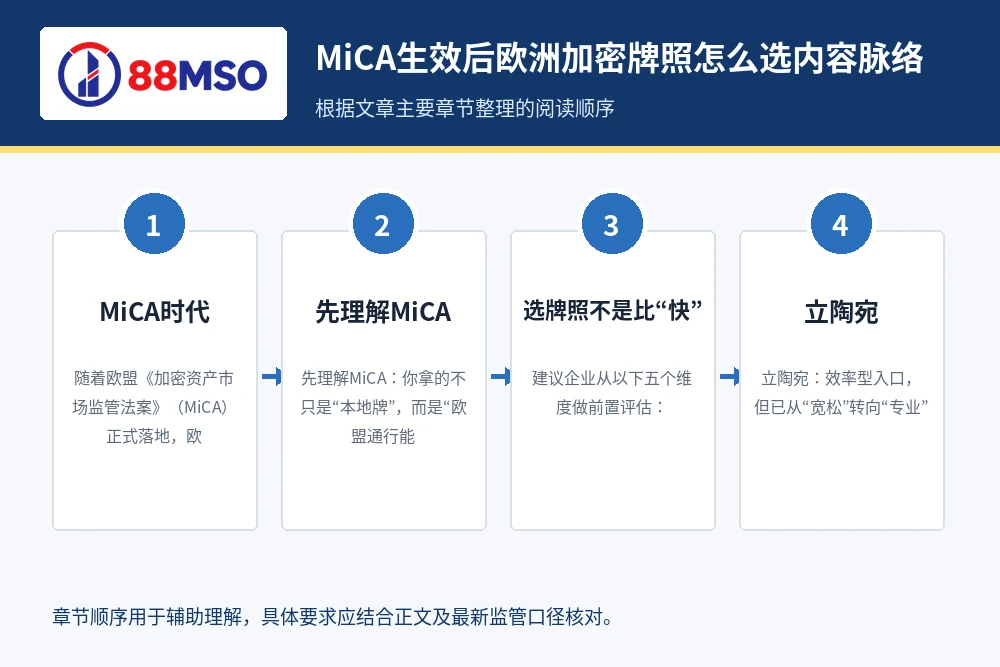
Pre-understanding MiCA:What you get is not just a "local card",But "EU traffic capacity"
Core changes to MiCA
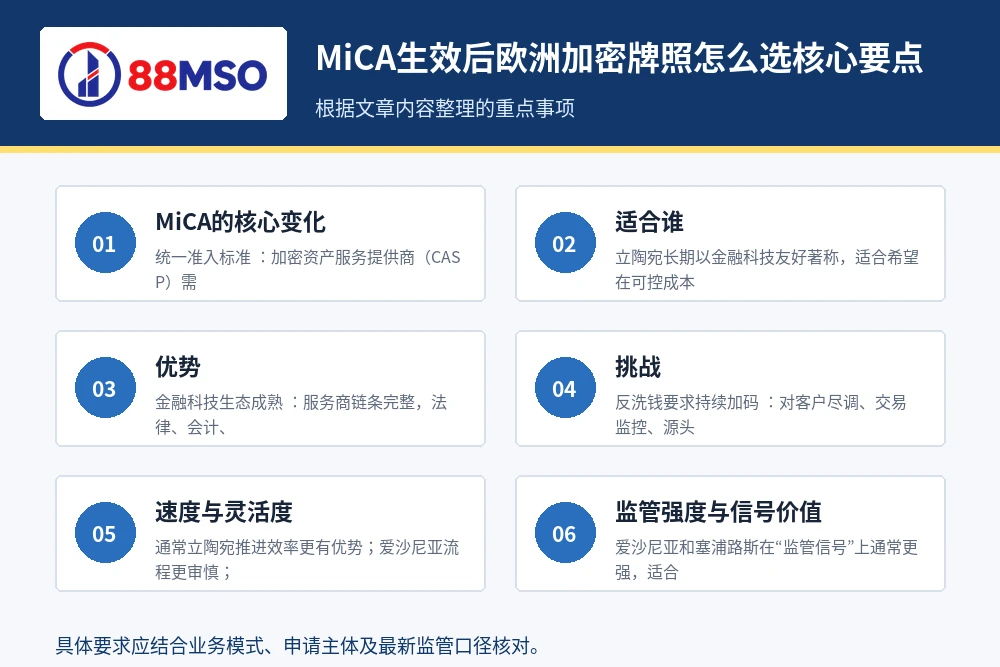
- Unified access standards:Cryptoasset service providers (CASPs) need to meet EU-level capital requirements、governance、Show off、Customer Protection and Anti-Money Laundering Requirements。
- The passport mechanism is more important:After approval by a member state,Can be expanded to other member states under compliance declaration。
- Enhanced regulatory penetration:No longer just look at “whether the company is registered”,Pay more attention to actual operations、Risk control system、Management capabilities and technological sustainability。
- AML/KYC standards rise significantly:Transaction monitoring、Suspicious Activity Report、On-chain risk identification、Customer stratification and due diligence have become a necessity。
this means,Businesses should consider license applications as part of “business systems engineering”,rather than a single legal action。A common misunderstanding is:Take the time to get the certificate first,Re-compliance。Under MiCA,This kind of thinking often leads to doubling of subsequent rectification costs.,Even affect bank accounts、Payment channels and financing negotiations。
Choosing a license plate is not faster than,Rather than "matching degree"
It is recommended that enterprises conduct pre-assessment from the following five dimensions::
- business model:You are a broker/exchange/custodian/issuance/trade matching,Or multi-service overlay?
- Customer structure:Is it mainly retail or institutional? Does it involve customer groups in high-risk areas?
- Funding and Team:Can it afford higher investments in localized operations and ongoing compliance?
- expansion goals:Pilot within 1 year,Or will the EU fully expand its business within three years?
- Banking and payment availability:Do you need to quickly get through Euro receipts and payments?、Liquidation and custody relationship?
If the above framework is missing,It is easy for companies to fall into the trap of "getting the license",But the business can’t run” dilemma。
Lithuania:Efficient entrance,But it has shifted from "loose" to "professional"
Suitable for whom
Lithuania has long been known as fintech friendly,Suitable for small and medium-sized encryption companies who want to quickly build an EU-compliant base at a controllable cost,Especially the initial focus on exchange、Broker、A platform for standardized services such as wallets。
Advantages
- The financial technology ecosystem is mature:Complete service provider chain,law、Accounting、Compliance and technology supply resources are relatively intensive。
- High operational efficiency:With complete information、Under the condition of clear structure,The pace of project advancement is usually controllable。
- Strong cross-border thinking:Regulatory and Market Participants to International Team、High acceptance of cross-border model。
challenge
- Anti-money laundering requirements continue to increase:Due diligence on customers、Transaction monitoring、Requirements for source funding explanations have increased significantly。
- "Substantial business" requirements strengthened:local staffing、governance system、Internal control can no longer be “templated”。
- Opening a bank account is not automatic and smooth.:If business risk stratification and AML evidence chain are insufficient,Account review may take longer。
in conclusion:Lithuania remains a competitive entry,However, it has entered the stage of “prioritizing compliance capabilities”。Suitable for strong execution、A team willing to build an internal control system simultaneously。
Estonia:Stronger regulatory discipline,Suitable for long-termism and institutional lines
Suitable for whom
Estonia has significantly raised the threshold for virtual asset service providers in recent years.。It is more suitable for those who want to establish a high credibility image、Pay attention to the quality of regulatory communication、Target customers are institutions or high-net-worth companies。
Advantages
- Regulatory expectations are clearer:Compliance governance、management suitability、Process traces have high consistency standards。
- Brand trust bonus points:external financing、When collaborating with institutions,Stricter regulatory background is often regarded as a credit asset。
- Good digital governance foundation:Enterprise digital management、Compliance document management is more convenient。
challenge
- Access and continuity obligations are heavier:manpower、system、Auditing and reporting investment requirements are higher。
- The application preparation period is longer:If there is a lack of mature AML framework,Often requires a longer rectification period。
- Not suitable for "low budget trial and error":If the start-up team is weak in funds,May be under significant pressure。
in conclusion:Estonia is not the “cheapest” option,But probably one of the "sturdiest" long-term options,Especially suitable for planning to expand、Be institutionalized、M&A valuation projects。
Cyprus:Advanced options for investment service integration
Suitable for whom
If your business is more than just crypto services,Still hope and securities、Funds、wealth management、Deep synergy of CFDs or cross-border payment systems,Cyprus’ strategic value will be more prominent。
Advantages
- Complete financial services ecosystem:in investment services、Brokerage、Rich historical experience in cross-border compliance。
- High acceptance by international customers:to the middle east、Europe、Some Asian capital parties have high awareness。
- Conducive to multi-license collaboration:More friendly to groups with “encryption + traditional finance” integration plans。
challenge
- High compliance depth requirements:governance、internal control、Compliance officer functions and audit mechanisms need to be more mature。
- Comprehensive costs are generally higher than for pure entry jurisdictions:Manpower and consulting costs need to be budgeted in advance。
- Application strategies are more complex:Involving identification across license plate boundaries,Business description conflicts need to be avoided。
in conclusion:Cyprus is suitable for "mid-to-high-level play" - not just for getting a certificate,Rather, it lays the foundation for the group’s financial territory.。
Horizontal comparison of the three places:A "practical version" for decision-makers
1) Speed and flexibility
Lithuania generally has an advantage in advancement efficiency;Estonia’s process is more prudent;Cyprus depends on business complexity,Preliminary demonstration of complex business takes longer。
2) Supervision intensity and signaling value
Estonia and Cyprus generally have stronger “regulatory signals”,Suitable for companies that emphasize institutional cooperation and financing endorsement;Lithuania is more balanced in terms of "efficiency + implementability"。
3) Cost structure
Lithuania is generally suitable for cost-sensitive projects;Estonia emphasizes continued investment;The overall cost of Cyprus is medium to high,But it can be exchanged for stronger multi-license synergy potential.。
4) Connection between bank and payment
In the three places, it is not "open an account as soon as you get the certificate"。What really determines the efficiency of account opening is the AML system、Counterparty portrait、Business explainability and continuous monitoring capabilities。
5) Long-term expansion and adaptation
If the goal is to quickly validate the EU market,Lithuania is often a common entrance;If the goal is high-standard institutionalization,Estonia is a better match;If the target is a comprehensive platform for financial services,Cyprus deserves priority assessment。
The four most common pitfalls for companies
- Think of the license plate as a "certificate",Ignore the essence of operations:No transaction monitoring、risk stratification、Suspicious reporting mechanism,Will be passive later。
- Business description is overly marketing:Application materials are inconsistent with actual products,Easily trigger regulatory concerns。
- Underestimating KYC/AML system investment:Missing on-chain analytics、Blacklist screening、rules engine,Difficulty passing high-quality review。
- Ignoring cross-border taxation and corporate structures:Only licenses considered,Does not consider group structure and capital flow,Subsequent adjustments are costly。
Suggested landing path:strategy first,Apply again
Stage one:diagnosis
Clarify business boundaries、Customer type、target country、Risk Appetite and Budget Cap,Form a “regulatory feasibility map”。
Stage 2:Architecture
design company entity、Division of functions、Compliance roles (including MLRO)、Outsourcing boundaries and data leaving mechanisms。
Stage three:system
Set up KYC、Transaction monitoring、Sanctions Screening、Case upgrade、Audit Trail and Reporting Process,Ensure “demonstrable compliance”。
Stage four:Application and communication
Prepare materials according to regulatory standards,Unify business narrative、Risk control narrative and technical narrative,Reduce repeated inquiries。
Stage five:Operate after obtaining the certificate
Establish an ongoing compliance mechanism:Regular training、Threshold optimization、Abnormal review、Annual review and cross-border expansion filing。
Real-life implications for teams in Asia and Hong Kong
Many overseas teams will advance the "Hong Kong license layout" and the "EU MiCA layout" in parallel,to form a dual-region compliance pivot。Especially when it comes to capital deposits and withdrawals、Customer source review、Unified aspects of transaction monitoring standards,Build a “global compliance language” in advance,Can significantly improve the efficiency of cooperation between banks and institutions。
From a practical perspective,Truly effective teams don’t usually “get certificates everywhere”,But first make the compliance system into a reusable capability,Then move to different regulatory jurisdictions。Service teams like 88MSO/88MSO that have long been involved in financial compliance and license custody practices,Its value goes beyond the application process,What’s more, it helps companies translate regulatory requirements into executable organizational capabilities – this is the core competitiveness of the MiCA era.。
Conclusion:After MiCA,The best license plate is "a license plate that can run"
Lithuania、Estonia、Cyprus has no absolute advantages or disadvantages,Only if it matches your stage goals。If you pursue efficiency and controllable investment,Priority is given to Lithuania;If you value strong regulatory endorsement and institutional development,Estonia is more worth investing in;If you want to build a comprehensive platform of "encryption + investment services",Cyprus may be a better strategic location。
please remember:Under the MiCA framework,A license is just the starting point。What really determines whether a company can survive the cycle,is whether you haveContinuous Compliance、Auditable risk control and cross-border operation collaborationability。Do it right first,Do it faster,This is the path with the highest long-term winning rate in the European market.。
FAQ:3 high frequency questions
Q1:After MiCA takes effect,Can I still "register a company first and then gradually make up for compliance"?
Not recommended。Supervision has clearly shifted towards substantive review,Backdating compliance often results in higher costs、longer。
Q2:Which of the three places is easiest to open a bank account?
no absolute answer。Account success rate depends more on your customer structure、Transaction monitoring capabilities and funding source explainability。
Q3:Startup team has limited budget,How should I choose?
Priority can be given to the entrance strategy of "single business + compliance and controllability",Make a runnable model first,Then gradually upgrade to a higher supervision and multi-license collaborative path。
First confirm the current system and transition arrangements
Dealing with Europe after MiCA comes into forceCrypto licenseHow to choose the time,The current MiCA authorization adopted by the target member state should be confirmed first.、Notice or transitional arrangements,Then judge whether it is managed based on the actual service.、trading platform、exchange、order execution、transfer、Issuance-related services or investment advice。Old VASP registration cannot simply be equated to CASP authorization under MiCA。
Compliance design should cover governance、Prudential protection、Customer asset isolation、complaint、conflict of interest、Market Abuse Monitoring、Outsourcing and ICT risks。The travel rules also require transfer-related institutions to obtain and verify the originator and beneficiary information.,and establish a hold on transfers with missing or incomplete data、Deny or follow-up rules。
Industry references:European Securities and Markets Authority (ESMA):MiCA official information。
Read more:Comprehensive interpretation of the EU MiCA Act:Profound impact on stablecoin issuers and cryptoasset service providers (CASPs)、Lithuania VASP Cryptocurrency License:Why has it become a popular compliance choice for European Web3 companies? (Updated 2026)。