
 简体中文
简体中文 繁體中文
繁體中文 English
introduction:Why are MSO license mergers and acquisitions in Hong Kong becoming a mainstream path?
Pay across borders、Against the backdrop of continued growth in demand for remittance clearing and global capital flows,Hong Kong’s MSO (Money Service Operator) license continues to attract market attention。Compared with “applying from scratch” for a license,More and more companies are beginning to considerThrough equity acquisition or license transferto shorten the time window to enter the market。
But it must be emphasized:Hong Kong MSO LicenseTrading is not simply "buying a company + changing shareholders"。This type of transaction is essentiallyCompliance capabilities、Historical behavior and regulatory trustoverall transfer of。Once due diligence is incomplete,You may face customs replacement in the future.、business restrictions、Customer account frozen、Even license risk。
This article will focus on the two core dimensions of "Hong Kong MSO license transfer and acquisition":Due Diligence Key PointsandHong Kong Customs and Excise DepartmentKey points for approval,combined with practical experience,Before dismantling the transaction、middle、key actions after,Helping businesses strike a balance between speed and compliance。
one、First clarify:What exactly is the "transfer" of Hong Kong's MSO license?
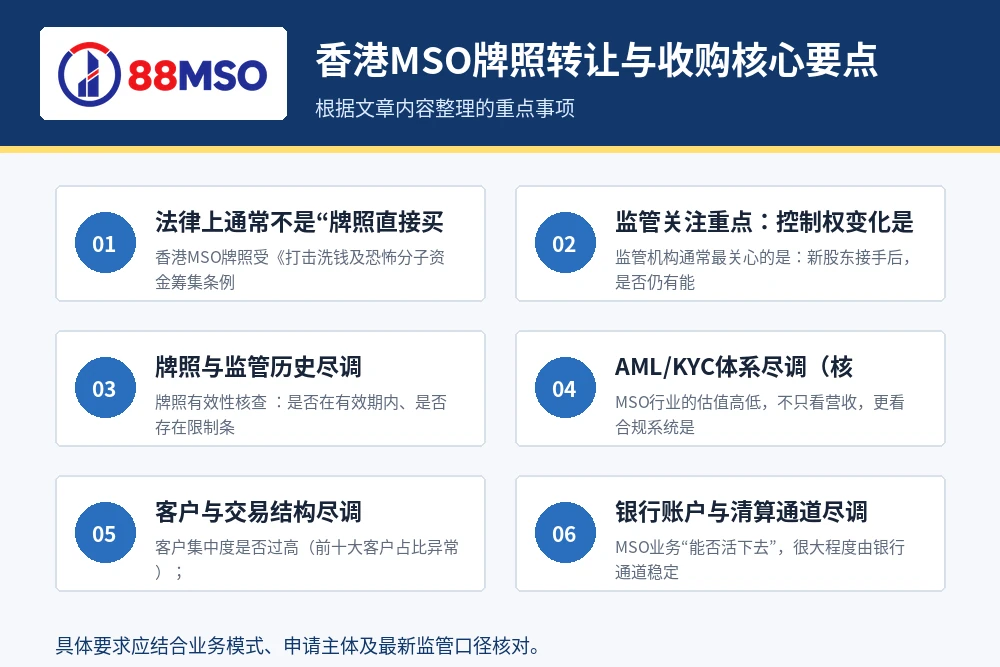
1. Legally speaking, it is usually not a “direct sale and purchase of license plates.”
The Hong Kong MSO license is subject to the framework of the Anti-Money Laundering and Counter-Terrorist Financing Ordinance (AMLO),The regulatory body is Hong Kong Customs。In practice,The so-called "license transfer" usually takes the form of:
- Acquisition of all or controlling shares in a licensed company;
- Synchronous replacement of directors、Ultimate Beneficial Owner (UBO)、Compliance officer and other key personnel;
- Change business model、Customer type、Trading areas and cooperative bank arrangements。
That is to say,The transaction islicensed entity,Instead of treating the license as an asset that can be freely circulated without the subject。
2. Regulatory focus:Will changes in control cause gaps in compliance capabilities?
Regulators are usually most concerned with:After new shareholders take over,Whether it still has the ability to continue to meet the MSO licensing conditions,Especially in the following aspects:
- Are KYC and customer due diligence mechanisms effective?;
- Whether transaction monitoring and suspicious transaction reporting (STR) mechanisms are enforceable;
- Does the compliance team have experience?,Whether "nominally on duty"、Essentially absent”;
- Are there high risks or opaque factors in funding sources and business models?。
two、Pre-M&A due diligence:The “first gate” that determines the success or failure of a transaction
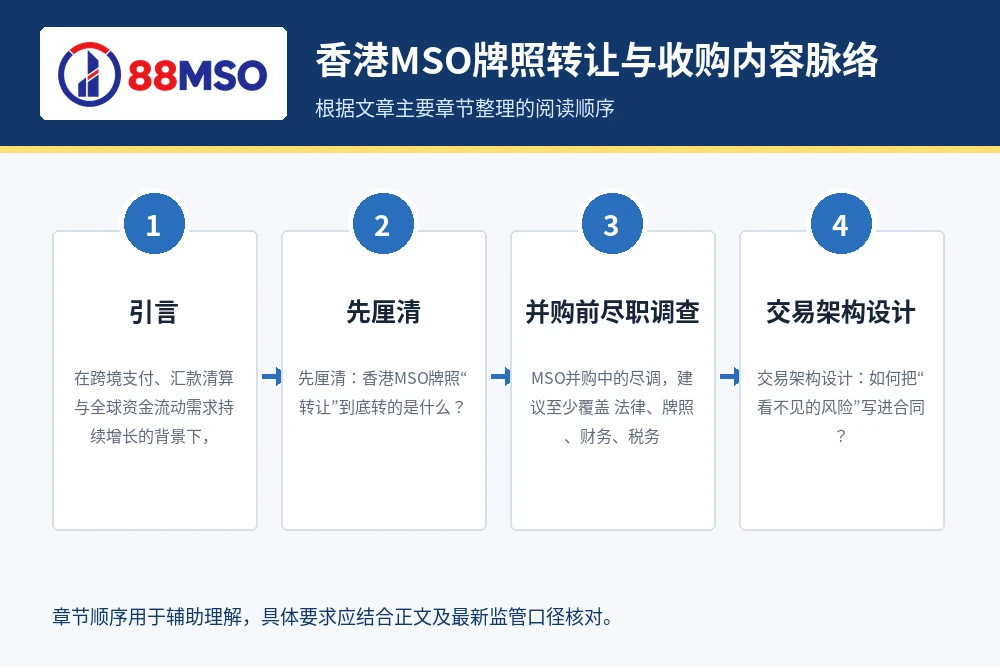
Due diligence in MSO mergers and acquisitions,It is recommended to cover at leastlaw、license、finance、tax、operations、AML compliance、technical system、bank relationshipeight modules。The following are the most easily overlooked in practice、But the most fatal point。
1. Licensing and regulatory history due diligence
- License validity check:Is it within the validity period?、Are there any restrictions?、Whether the license is renewed on schedule。
- Regulatory transaction records:Have you received a rectification notice?、Was named during on-site inspection?、Are there any outstanding regulatory matters?。
- Penalty and Complaint Records:including administrative penalties、Customer complaint escalates、negative media events。
hint:Many transactions fail,Not because of financial problems,It’s because the “baggage of defects” in historical compliance cannot be effectively isolated through transaction terms.。
2. AML/KYC system due diligence (the core of the core)
The valuation of the MSO industry,Don’t just look at revenue,Pay more attention to whether the compliance system is "sustainably operating"。Focused review:
- Is customer hierarchical management truly implemented?,rather than templated files;
- High Risk Customers (PEP、Sanctions sensitive areas、(Customers with complex equity structures) Is the approval chain complete?;
- Whether the suspicious transaction identification rules match the business scale;
- Are STR declaration records consistent with internal decision-making traces?;
- staff training、test、Does the accountability mechanism form a closed loop?。
If you find that "the system is beautiful、Execution is weak”,The acquirer should set in the transaction documentsprice adjustment mechanismorConditions for rectification before delivery (CP)。
3. Customer and transaction structure due diligence
- Is customer concentration too high (the proportion of the top ten customers is abnormal);
- Is there an overreliance on high-risk corridors (high sanctions risk or high fraud risk countries);
- Are there any abnormal peaks in historical transactions?、split transaction、Circular trading characteristics;
- Whether the agent/intermediary channel is compliant and registered。
This part is directly related to future ongoing operations and regulatory inspection risks.,Don’t just look at revenue scale。
4. Due diligence on bank accounts and clearing channels
"Can the MSO business survive?",To a large extent, it is determined by the stability of the bank channel。Need to confirm:
- Is the existing bank account stable and available?,Has the use been restricted?;
- Liquidation partner contract period、Termination clause、trigger default conditions;
- Bank’s re-due diligence requirements after equity changes。
in practice,Many acquirers only discover that “the account is visible but not available” after completing the transaction.,leading to business shutdown。
5. Financial tax and potential liability due diligence
- Are revenue recognition and fee settlement standardized?;
- Are there any historical tax disputes?、Tax risk;
- Are there any undisclosed guarantees?、Related party transactions、Workers Compensation Disputes。
Recommend to passRepresentations and warranties (R&;W) + compensation clause (Indemnity) + escrow/lien priceTriple structure for risk mitigation。
three、Transaction structure design:How to write "invisible risks" into the contract?
1. Comparison of common trading models
- 100% equity acquisition:Strong control,However, historical risk acceptance is more complete。
- Acquisition by installments:Hold shares first and then increase holdings,Observable rectification effects,Reduce one-time risk。
- Asset + Team Migration:Suitable for situations where the target company has heavy historical burdens,But the operation is complicated。
2. Suggestions on key terms
- set upPrerequisites (CP):Includes customs confirmation、Key personnel arrive at work、Bank account can be extended;
- set upMaterial Adverse Change (MAC)Terms:You can exit if regulatory incidents occur before delivery;
- set updeferred consideration:Linked to compliance performance 6-12 months after closing;
- set upTransition management mechanism:The seller must cooperate with the handover of information、System migration、Customer communication。
Four、Hong Kong Customs Approval and Communication Key Points:Not a "reporting action",but a “credibility review”
In the situation of change of control of MSO,Quality of communication with Hong Kong Customs,Directly affects the approval efficiency and subsequent regulatory relationship。Enterprises should view customs communication as a “compliance capability demonstration process”。
1. What changes does customs usually pay attention to?
- Changes in ultimate beneficial owner (UBO) and explanation of funding sources;
- Directors and core management background、Professional Competencies and Compliance Records;
- Changes in business scope (new products、new market、new customer type);
- AML policy、Whether the risk control system and internal controls have been upgraded simultaneously。
2. Practical Checklist for Preparing Approval Documents
It is recommended that the following materials be prepared as early as possible and be consistent in caliber:
- Equity change structure chart (before/after change);
- UBO ID card、Description of sources of funds and wealth;
- Resumes of Directors and Compliance Officers、No Crime and Compliance Statement;
- Updated AML/KYC Policy Document and Flowchart;
- business plan (marketing、product、Customer portrait、risk control);
- Description of IT transaction monitoring and record keeping mechanism。
The point is not the “amount of data”,Ratherconsistency、Verifiability、Enforceability。
3. Three key actions to improve approval efficiency
- Pre-emptive gap assessment:First do the "Simulated Supervision Questions and Answers",Identify weak points in the information before submitting it。
- Unified external caliber:lawyer、financial advisor、The compliance consultant’s statements must be consistent。
- Leave enough time to buffer:Incorporate the replacement and inquiry cycle into the transaction schedule,Avoid loss of control on delivery day。
five、90 days after delivery:The real "supervisory assessment period" has just begun
Many buyers mistakenly believe that acquisitions will be completed once they gain control.。in fact,The 90 days after delivery are often the peak period of risk exposure。
1. Must-do “compliance takeover” actions
- Update customer risk rating model,Rerun high-risk customer list;
- Review historical suspicious transaction samples,Supplement internal reports when necessary;
- Complete employee retraining and job authorization re-signing;
- Update external legal documents、Customer Terms and Privacy Policy;
- Establish regular management compliance meetings and monthly KRI (key risk indicator) mechanisms。
2. Rebuilding communication between banks and partners
After settlement, you should proactively contact the bank where the account is opened、clearing partner、The payment channel party provides "explanation after change of control",Demonstrate the new management team’s compliance capabilities,Reduce the risk of account review and escalation。
six、Common failure scenarios and coping strategies
Scene A:Due diligence relies too much on verbal promises from the seller
response:All key matters must be written、Evidence,and embed an indemnity clause。
Scenario B:Trading schedule deviates from regulatory rhythm
response:Incorporate customs inquiry and replacement time into the critical path,Avoid “sign first and panic later”。
Scene C:Continue to use the old system after acquisition,No substantial upgrades
response:Start AML system re-inspection immediately after delivery,Bring in external compliance advisors when necessary。
Scene D:Ignoring banking channel sustainability
response:Obtain in-principle confirmation of the change of control from major banks/partners before closing。
seven、The value of professional organizations:Turn “doable” into “implementable”、"sustainable"
The difficulty of MSO mergers and acquisitions lies in cross-disciplinary collaboration:law、Accounting、regulatory communications、AML system、Bank relationship is indispensable。For most companies,It is difficult for an in-house team alone to cover all the details in a short period of time。
This is why more and more market participants tend to choose service teams with full experience in Hong Kong financial license cases,From pre-transaction due diligence framework design,Communicate with customs in the transaction,Then to the post-delivery annual review and license maintenance to form a closed loop.。Like 88MSO and its 88MSO expert team, they have long been focusing on the compliance practices of Hong Kong MSOs.,Can help enterprises identify hidden risks more efficiently、Optimize the approval path,And truly build up the continuous compliance capabilities after mergers and acquisitions。
Conclusion:The essence of MSO license mergers and acquisitions,It’s “Buying Future Compliance Capabilities”
Hong Kong MSO license transfer and acquisition,It’s definitely not a single transaction that “grabs the time window”,It is an early investment in compliance management capabilities in the next 3-5 years.。Really high-quality M&A projects,Usually has three characteristics:
- The depth of adjustment is sufficient:Can see historical issues,It can also quantify future rectification costs.;
- Customs communication is stable:Data consistent、clear logic、Respond promptly;
- Acceptable after delivery:system、team、Bank relationships can be smoothly transitioned。
If you are planning to enter the Hong Kong remittance and exchange market,It is recommended to use “due diligence + approval + post-delivery governance” as integrated project management,rather than segmented processing。only this,MSO mergers and acquisitions can upgrade from "obtaining licenses" to "running for a long time"。
FAQ:5 issues that companies are most concerned about
1) Is MSO license acquisition necessarily faster than new application?
uncertain。If the target company has a clean history、Complete information、Customs communication is smooth,usually faster;If there are many historical compliance issues,May be slower and more expensive than new application。
2) Only make equity changes,Do not change business,Is it simple?
Still need to be cautious。Supervision will focus on the risks brought about by changes in control itself,The review standards will not be lowered just because “the business remains unchanged for the time being”。
3) What should be the priority during the due diligence phase?
Prioritize AML/KYC execution evidence、regulatory history、Bank Account Sustainability,These three items most affect post-transaction operability。
4) What are the common parts replacement points for customs approval?
Common problems include insufficient explanation of UBO funding sources.、Incomplete management resume、Mismatch between business plan and risk control measures, etc.。
5) How long after delivery does it take to initiate compliance upgrade?
It is recommended to "start immediately after delivery",Especially customer stratification、Transaction monitoring rules、Employee training and reporting mechanism,The sooner the better。
First determine whether the business falls within the scope of MSO based on capital flow.
When evaluating the transfer and acquisition of MSO licenses in Hong Kong,What should be handed over from the customer to the company?、How the company exchanges or remits、Which accounts do the funds go through?、What assets are finally delivered to start drawing the capital flow?。Just looking at the product name is not enough to determine the scope of regulation;Involving legal currency exchange、Cross-border remittance、When collecting and paying virtual assets or third parties,It is also necessary to check separately whether other regulatory systems are applicable at the same time.。
Application and going concern information should cover actual business location、Equity and ultimate owners、fit and proper person、business plan、risk assessment、Customer due diligence、Sanctions Screening、Transaction monitoring、Report suspicious transactions、Record keeping and staff training。During on-site inspection,Institutional documents、Sampled customer files and bank statements must be mutually corroborative。
Read more:Transformation of traditional money change shops:How can I legally access the virtual asset exchange business with an MSO license?、Hong Kong MSO licensed company bank account opening:Compliance materials list and interview points。
