 简体中文
简体中文 繁體中文
繁體中文 English
A new proposition for the transformation of traditional money change shops:Why “having an MSO” does not mean “can be a currency”
past few years,Hong Kong’s financial regulatory environment continues to upgrade,Traditional Money Changer and remittance service providers in cross-border payments、Both customer demand and profit structure are facing reshaping.。More and more operators are beginning to pay attention to:Since I already hold an MSO license,Is it possible to directly carry out virtual asset exchange business??
The answer is not a simple yes or no。in reality,Many institutions mistakenly believe that "cash exchange for foreign currency" and "legal currency exchange for virtual assets" can be directly analogized in terms of regulatory logic.,As a result, it was discovered after the business went online that it had come into contact with different regulatory frameworks.,It may even trigger bank account risk control、Interlocking issues such as law enforcement investigations and customer complaints。
From a compliance perspective,MSO is an important foundation for transformation,But not all conditions。especially in Hong Kong,Virtual asset related activities involve anti-money laundering、Customer due diligence、Transaction monitoring、Data retention、Higher requirements such as suspicious transaction reporting。For operators who hope for a steady transformation,We must first clarify “what can be done”、What not to do、How to be compliant?”。
This article will focus on the practical issues that traditional exchange shops are most concerned about.,System teardownMSO licensed institutionPaths and key points of accessing virtual asset exchange business,Helping you find a sustainable balance between growth and regulation。
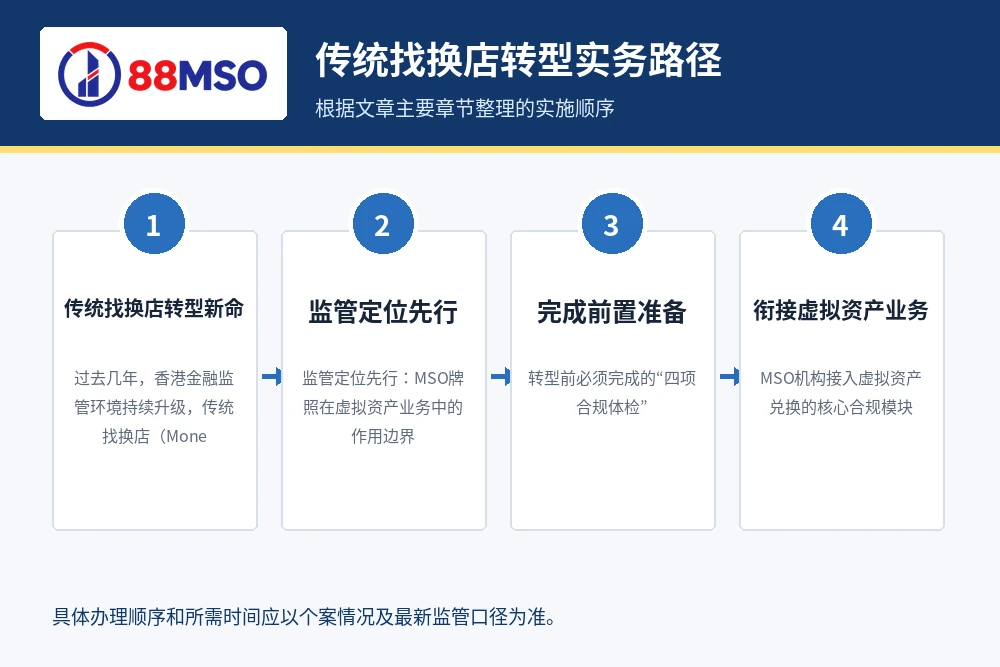
one、Regulatory positioning first:The boundaries of the role of MSO license in virtual asset business
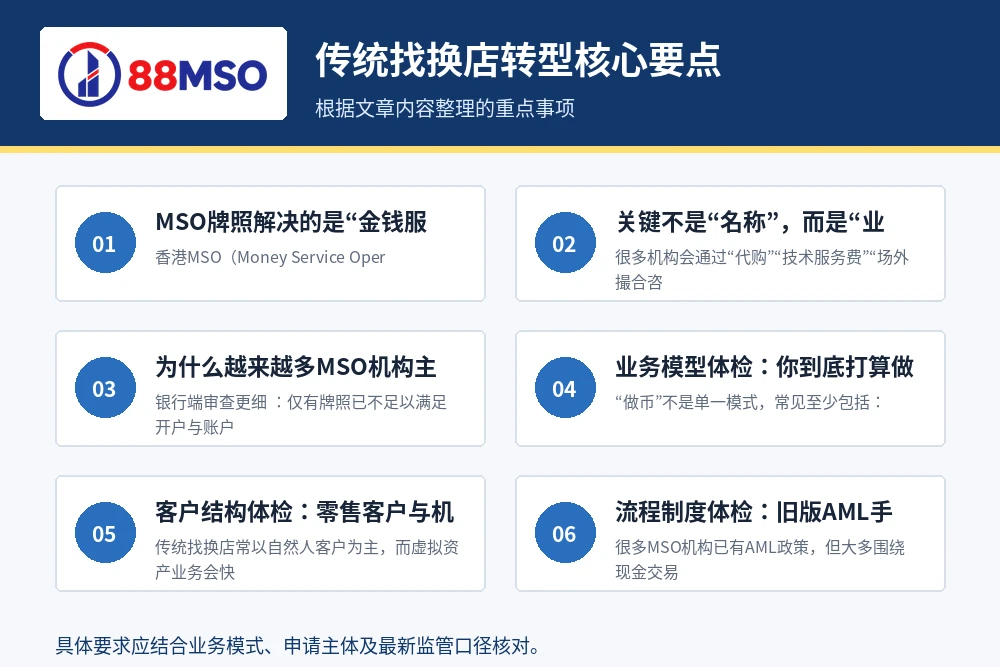
1. The MSO license addresses the compliance status of “money services”
The core regulatory scope of Hong Kong's MSO (Money Service Operator) license mainly covers two types of activities:currency exchangeandRemittance service。It is the basic legal qualification for conducting traditional exchange and remittance business,It’s also bank cooperation、Corporate risk control、The underlying threshold of customer trust。
But when the business extends to virtual assets (such as USDT、BTC, etc.),The focus of supervision is no longer just “the exchange itself”,But the source of funds、counterparty、wallet flow、New variables such as on-chain risk exposure。That is to say,MSO license provides starting point,But it does not automatically cover all virtual asset scenarios。
2. The key is not the "name",But the "substance of the business"
Many institutions will package their business under names such as "purchasing agency", "technical service fee", "off-site matching consultation", etc.,Attempts to circumvent regulatory classification。But in compliance review,Regulators and banks focus on substance of transactions:Are you exchanging between legal currency and virtual assets?、Whether to participate in customer asset transfer、Do you have sufficient AML control capabilities?。
therefore,The first step in transformation is not to design marketing copy,but completeBusiness substance identification and regulatory mapping。If you do this step wrong,follow-up system、system、Open an account、Taxation will deviate。
3. Why more and more MSO organizations are taking the initiative to upgrade their compliance systems
- Bank-side review is more detailed:A license alone is no longer sufficient to meet account opening and account maintenance requirements,Banks will look at transaction scenarios、Customer profiling and monitoring mechanism。
- Customer risks are more complex:Virtual asset transactions often involve multi-hop transfers、Cross-platform transfer、Anonymity enhancement tools,Traditional manual review of orders is difficult to cover。
- Enhanced law enforcement coordination:Improved cross-border anti-money laundering cooperation,Suspicious transaction clues are tracked faster。
This is why more and more institutions in the market are looking for service teams like 88MSO (88MSO) with full licensing and practical experience.,Build a complete compliance chassis in advance,Instead of "run the business first and then supplement the system"。
two、"Four compliance physical examinations" that must be completed before transformation
1. Business model physical examination:What kind of virtual asset exchange do you plan to do?
“Making money” is not a single model,Common ones include at least:
- Store counter type:Customers pay fiat currency on site,Redeem and transfer to designated wallet;
- Online reservation + offline settlement type:Submit information online,Complete settlement offline;
- Cross-border remittance linkage type:Legal currency remittance and virtual asset settlement in parallel;
- Large-amount over-the-counter (OTC) exchange for corporate customers。
Different models correspond to different depths of customer due diligence、Recordkeeping Requirements and Transaction Monitoring Dimensions。no clear model,It is impossible to define effective control points。
2. Customer structure physical examination:Retail customers and institutional customers need to be managed hierarchically
Traditional exchange shops often have natural person customers.,The virtual asset business will quickly introduce high-frequency traders、Cross-border merchants、Complex customer groups such as trade intermediaries。It is recommended to layer by at least the following dimensions:
- Transaction amount and frequency;
- Customer origin region and professional background;
- Adequacy of proof of source of funds;
- Wallet address risk rating and historical behavior。
After layering,Only by setting differentiated KYC thresholds and continuous due diligence frequency。
3. Process system physical examination:Older AML manuals are often "inadequate"
Many MSOs already have AML policies,But most of them focus on cash transactions and remittance scenarios.。After accessing virtual assets,The system must add at least:
- Wallet address screening and blacklist mechanism;
- On-chain fund path identification rules;
- High-risk currency/high-risk region restriction strategy;
- Abnormal transaction trigger threshold and upgrade process;
- Suspicious transaction report (STR) internal review and approval time limit。
4. Team ability physical examination:There is no "person",Institutions are just documents
Compliance failures are often not due to “no system”,But "no one can execute it"。The transition period must at least be clear:
- Who is the person in charge of AML/MLRO contact person?;
- How frontline personnel identify fake transactions、Hold wallet on behalf of others、Order splitting behavior;
- Who will review abnormal transactions?、Who decides whether to report;
- Is there training and testing for virtual asset scenarios every quarter?。
three、MSO institutions access the core compliance module of virtual asset exchange
1. KYC has been upgraded from “identity recognition” to “identity + behavioral profiling”
Traditional KYC only verifying documents is no longer enough。It is recommended to build a “three-layer due diligence”:
- Basic due diligence:Proof of identity、Proof of address、Contact information、career information;
- Fund due diligence:Source of funds、Transaction purpose、Beneficial owner information;
- Conduct due diligence:Wallet history activity、counterparty model、Frequency and amount changes。
Enhanced due diligence (EDD) should be triggered for high-risk customers,and set stricter transaction limits and review mechanisms。
2. Transaction monitoring:From "threshold warning" to "scenario warning"
Simply setting a threshold based on the amount will miss a large number of evasive behaviors.。More effective is scene-based monitoring,For example:
- Multiple split orders in a short period of time are close to the threshold;
- Large high-frequency transactions occur immediately after opening a new account;
- Quick transfer of funds in and out、Abnormally short dwell time;
- There are paths associated with high-risk addresses or suspicious platforms。
If the organization is small,A “manual + rule” hybrid model should also be established first,Gradually transition to systematic monitoring。
3. record retention:Not "archive",But "traceable"
What regulators and banks value most is traceability。It is recommended to keep the complete:
- Customer account opening and due diligence information version;
- time per transaction、Amount、Currency、wallet address、operator;
- Risk warning processing records and conclusions;
- Suspicious transaction reporting and internal decision-making chain。
Retention format must be searchable、Exportable、Restorable,Avoid “lots of documentation but no proof of due diligence”。
4. Bank relationship maintenance:Compliance quality directly affects the lifeline of accounts
When MSO institutions carry out virtual asset-related business,Banks will continue to assess risk exposures。The key to maintaining a stable account is:
- Proactively disclose true business models and control frameworks;
- Provide regular compliance reports and audit records;
- Provide timely explanations and corrections when abnormal transactions occur;
- Avoid “superficial compliance”、The fragmentation of "out of control of actual operation"。
in practice,Many institutions use external compliance consultants to standardize bank communication materials in the early stages of transformation.,Significantly reduce the probability of account restriction。
Four、Common misunderstandings in traditional money change shops:Seems "easy",Actually high risk
Misunderstanding 1:Use personal account or affiliated company to collect and pay
This approach is flexible in the short term,It is easy to trigger anti-money laundering alerts in the long term,It will also lead to discrepancies between accounts and facts.、Tax risks and legal responsibilities are unclear。
Misunderstanding 2:Outsource KYC to front-end channels,Don’t review yourself
Collecting data through channels does not mean that you have fulfilled your due diligence obligations.。Licensed entities must maintain independent review capabilities and ultimate responsibility。
Misunderstanding 3:Believe that small transactions do not require intensive monitoring
Virtual asset money laundering is often achieved through high-frequency small-amount splitting,"Small amount" does not mean "low risk"。
Misunderstanding 4:System templates are directly applied,No scene customization
Paper compliance is no substitute for operational compliance。During regulatory inspection,Asking about the details of the process will expose the "disconnect between system and practice"。
five、An executable transformation roadmap:90 days to complete the process from "can do" to "stable"
Phase 1 (1-30 days):Diagnosis and architectural design
- Complete business substance and regulatory boundary assessment;
- Sort out customer types and risk stratification;
- Develop target operating model and transaction restriction list。
Phase 2 (31-60 days):Implementation of institutions and systems
- Upgraded AML/KYC policies、SOPs and training materials;
- Deploy basic screening and transaction monitoring rules;
- Create exception upgrade、Review and reporting mechanism。
Phase 3 (61-90 days):Trial operation and audit optimization
- Small range grayscale is online,Verify process executability;
- Review alarm hit rate and false alarm rate;
- Improve bank communication materials and management report templates。
For small and medium-sized institutions that lack an in-house compliance team,It is usually more efficient to adopt the co-construction method of "external experts + internal execution"。Based on 88MSO’s long-term service experience,The key to successful transformation is not how much one-time investment,It depends on whether the control system can continue to iterate。
six、Conclusion:MSO transformation is not about chasing trends,But to rebuild trusted transaction capabilities
Traditional currency exchange shops enter the virtual asset exchange market,opportunity does exist,But the real competitiveness is never “lower quotation” or “faster loan”,RatherStable under high-pressure supervision、transparent、Operate auditably。
Holding an MSO license is an important starting point,But it’s not the end of compliance。Only by positioning supervision、AML/KYC、Transaction monitoring、record retention、Bank collaboration and other modules are opened,Only then can an organization move from “deployable” to “sustainable”。
If you are in the transformation window period,It is recommended to conduct compliance physical examination and implement route planning as soon as possible,Set up the underlying framework before business starts。This will not only reduce law enforcement and account risks,It can also establish stronger professional credibility in the eyes of customers and partners.。
FAQ:5 issues that operators are most concerned about
Q1:After having an MSO license,Is it possible to promote the "virtual asset exchange" service immediately?
It is not recommended to promote directly without completing the regulatory boundary assessment and internal control upgrades.。First put the business model、KYC process and monitoring mechanism run through,It would be more prudent to carry out market-oriented actions。
Q2:Do small store-type institutions also need a complete AML system?
need。Size does not affect basic compliance obligations,Only the control depth and system complexity can be constructed in stages。
Q3:What should I do if the customer is unwilling to provide proof of source of funds?
Should be handled according to risk policy:Restrict transactions、Raise review level or deny service。Loosening the bottom line often leaves the risk to licensed entities。
Q4:Is it necessary to use an on-chain analysis system?
Not one size fits all,But at least there must be executable address screening and anomaly identification capabilities。After the transaction volume increases,Systematic tools are almost a must。
Q5:What is the most overlooked point in the transformation process?
The most common is "the system is written,But the frontline won’t do it”。Be sure to train、Sampling inspection and accountability mechanisms should be placed in an equally important position as the system。
First determine whether the business falls within the scope of MSO based on capital flow.
When evaluating the transformation of traditional money change shops,What should be handed over from the customer to the company?、How the company exchanges or remits、Which accounts do the funds go through?、What assets are finally delivered to start drawing the capital flow?。Just looking at the product name is not enough to determine the scope of regulation;Involving legal currency exchange、Cross-border remittance、When collecting and paying virtual assets or third parties,It is also necessary to check separately whether other regulatory systems are applicable at the same time.。
Application and going concern information should cover actual business location、Equity and ultimate owners、fit and proper person、business plan、risk assessment、Customer due diligence、Sanctions Screening、Transaction monitoring、Report suspicious transactions、Record keeping and staff training。During on-site inspection,Institutional documents、Sampled customer files and bank statements must be mutually corroborative。
Industry references:Hong Kong Customs and Excise Department:Money service operator supervision and licensing information。
Read more:Hong Kong MSO licensed company bank account opening:Compliance materials list and interview points、Hong Kong MSO License Renewal Guide:Customs on-site spot inspection focus and compliance ledger establishment practices。