 简体中文
简体中文 繁體中文
繁體中文 English
Hong Kong Precious Metals and Gemstones Dealers (DPMS) Registration System:Why companies must understand Category A and Category B as early as possible
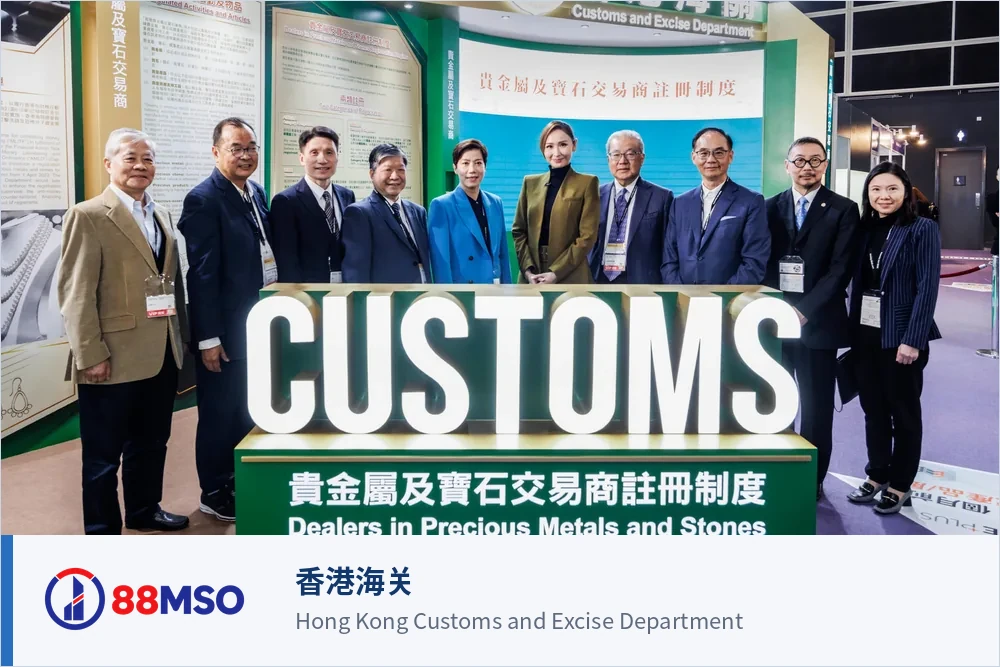
Official verification update (August 2026):Category A and B belong to the precious metals and gemstone dealer registration category,Should not be expressed as two levels of "licenses"。Category judgment must be based on whether specified transactions are carried out、Cash transaction amounts and business model;Class B assumes more complete AML/CFT obligations,But it does not mean that the commercial level is higher。 For specific rules, seeHong Kong Customs Precious Metals and Gems Dealers Registration System。
As global anti-money laundering regulations continue to escalate,The precious metals and gemstone industry has become one of the high-risk areas that international regulatory agencies focus on。Hong Kong as an international financial and trading center,againstPrecious metals and gemstone traders(Dealers in Precious Metals and Stones, DPMS)Establish a registration system,Not just a legal obligation,It also allows enterprises to enter the banking system、Key threshold for expanding cross-border business and maintaining business reputation。
The most common question asked by many practitioners is:"What is the essential difference between Category A and Category B? Is Category B more advanced?" actually,This is a common misunderstanding。Division of Category A and Category B,Not "high or low level",It's based on the transaction amount、Different compliance paths set by transaction methods and anti-money laundering risk exposure levels。Wrong category selected,The process may be repeated、Account opening blocked,More seriously, they face the risk of law enforcement investigation and punishment.。
This article will start from the regulatory logic、Scope of application、Compliance obligations、Application points、Common misunderstandings and system dismantling are recommended for enterprise implementation,Help you truly understand the core differences and practical strategies between Class A and Class B under the DPMS registration system。
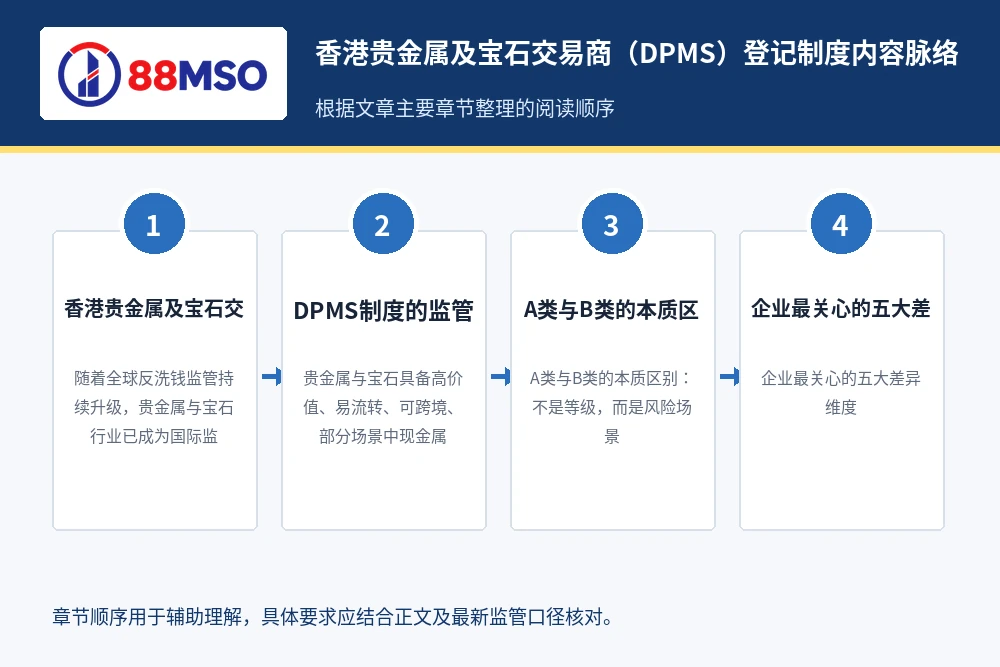
one、The regulatory background of the DPMS system:Why the precious metals and gemstone industry is under “key scrutiny”
Precious metals and gemstones are of high value、Easy to transfer、Can cross borders、Characteristics such as strong cash attributes in some scenarios,There is a natural risk of being exploited by illegal funds。Based on international anti-money laundering standards (such as FATF framework) and local regulatory requirements,Hong Kong incorporates specific traders into anti-money laundering regulatory system,core purposes include:
- Preventing money laundering and terrorist financingFlow into the legitimate economic system through physical high-value commodity channels;
- Improve industry transparency and traceability,Strengthen transaction records and identification;
- Establish a risk stratified management mechanism,Let different business models correspond to different regulatory intensity;
- Promotion and Banking、Compliance collaboration among payment institutions,Reduce compliance friction costs in the entire financial ecosystem。
this means:DPMS registration is by no means as simple as “one more card”,It is part of the overall compliance system construction of the enterprise.,Directly affects your subsequent bank account opening、Payment channel、Upstream and downstream cooperation and cross-border expansion。
two、The essential difference between Category A and Category B:not level,but a risk scenario
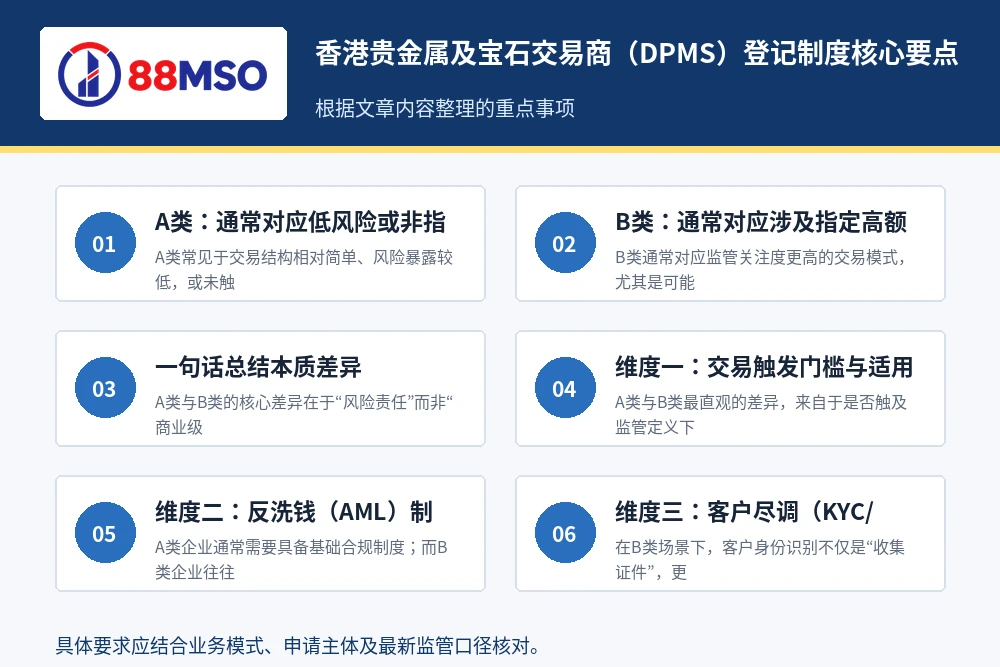
1) Class A:Usually corresponds to low-risk or unspecified high-amount cash scenarios
Type A is common when the transaction structure is relatively simple、Lower risk exposure,or business activities that do not reach designated high-risk transaction thresholds。Although companies still need to comply with basic legal obligations,But in terms of the depth of the anti-money laundering system、Frequency of adjustment、Transaction monitoring intensity,Typically lower than Category B requirements。
2) Category B:Usually corresponds to highly sensitive scenarios involving designated high-value cash transactions.
Category B usually corresponds to trading patterns with higher regulatory concerns,especially likely to touchLarge cash transactions、Businesses with complex transaction links or high anonymity risks。Category B is not “more attractive”,Rather, it means that companies need to assume stricter anti-money laundering and record-keeping obligations.,Includes more complete customer due diligence (CDD/KYC)、Suspicious transaction identification and reporting mechanism, etc.。
3) Summarize the essential differences in one sentence
The core difference between Category A and Category B is "risk liability" rather than "commercial level"。Regulation is not meant to restrict industry development,Instead, it requires “high-risk businesses to assume higher compliance obligations.”。
three、The five dimensions of difference that companies are most concerned about
Dimension one:Transaction triggering threshold and applicable conditions
The most intuitive difference between Type A and Type B,It comes from whether it touches high-risk transaction types under regulatory definitions (especially cash transaction thresholds and transaction structures)。Enterprises should make judgments based on their own real business models,Instead of just looking at "single amount" or "historical experience"。
Practical reminder:If business will increase with the peak season、Changes in transaction amount structure due to growth in wholesale orders or cross-border customer base,It is recommended to evaluate according to the "business plan for the next 12-24 months",rather than just judging by the current size。
Dimension two:Depth of anti-money laundering (AML) system construction
Category A companies usually need to have a basic compliance system;Class B companies often need to establish a more systematic AML framework.,For example:
- Clear customer risk rating mechanism;
- Enhanced due diligence (EDD) trigger rules;
- Transaction monitoring and abnormal warning mechanism;
- Internal escalation and reporting path for suspicious transactions;
- Regular AML training and assessment records for employees。
Dimension three:Customer Due Diligence (KYC/CDD) Strength
In type B scenario,Customer identification is more than just “collecting documents”,More importantly,Understand the purpose of customer transactions、Reasonable source of funds、Beneficial Ownership (UBO) Structure。If the customer is a corporate entity,It may also involve equity penetration and identification of control rights。
In comparison,Category A is usually more basic in terms of depth of adjustment and trigger frequency.,But this does not mean that data integrity can be ignored。Many violation cases are not "absolutely nothing",but "done but not verifiable"、Not traceable、Inexplicable”。
Dimension four:Record keeping and audit traceability
A common “invisible minefield” in DPMS compliance lies in ledger quality:transaction documents、customer identification information、due diligence process、Internal approval、Whether abnormal handling, etc. form a complete chain of evidence。Category B usually requires higher trace standards and retention period management。
It is recommended that enterprises use "whether it can withstand spot inspections" as the bottom line standard,Instead of "it just needs to be recorded in the system"。Supervision looks at process compliance,not just a description of the results。
Dimension five:Impact on bank account opening and payment channels
in actual business,A/B classification will indirectly affect the risk assessment of financial institutions。Banks and payment institutions usually focus on:
- Have you completed registration as required?;
- Are your categories consistent with your business reality?;
- Is the AML policy enforceable?;
- Whether there is insufficient explanation of large amounts of cash or complex cross-border transactions。
In other words,DPMS is not “a matter for supervision”,It’s also “something that banks look at”。The more prepared you are for compliance,The more stable the funding channel is。
Four、Common misunderstandings:The four pitfalls that companies are most likely to fall into
Myth 1:Think of Class A as the “entry version”,Think of Category B as an “upgraded version”
This is the most typical misunderstanding。A/B is not a hierarchical relationship,But the scene matching relationship。Wrong declaration may result in subsequent supplementary documents、Rectification and even enforcement risks。
Myth 2:Get registration first,The system will be supplemented later
Many companies believe that "get on the bus first and pay for the ticket later",But in the context of high-frequency trading and bank scrutiny,Institutional gaps will be quickly exposed。Especially Class B business,If there is no practical process,Difficult for employees to perform,Risks translate directly into operational disruptions。
Myth 3:Only focus on application documents,No focus on ongoing compliance
DPMS compliance is an ongoing obligation,Not a one-time action。training、monitor、Review、Updates are all "continuous actions"。Ignore follow-up maintenance,Often in the annual review、Problems arise during spot checks or account opening reviews。
Myth 4:Treat AML as “the task of the legal department”
Actual implementation,front desk sales、customer service、finance、warehousing、Deliveries are all tied to anti-money laundering processes。No cross-departmental collaboration,The system will remain on paper,Difficult to pass practical test。
five、How to choose between Category A and Category B:Judgment framework based on “business reality”
Enterprises can follow the following steps to establish a preliminary judgment:
- Sorting out trading models:Cash/transfer ratio、Single transaction and cumulative amount、Customer type、Is it cross-border?;
- Identify risk trigger points:Are high value cash transactions possible?、agency transaction、Third party payment, etc.;
- Assess organizational capabilities:Are there people who can implement higher level AML requirements?、Processes and Systems;
- Reserve business growth flexibility:Avoid frequent adjustments to the compliance framework due to changes in future transaction structures;
- Conduct professional pre-screening:Gap Analysis through Compliance Consultants,Reduce trial and error costs。
For plans to operate the Hong Kong market in the long term、For companies that want to connect with banks and international partners,Get the classification and system right in the early stage,More cost-effective than later “remedial rectification”。
six、Practical suggestions:Compliance roadmap from application to implementation
Stage 1:Admission assessment
- Confirm whether the business scope and transaction scenarios trigger DPMS requirements;
- Clarify A/B category compatibility;
- Evaluate shareholders、Compliance background of directors and key personnel。
Stage 2:System and document construction
- Prepare AML/KYC policy、Customer Risk Rating Rules;
- Establish suspicious transaction identification、Reporting and leaving trace mechanism;
- Prepare transaction record template、Customer Profile Template、Training record template。
Stage 3:Application and communication
- Submit information in accordance with regulatory requirements and maintain consistent standards;
- Be prepared to explain logic in advance for complex trading patterns;
- Define response timetable for possible remedial matters。
Stage 4:Continuous compliance operations
- Regularly update customer risk ratings;
- Carry out employee training and sampling review;
- Synchronize bank compliance requirements,Reduce account risk control friction。
in this process,It will be safer to choose a team with practical experience in financial compliance in Hong Kong.。In the cases of enterprises like those served by 88MSO,The common value is not in “handing over documents”,It’s about translating regulatory language into executable processes,Help enterprises truly get through the process of registration、Closed loop from account opening to ongoing operations。
seven、The relationship between DPMS and corporate globalization:More than just “compliance costs”
Many companies initially regard DPMS as a cost item,But in the medium to long term,it is actuallybusiness infrastructure:
- Make it easier for companies to conduct due diligence through international banks and payment institutions;
- Enhance cross-border partners’ confidence in transaction transparency and stability;
- in financing、mergers and acquisitions、Gain higher credibility through license synergy;
- Reduce the risk of reputational damage and business disruption caused by breaches。
For precious metals and gemstone companies planning to use Hong Kong as a capital and trading hub,Establish a compliance system as early as possible,It is equivalent to paving the track for future growth in advance.。
Conclusion:First understand the A/B logic,Only in this way can the Hong Kong market be stabilized
Category A and Category B under Hong Kong’s DPMS registration system,The core is not "who is better",And in "Who better matches your real business risk?"。Businesses should avoid substituting short-term convenience for long-term compliance,Especially as bank scrutiny tightens、In the context of strengthening cross-border regulatory linkage,Misclassification and institutional deficiencies will be quickly amplified。
If you are planning a precious metal or gemstone business in Hong Kong,It is recommended to do three things as early as possible:Clarify the transaction scenario、Calibration A/B Category、Build an executable AML system。Only by doing these three steps solidly,Only when regulations are predictable can enterprises,Achieve stable business expansion and global layout。
FAQ:Regarding the high-frequency issues of DPMS Class A and Class B
Q1:Is category B necessarily "more advantageous" than category A?
uncertain。Category B represents higher regulatory obligations,Does not represent a commercial advantage。The key is whether it matches your trading model。
Q2:If we do Category A now,Can it be adjusted to future business changes?
Usually OK,However, changes need to be processed in a timely manner in accordance with regulatory requirements and internal systems must be updated simultaneously.。It is recommended to reserve growth scenarios in the early stage,Reduce repeated adjustment costs。
Q3:Only make transfers、Not doing cash,Does it mean there are fewer compliance requirements?
Not so。Even cashless transactions,Customer identification、Transaction rationality judgment、Obligations such as record keeping remain important。
Q4:Will DPMS compliance affect the speed of account opening?
In the long run, it has a positive impact。Complete compliance information、logically consistent,It is usually easier to obtain approval from banks and payment institutions。
First determine the registration type based on transaction and service content
Non-Hong Kong precious metals and gemstone dealers are required to complete the transaction within one day after completion of any specified cash transaction.,or at the earliest time when the dealer or a person acting on behalf of the dealer leaves Hong Kong,Whichever is earlier,Submit relevant cash transaction reports to customs,This includes the dealer and/or dealer representative(If applicable)Itinerary data and basic data、Customer data and transaction details, etc.。
In preparation for the Hong Kong Precious Metals and Gemstones Dealers (DPMS) registration system,The actual service should be put first、Customer type、Please clearly state the payment method and transaction amount,Double check the applicable registration or licensing category。TCSP focuses on trust or company services and customer due diligence,DPMS focuses on precious metals and gemstone transactions and corresponding anti-money laundering obligations.,The two cannot share a set of business descriptions just because they are provided by the same company.。
Application and ongoing records should cover the ultimate owner、fit and proper person、risk assessment、Customer and transaction due diligence、Sanctions Screening、Report suspicious transactions、Record keeping and employee training。When using third-party referrals or cash to receive and pay,It should be clear in the process who identifies the customer、Who saves files and how exceptions are escalated。
Industry references:Hong Kong Customs and Excise Department:Registration system for dealers in precious metals and gemstones。