 简体中文
简体中文 繁體中文
繁體中文 English
Difficulties in opening a virtual asset over-the-counter (OTC) account:Why Banks “Ask Compliance First”,Let’s talk about business”?
In the virtual asset industry,OTC (over-the-counter) business seems to be just “buying and selling”,But in the eyes of the bank,It is often classified asHigh risk customer types。The reason is very direct:Money flows quickly、Diverse counterparties、Strong cross-border attributes、Frequent conversion of funds on and off the chain。If the company cannot clearly prove “where the money comes from”、where to go、Why is it reasonable?”,Banks will worry about anti-money laundering (AML) and counter-terrorism financing (CFT) risks,Then refuse to open an account or limit account functions。
therefore,The core of opening a bank account for OTC institutions,It’s not “Which bank is better to talk to?”,Instead, first complete a set of auditable、can be explained、A compliance system that can be continuously verified。Especially in major financial centers in Hong Kong and overseas,Bank review has been upgraded from "static material review" to "continuous transaction behavior monitoring",Passing the account opening once does not mean you can sit back and relax.。
OTC business from a regulatory perspective:5 things banks really care about
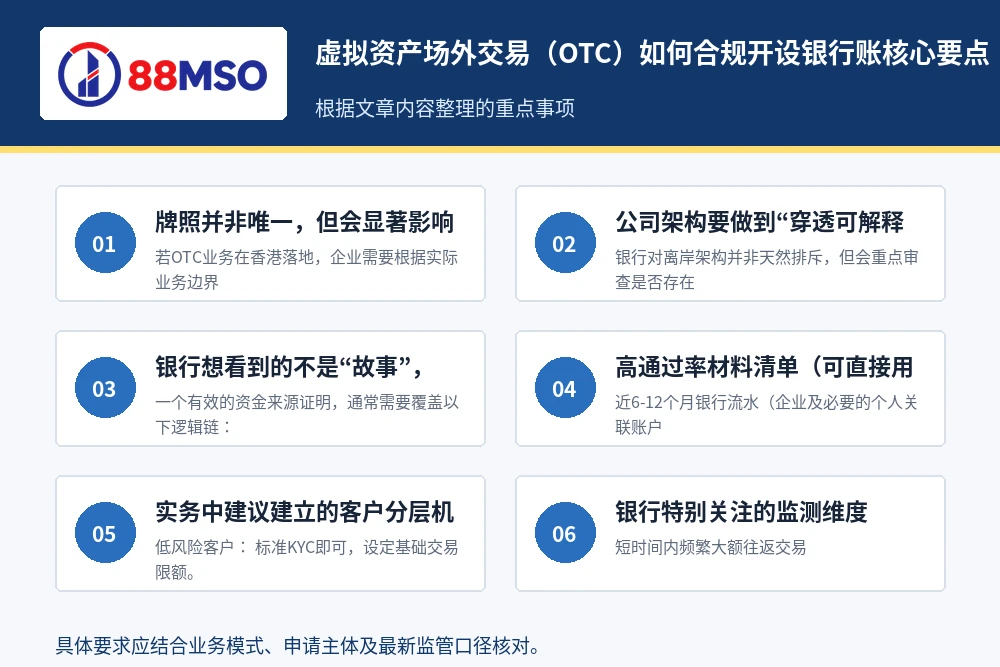
Many companies prepare a pile of company documents,but still rejected,The root cause is a failure to align the bank's list of risk issues。In practice,Banks usually conduct due diligence around the following five core issues::
- Is the business model transparent?:Are you doing proprietary trading?、Matchmaking,Or mixed mode? Are the sources of profits explainable?
- Is the customer group identifiable?:What jurisdictions do your clients come from? Does it touch sanctioned areas or high-risk countries?
- Is the path of funds traceable?:Fiat currency deposit、Virtual asset transfer、Does every step of the legal currency withdrawal process leave traces?
- Is the internal control mechanism in place?:Is there KYC/KYB?、Transaction monitoring、Report suspicious transactions、Sanctions screening process?
- Whether management has compliance capabilities:director、shareholder、Is the background of the actual controller (UBO) clear? Is there a compliance officer mechanism?
Simply put,Banks don’t just check “authenticity of documents”,Rather, examine “whether you have the ability to、Stablize、Provably operating in compliance”。
License and entity structure before opening an account:Let’s make “identity” clear first
1) License is not the only one,But it will significantly affect bank trust
If OTC business is launched in Hong Kong,Enterprises need to determine whether corresponding regulatory licenses or registration requirements are involved based on actual business boundaries.。Even if certain business scenarios do not directly trigger specific license requirements,The bank will also ask you to explain:why not needed、What is the applicable legal basis?、Is there any external legal opinion to support it?。
This is also the blind spot of many OTC teams - "the business can be done" does not mean "the bank can collect it"。Banks pay more attention toClear legal positioning + clear regulatory path。at this stage,Rely on a professional team familiar with Hong Kong’s financial compliance and licensing practices,It often saves you a lot of detours。
2) The company structure must be “penetrating and explainable”
Banks are not naturally averse to offshore structures,However, we will focus on reviewing whether there is excessive complexity、No commercial substance、Issues such as opacity of beneficiaries。It is recommended that OTC companies complete the following preparations before opening an account:
- Group structure chart (including shareholding ratios of shareholders at each level)
- Ultimate Beneficiary (UBO) Identity and Address Proof
- A description of the business purpose of each entity (why it is established in that jurisdiction)
- Document on the division of responsibilities between the board of directors and management
The better you can explain in advance "why it is designed this way",The more it can reduce the bank's "subjective doubts"。
Proof of legality of source of funds (SOF/SOW):The watershed between success and failure in OTC account opening
in all materials,Most likely to be repaired repeatedly、It is also the most critical one,that isSource of Funds, SOF) and Source of Wealth, SOW) Proof。Especially when it comes to virtual asset income、miner income、Early investment value-added and other types of,Banks will require higher standards of evidence chain。
What banks want to see is not a “story”,Rather, it is a "closed loop of the evidence chain"
Proof of a valid source of funds,Usually the following logical chain needs to be covered:
- starting point:Where does the initial funding come from (salary、dividend、Equity transfer、historical investment、operating profit, etc.)
- path:How funds enter the account you control (bank flow、Brokerage records、On-chain transfer records)
- Convert:How to exchange legal currency and virtual assets (exchange statement、OTC transaction certificate)
- status quo:Whether the current asset size matches the account balance (description of assets and liabilities)、audit or management reporting)
Bank review materials checklist (can be used for internal preparation)
- Bank statements in the past 6-12 months (corporate and necessary personal related accounts)
- tax bill、Audit report or financial statement (can prove historical earning ability)
- Exchange monthly statement、On-chain address ownership instructions、Transaction hash summary table
- Large transaction contract、bill、payment voucher、Payment confirmation
- Equity Sale Agreement、Dividend resolution、Investment exit documents (if applicable)
- Description of use of funds (operations、market making、Settlement、risk control reserve)
Important reminder:between materialsThe amount is adjustable、Time available、Subject can match。If only screenshots are provided but cannot correspond to the subject or timeline,It is usually judged that there is insufficient evidence。
KYC/KYB due diligence with counterparties:Are you "filtering risks" for banks?
Banks will evaluate whether OTC companies have the "first risk control gate" capability。in other words,Banks hope you've screened out high-risk customers,Rather than leaving the risk to the banks。
Suggested customer stratification mechanism in practice
- low risk customers:Standard KYC is enough,Set basic transaction limits。
- Medium risk customers:Additional proof of source of funds、career information、Description of transaction purpose。
- high risk customers:Enhanced due diligence (EDD),Includes video verification、Related address analysis、Sanctions screening strengthened、Management approval。
Monitoring dimensions that banks are particularly concerned about
- Frequent large round-trip transactions in a short period of time
- with "coin mixer"、high risk address、There is a correlation between dark web label addresses
- There is an obvious mismatch between the client’s professional background and the size of the transaction.
- Cross-border multi-hop transfer、Incomplete beneficiary information
If the company can provide a documented AML policy、Alarm thresholds and handling procedures,Account opening communication will be much smoother。
How to make an account opening information package,Which bank is the most supportive?
Instead of "passive supplements",Why not submit a structured package from the beginning?。It is recommended to organize according to the following modules:
Module A:Corporate Identity and Governance
- Company registration documents、Charter、Register of Directors and Shareholders
- UBO Statement、Management resume、Compliance officer information
Module B:Business and Compliance Notes
- Business plan (customer type、area、Estimated transaction volume)
- Compliance Manual (KYC、AML、Sanctions Screening、Suspicious transaction reporting)
- Description of third-party risk control tools (such as on-chain monitoring systems)
Module C:Fund sources and transaction evidence
- SOF/SOW Document Collection and Explanatory Memorandum
- Sample transaction flow (after desensitization) and reconciliation logic
If the material is unified and compiled into a "review-friendly version" by a professional team,Can significantly reduce the number of back-and-forth inquiries from banks。Many companies have made the most obvious improvements at this step.。
Common Rejection Reasons and Fix Strategies
Reason for rejection 1:Business description is too general
repair:Break down “doing OTC” into specific processes:How to acquire customers、Quotation mechanism、settlement path、Risk control node、Exception handling。
Reason for rejection 2:The proof of funds is only a screenshot,No legal support
repair:Supplementary contract、tax documents、Audit materials,If necessary, add legal opinions to explain the legality of the funds.。
Reason for rejection 3:There are high-risk counterparties in historical transactions
repair:Provide supplementary investigation report,Explain that cooperation has been terminated and a blacklist and continuous monitoring mechanism have been established.。
Reason for rejection 4:Management has insufficient compliance experience
repair:Configure compliance consultants or MLRO support with practical experience,Improve systems and training records。
Opening an account is not the end:Continuous compliance is the key to account stability
Many OTC institutions mistakenly believe that "it is safe once you open an account.",In fact, banks will continue to review,Especially in the following scenarios:
- Sudden increase in transaction volume or change in business model
- New clients from high-risk jurisdictions
- Negative media public opinion or changes in regulatory policies
It is recommended to establish a quarterly compliance review mechanism:Update customer risk rating、Randomly check large transactions、Review the quality of alarm processing、Update policy version。This will not only reduce the risk of account being frozen or closed,It can also improve the efficiency of subsequent multi-account expansion.。
Practical suggestions:How OTC companies improve first-time account opening success rate
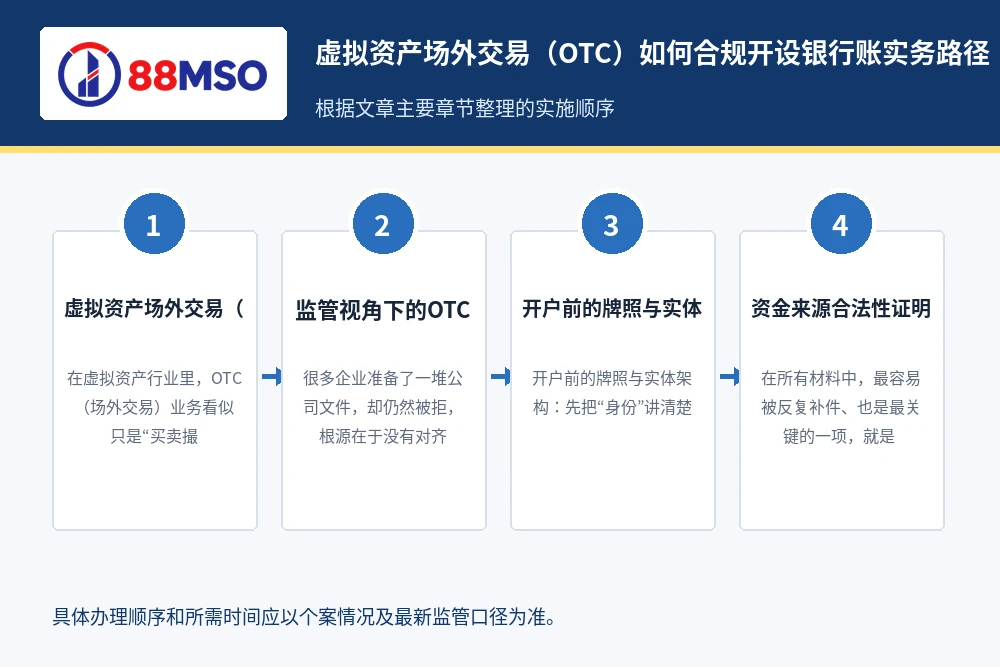
- Do a “pre-screening” first:before formal submission,Internal mock bank Q&A,Identify evidence weaknesses。
- unified caliber:Sale、finance、External descriptions of compliance must be consistent,Avoid "inconsistencies"。
- Pay attention to timelines:All key trading events sorted by time,Easy for banks to quickly understand。
- Prepare English version:Cross-border banks often require bilingual materials,Preparing in advance can shorten the cycle。
- Leverage a professional team:Positioning on license plate、AML framework、Introducing consultants with practical experience in Hong Kong for account opening communication,Can significantly improve success rate and efficiency。
In Hong Kong’s financial compliance ecosystem,Service teams like 88MSO and the 88MSO behind it that have been deeply involved in licensing and compliance custody for a long time,It can usually provide practical value in terms of "regulatory language conversion", "structured presentation of materials" and "bank communication strategies".,Help enterprises solve complex problems in advance。
Conclusion:The essence of OTC account opening,Is to establish a “trustworthy compliance system”
Open a bank account for virtual assets OTC,It’s never as simple as “submitting documents”,Rather, it is a comprehensive compliance capability review。Who can explain the business logic clearly?、Confirm the funding path、Put risk control into practice,Who is more likely to gain long-term trust from banks?。
If you are preparing for the implementation of OTC business,It is recommended to build a complete SOF/SOW evidence chain starting today、KYC/AML system and continuous monitoring mechanism。Put compliance first,Opening an account is no longer an obstacle,And it will become the infrastructure for your business expansion.。
FAQ:High-frequency issues in OTC account opening
Q1:Is it impossible to open an account without a big license?
uncertain,But you must clearly state the legal positioning of the business,and provide proof of compliance control capabilities。The clearer the license/registration status,Bank trust is generally higher。
Q2:The source of funds is virtual asset income,Is it acceptable?
Can,But a complete chain of evidence is needed:Purchase source、hold path、Realization record、Tax or financial certificates, etc.,And the subject corresponds to the same。
Q3:How long does it usually take to open an account?
Depends on material quality and bank risk appetite。Complete information、When the structure is clear,The cycle can be significantly shortened;Repeated patching will significantly lengthen the time。
Account opening materials must form a complete chain of financial evidence
How to prepare for over-the-counter (OTC) virtual asset trading when opening a bank account in compliance with regulations,Banks usually structure their companies、actual controller、business contract、Customers and Suppliers、Expected trading country、Single and monthly amounts and funding sources are judged together.。website、bill、contract、If the written and verbal instructions conflict with each other,Easily trigger patchwork or enhanced due diligence。
High-risk industries should prepare separate licenses or registration certificates、Anti-Money Laundering System、Customer access criteria、Sanctions Screening and Transaction Monitoring Instructions,and evidence of source of funds and source of wealth for major transactions。Remote account opening does not mean less review;Unexplained collection and payment、Short-term large-amount postings and transactions inconsistent with reported business,You should adjust the process before opening an account。
Industry references:Hong Kong Monetary Authority:Anti-money laundering and customer due diligence information。
Read more:What are NRA and FTN accounts? Compliance Operation Guide for Mainland Enterprises to Open Foreign Currency Offshore Accounts、How does a cross-border e-commerce (Amazon/independent website) open a public account with CBiBank?。
Read more:Overseas bank account opening services and compliance requirements。