 简体中文
简体中文 繁體中文
繁體中文 English
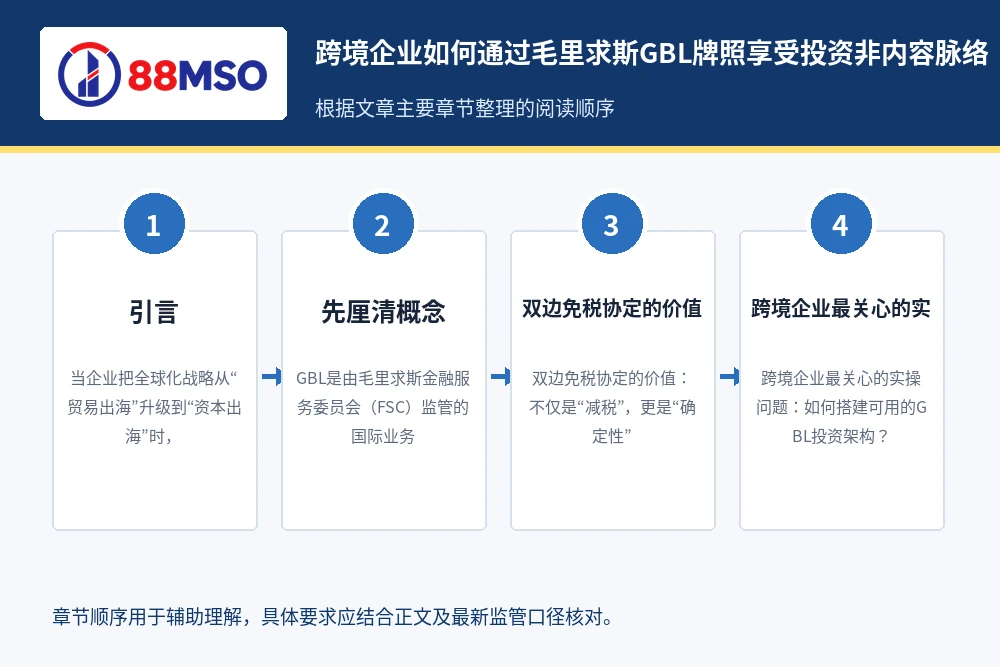
introduction:Why are more and more cross-border companies paying attention to the Mauritius GBL license?
When companies upgrade their globalization strategy from "going overseas for trade" to "going overseas for capital",investment structure、Tax efficiency and regulatory complianceOften determines the success or failure of a project。Especially in the two high-growth markets of Africa and India,Opportunity and complexity coexist:One side is resources、Demographic and digital dividends,On one side is the multi-jurisdictional tax system、Foreign exchange supervision、Anti-tax avoidance rules and transparency requirements。
in this context,Mauritius Global Business License (hereinafter referred to asGBL license) has become the preferred intermediate holding and investment platform for many cross-border enterprises.。Its core value is not just “low taxes”,More importantly, through bilateral tax treaties (DTAs) and international compliance frameworks,accomplishsustainable、auditable、Can exitinvestment path。For businesses looking to cover both Africa and India,The GBL platform combines flexibility with legal certainty。
This article dismantles the system:How do cross-border enterprises passMauritius GBL license,Legally enjoy the advantages of bilateral tax-free agreements for investing in Africa and India,and taking into account BEPS、economic substance、Beneficial Ownership Review、CRS/FATCA and other regulatory requirements。
one、Clarify the concept first:What exactly is a GBL license?
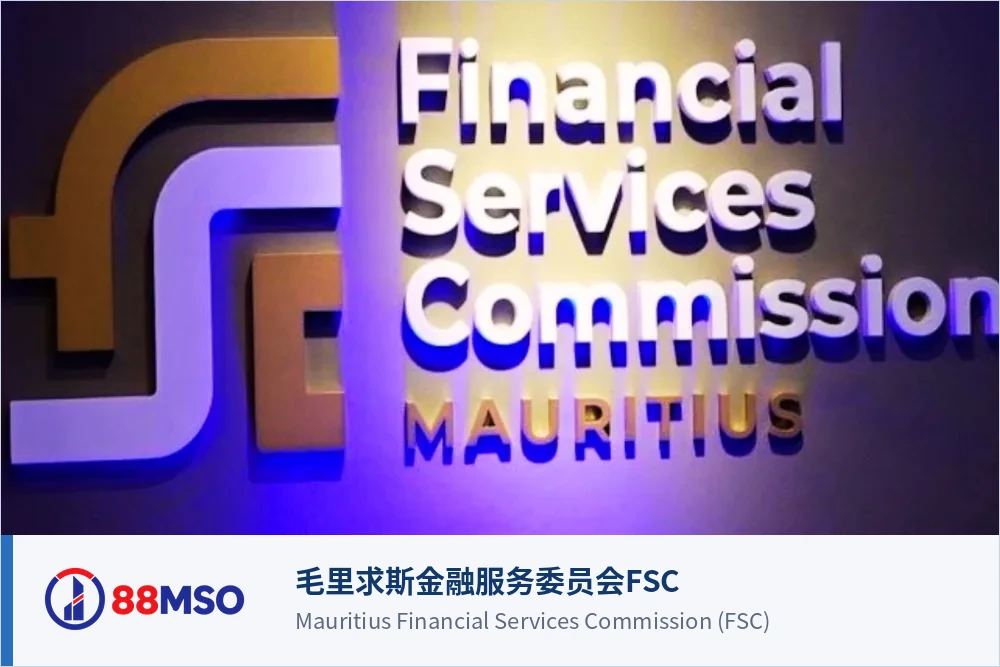
GBL is made up ofMauritius Financial Services Commission(FSC) regulated international business license,Usually used to carry out cross-border investment holdings、Fund management、Financial services and related international businesses。For investment companies,GBL subjects are often used for:
- Serves as an intermediate holding company (HoldCo) for projects in Africa or India;
- Hold equity、debt、Convertible bonds、Fund shares and other assets;
- Undertake dividends、Interest、Capital gains and exit proceeds;
- Optimizing tax efficiency under the treaty network。
What needs special emphasis is that:Today's GBL structure is no longer the era of "paper companies"。regulatory agency、Tax authorities and banks pay close attention toSubstance,That is, whether the company has real management and control activities in Mauritius。
two、The value of bilateral tax-free agreements:Not just “tax cuts”,It’s more “certainty”
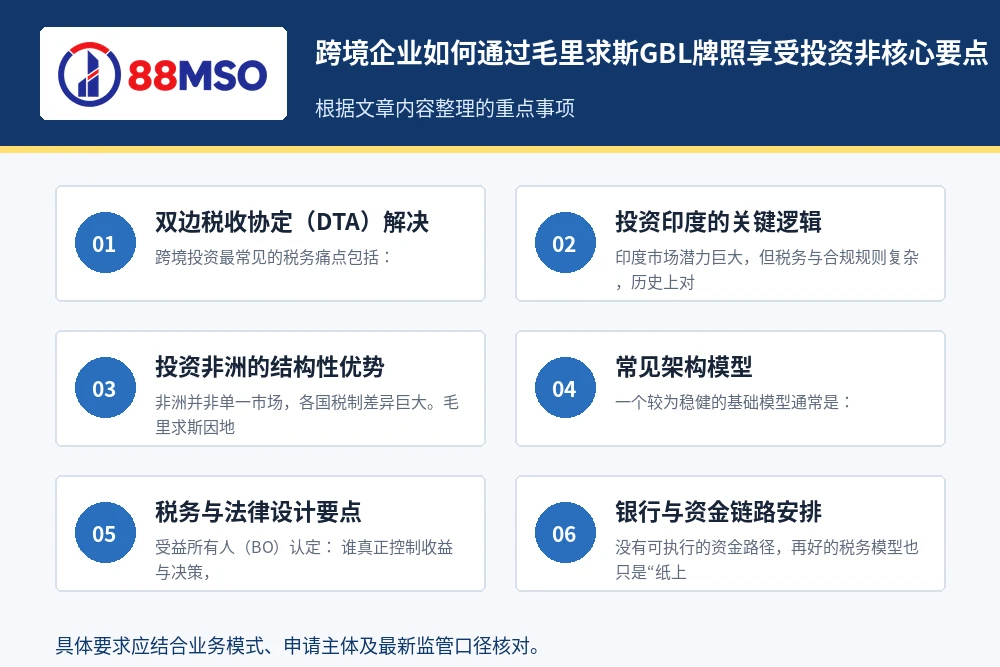
1. Core Issues Solved by Bilateral Tax Agreements (DTA)
The most common tax pain points for cross-border investments include:
- The same income is taxed twice in the country of source and the country of residence;
- dividends、Interest、Royalty withholding tax (WHT) is too high;
- Capital gains tax attribution unclear,Exit costs are difficult to predict;
- Tax dispute processing takes a long time,Affect the return of funds。
Mauritius has established tax treaties with many African countries and India.,able to meet the conditions,Offers withholding tax reductions、tax credit、Advantages such as clear distribution of taxation rights,Help companies achieve"The tax burden can be calculated、Transaction is executable、Audit can explain”。
2. Key logic for investing in India
India has huge market potential,But tax and compliance rules are complex,Historically, indirect transfers、capital gains、GAAR (General Anti-Avoidance Rules) is subject to stricter scrutiny。Invest in India through Mauritius GBL,The focus is not on “avoiding tax burdens”,But lies in:
- Use the treaty framework to clarify tax treatment pathways;
- Reduce dispute risks through real business purposes and substantive operations;
- Improve investment exit (equity transfer、IPO、Predictability in mergers and acquisitions。
need attention:India’s tax policy has been adjusted many times,Enterprises mustCurrent agreement terms + local tax laws + judicial precedentsDo dynamic assessment,Can’t continue the old model。
3. Structural advantages of investing in Africa
Africa is not a single market,Tax systems vary widely between countries。Mauritius geography、legal system、Financial services capabilities and agreement coverage,in east africa、Southern Africa and other regions have long played a role as investment hubs。Typical advantages are reflected in:
- Dividend/interest/royalty withholding taxes can be optimized in some countries;
- Shareholding platforms in cross-border mergers and acquisitions are more likely to be used by international LPs、Accepted by banks and audit institutions;
- The exit path (trade sale/secondary transfer) can be designed in advance at the architectural level。
three、The practical issues that cross-border enterprises are most concerned about:How to build a usable GBL investment structure?
1. Common architectural models
A more robust basic model is usually:
Overseas parent company/family office → Mauritius GBL HoldCo → India/Africa Project Company (SPV)
Can be superimposed according to project properties:
- Creditors (shareholder loans、mezzanine financing);
- Fund level (GP/LP structure);
- Intellectual property layer (if there is technology or brand output);
- Exit level (M&A channel、Overseas listing route)。
2. Key points of tax and legal design
- Beneficial Owner (BO) Determination:Who really controls earnings and decisions,Determine whether treaty benefits are available。
- Primary Purpose Test (PPT):If the main purpose of the structure is determined to be to obtain tax benefits,May be denied agreement benefits。
- transfer pricing:management fee、Financing interest rate、Service fees must comply with the arm's length principle。
- Equity to Debt Ratio:Taking into account thin capitalization rules and interest deduction restrictions。
- exit tax:Equity transfer、indirect transfer、Capital gains tax points must be locked in advance。
3. Bank and capital link arrangements
No executable funding path,No matter how good the tax model is, it is just a "paper structure"。GBL entities need to plan ahead:
- Bank account opening materials and KYC document chain integrity;
- Source of Fund and Source of Wealth;
- Investment money、dividend、Compliance path for repatriation of loan principal and interest;
- Multi-currency management and foreign exchange risk hedging mechanism。
Four、Compliance red line:What issues are most likely to cause agreement benefits to expire?
1. "Empty shell" operation
If the GBL company has no local directors、No meeting minutes、no actual decision-making process、No trace of office or management,Easily challenged in tax review。Nowadays, “substantial business” is the bottom line,rather than a bonus。
2. Inconsistent documentation and insufficient transaction evidence
Write a contract、Funds go one way、The audit report is another set,It is the most common minefield for cross-border enterprises.。All legal texts、bill、Board resolution、Bank statements and tax declarations must be logically closed loops。
3. Ignore anti-tax avoidance and information exchange
BEPS、CRS、FATCA、Anti-money laundering (AML) and counter-terrorism financing (CFT) requirements are deeply integrated。If a company only focuses on tax rates,Not building a compliance system,Follow-up review at the bank、Financing due diligence、The exit phase of M&A will be hindered。
five、From "can be established" to "can be operated for a long time":GBL license life cycle management checklist
Pre-Setup
- Clarify the investment target country and expected holding period;
- Conduct tax feasibility calculations (three scenarios of dividends/interest/exit);
- Assess regulatory license boundaries (whether regulated activities are involved);
- Develop KYC and substantive operational plans。
Setup
- Company registration and preparation of GBL application materials;
- Appointment of qualified directors and company secretary;
- Account opening and payment link configuration;
- Implementation of internal governance documents and compliance systems。
Post-Setup
- annual audit、tax return、License renewal;
- Board meetings and management decisions leave traces;
- Transaction pricing and related transaction document maintenance;
- Dynamically adjust the structure according to changes in investor country policies。
six、Why do cross-border enterprises need "Hong Kong + offshore" linkage thinking?
In practice, many companies will adopt the combination of "Hong Kong operation platform + Mauritius investment platform":Hong Kong undertaking team、business、Financing and compliance center,Mauritius undertakes treaty-type foreign investment。The advantage of this model is that:
- Separation of operations and investment functions,Risk isolation is clearer;
- It is easier for financing institutions to understand the overall business logic;
- Audit and tax disclosure paths are more standardized;
- Available with future SFC、MSO or other financial license layout creates synergy。
For companies that want to develop long-term overseas financial compliance,Choose a service team that can understand both Hong Kong’s regulatory system and offshore structure rules,Will significantly reduce trial and error costs。Take 88MSO and its long-term service system as an example,Its financial license in Hong Kong、Experience in compliance custody and cross-border structure practice,It can help enterprises turn "architectural design" into "executable operation"。
seven、Typical case ideas (schematic)
Case background:A technology company plans to invest in Indian financial technology projects and East African payment infrastructure in the next five years.,It is expected to introduce US dollar funds in the medium term,Consider merger and exit later。
solution path:
- Established Mauritius GBL HoldCo as a unified foreign investment entity;
- Establish SPVs by project country,Isolate single project risks;
- The financing side uses a combination of "equity + convertible bonds",Balancing expansion with tax efficiency;
- Establish a quarterly compliance inspection mechanism,Cover AML、tax、audit、Board of Directors Minutes;
- Design exit terms in advance,Ensure tax and legal settlement during mergers and acquisitions。
result:without relying on aggressive tax arrangements,Enterprises gain higher certainty of capital return,It is also easier to pass the due diligence of institutional investors.。
Conclusion:GBL license is not a "tax saving tool",But cross-border capital governance capabilities
If cross-border enterprises want to enjoy the bilateral tax-free agreements for investment in Africa and India through the Mauritius GBL license,The key is not “whether to set up a company”,It depends on whether you can establish a set ofTaking into account tax efficiency、Legally sound、Regulatory transparency、bank acceptablelong-term mechanism。
Future international investment competition,Essentially a competition in compliance capabilities。Who can put the architecture、tax、license、Connecting banks and risk control,Who can get more stable returns in high-growth markets?。For Chinese overseas companies,Introduce a professional team as early as possible to plan the entire case,Often more cost-effective than subsequent remediation、More controllable。
FAQ:5 questions frequently asked by companies
1) Is GBL equivalent to a "tax-free license"?
no。GBL is a regulated international business platform,Tax incentives need to meet the conditions and substantive requirements of the agreement,It cannot be simply understood as “zero tax burden”。
2) Can I apply if I don’t have a physical office?
Initial arrangements can be established,However, long-term operations must meet substantive operating requirements,Including local management and decision-making traces, etc.。
3) Can I still use the Mauritius structure when investing in India?
Can,But it must be based on the latest agreement terms、A case-by-case assessment of India’s local tax laws and anti-tax avoidance rules,Historical experience cannot be copied directly。
4) There are so many African countries,Is there a universal architecture?
Not universal。According to the national tax system、Industry supervision、Foreign exchange rules design SPV and capital paths respectively。
5) When is the most appropriate time to involve professional consultants?
The sooner the better。It is recommended to complete a tax and compliance feasibility assessment before signing an investment intention,Avoid subsequent transaction reconstruction。
Check with regulatory agencies first、Legal name and available business
When studying how cross-border enterprises can enjoy the bilateral tax-free agreements for investment in Africa and India through the Mauritius GBL license,The first step is to identify the local authority、License's official name in law、Permitted activities and public inquiry methods。Companies are often registered in the market、Industry registration、Regulatory licenses and private sector memberships are collectively referred to as "licences",If you don't disassemble it first,Costs and available business will be overestimated。
When comparing different regions,The same set of dimensions should be used:Where customers can be located、Can I hold client assets?、Capital and guarantees、local directors and personnel、Entity operation、Audit declaration、Banking and payment channels,and whether major markets recognize the license。When it comes to fees and processing times,The current form and fee schedule of the regulatory agency shall prevail.。
Read more:Belize IFSC License:Compliance options for offshore derivatives brokers and the latest regulatory developments、How much does it cost to apply for an overseas financial license? Ranking of license plate maintenance costs in mainstream countries。