 简体中文
简体中文 繁體中文
繁體中文 English

What is the difference between Hong Kong SFC No. 1 and No. 4 plates? Let’s look at this first:Are you "making deals" or "giving advice"?
Apply in Hong KongSecurities and Futures Commission (SFC) licensehour,Many organizations easily go astray in the first step.:Bundle"Provide investment advice"and"Execute Securities Transactions"lumped together。turn out,The license application cycle is lengthened、capital budget adjustments,Even after the business went online, it was discovered that there was an out-of-scope operation risk.。
Especially preparing for the layout of cross-border wealth management、Home office services、Securities distribution or investment advisory platform companies,often asked:What is the essential difference between License No. 1 (securities trading) and License No. 4 (providing opinions on securities)? Do I have to apply at the same time? What is the difference in capital requirements?
This article will start from the regulatory definition、business boundaries、capital requirements、Staffing、Six dimensions of common combination models and practical misunderstandings,Create a complete analysis that can be used directly for internal decision-making。For teams that want to efficiently implement Hong Kong’s licensed structure,We will also give you suggestions on executable application paths.。
one、regulatory positioning:What do No. 1 and No. 4 do?
Type 1:Dealing in Securities
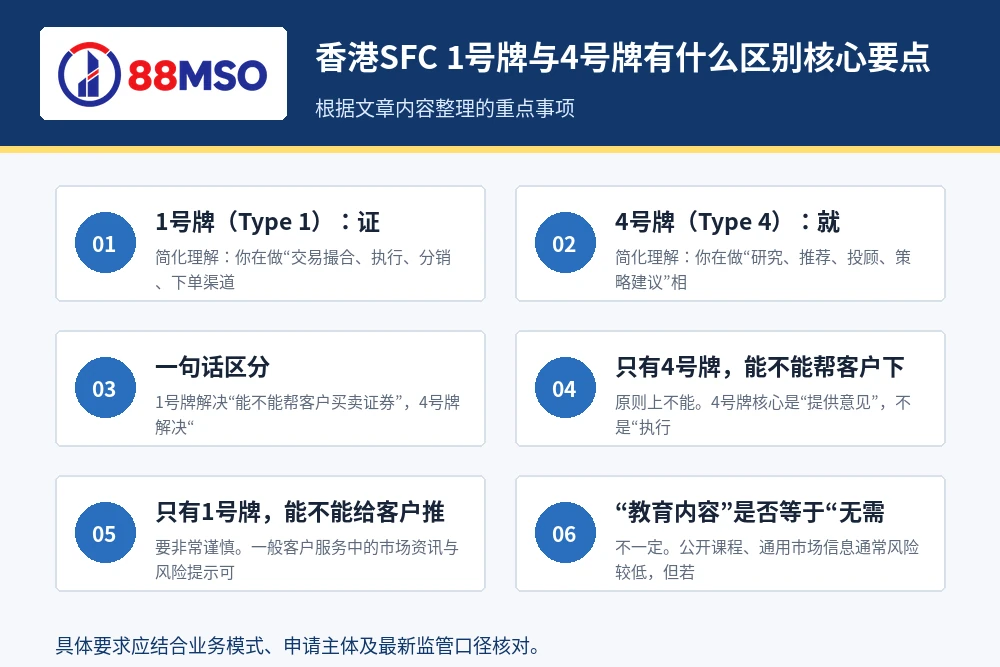
Simplify understanding:You're doing "dealmaking"、implement、Distribution、"Order Channel" related activities,There is a high probability that it involves plate No. 1。
- Accept and execute customer orders to buy and sell securities;
- Securities brokerage business、Trading platform related brokerage functions;
- Securities placement、Distribution、Underwriting related activities (other licenses may be superimposed depending on the specific structure);
- Arrange securities trading on behalf of clients。
keywords:implement、trade、Broker、Distribution。
Type 4:Advising on Securities
Simplify understanding:You are doing "research"、recommend、investment advisory、“Strategic Suggestions” related activities,There is a high probability that plate No. 4 is involved。
- Provide securities investment advice to clients;
- Publish research reports、Individual stock or portfolio views;
- Providing investment advisory services (not just educational information);
- Charge consulting fees、Consulting fees and forming an ongoing investment advisory relationship。
keywords:suggestion、Research、point of view、investment advisory。
One sentence to distinguish
No. 1 plate solves "Can you help customers buy and sell securities?",No. 4 addresses "Can you provide clients with securities investment advice?"。If your business model covers both “advice + execution”,Often requires a double deck or structured arrangement。
two、Full analysis of business boundaries:Which behaviors are most likely to “step over the line”?
1. Only number 4,Can you help customers place orders?
In principle, no。The core of No. 4 is “providing opinions”,Not “Execute Transactions”。If you take orders directly during the investment advisory process、transfer order、Valet execution,May trigger the regulatory scope of No. 1 plate。
2. Only No. 1 plate,Can you recommend specific stocks to clients?
be very cautious。Market information and risk warnings in general customer service can be,But if it formsPersonalized investment advice、Clarify buy-sell ratings or ongoing advisory relationship,Usually involves plate number 4 activities。
3. Does "educational content" mean "no No. 4 plate required"?
uncertain。Open courses、General market information is generally lower risk,But if the content is targeted、Enforceability、and bound to paid services,Activities that may be considered investment advice for regulatory purposes。
4. The most common risks of cross-border online platforms
- Write "for reference only" on the front end,In the background, there are consultant managers who recommend stocks one-to-one;
- Nominally an information platform,Participate in the flow of customer trading instructions in practice;
- Overseas entities provide advice,Hong Kong entities execute transactions,Unclear actual control and compliance responsibilities。
This kind of "functional hybrid" business,This is the part that SFC pays the most attention to during its review。
three、capital requirements:Who is more "capital-eating", No. 1 or No. 4?
Many applicants only focus on the “minimum capital number”,But they ignore what really affects the cost:Whether to hold client assets、Whether self-operated、Whether underwriting is involved、Risk control system complexity、Continued liquidity pressure。
The following is a common understanding framework in practice (specifically based on the latest SFC regulations、Financial resource rules and case approval shall prevail):
1. Capital pressure on No. 1 plate is usually higher
- If the business model involves customer assets、Trade Execution and Brokerage Activities,Typically requires higher capital and ongoing liquidity management;
- System construction costs are higher:Transaction monitoring、Client funds segregation、Both reconciliation and risk control mechanisms need to be strengthened;
- The complexity of follow-up auditing and reporting is generally higher than that of pure consulting business.。
2. The capital threshold of No. 4 plate is relatively controllable,But “Light capital does not mean low compliance”
- Card No. 4 is usually not centered around executing trades,Capital requirements are more friendly in many models;
- But if the customer scale is large、Suggestions have a wide range of influence,SFC on internal controls、Conflict of Interest Management、Suitability process requirements remain stringent;
- Research and investment advisory records leave traces、Information disclosure、Complaint handling is a high-frequency checkpoint。
3. Practical suggestions:Make a three-dimensional budget of “capital + business + compliance”
It is recommended not to just apply for a one-time budget,And do an operating budget for at least 12-18 months,Include:
- Licensed Corporation Maintenance Costs (Audit、Compliance outsourcing、system、office, etc.);
- RO and core licensed personnel costs;
- Ongoing Capital Adequacy and Stress Test Provisions;
- Additional investment when license scope is expanded。
Four、People and organizational requirements:As long as the RO configuration is not "named"
1. The responsible officer (RO) is the core of approval
Whether it’s number 1 or number 4,RO qualification、Both experience matching and actual ability to perform duties directly affect the approval progress.。SFC focuses on more than just academic qualifications and exams,Pay more attention to whether candidates truly match the business model。
2. Card No. 1 and Card No. 4 have different emphasis on team abilities.
- No.1 plate:More emphasis on transaction process、Enforce compliance、Customer asset processing、Transaction monitoring experience;
- No. 4:More emphasis on research methodology、investment advisory suitability、Information Disclosure and Conflict of Interest Management。
3. Common reasons for rejection or replacement
- RO resume does not match the declared business;
- The compliance manual is heavily templated,Does not reflect real business processes;
- The group structure is complex but the boundaries of responsibilities are unclear;
- Insufficient separation of responsibilities between front, middle and back offices,Form "Fan Review and Approval"、Executed by the same person”。
five、Application strategy:Should I choose single card or double card?
Scene A:You are a pure investment advisory/research institution
Prioritize plate number 4,Focus on “advice services” and consultant charging models,Deepen the compliance process first,Re-evaluate whether to expand execution capabilities。
Scenario B:You are a brokerage or trading platform guide
Prioritize plate number 1,and plan the handling of customer assets in advance、Transaction risk control and system audit requirements。
Scene C:You want to do a "consultant + execution" closed loop
Usually the No. 1 + No. 4 combination should be evaluated。Double license is not just "one more license",It means a more complete governance structure and compliance system,Need to unify the design from day one。
Scene D:A staged path that starts with lightness and then heavyness
Many companies will first enter the market with the No. 4 license plate,Validate customer needs and consultant model,Expand No. 1 plate to build trading capabilities。This path is more friendly to financial pressure,It also facilitates the organization to gradually mature.。
six、Common misunderstandings:Seems cost effective,In fact, the cost is higher
- Myth 1:"Get a cheap license first,Let’s start the business first and then talk about it。”
If the actual operation exceeds the scope of,Subsequent rectification costs、Legal risks and brand loss are often much higher than upfront compliance investments。 - Myth 2:"RO can be loaned out,Pass batch first and then adjust。”
Supervision pays more attention to real governance and continuous performance of duties,Formal arrangements are extremely risky。 - Myth 3:“You can find a template of the compliance manual online.。”
Templates can only be used for reference,Must map your own customer journey、Charging method、Risk control process and complaint mechanism。 - Myth 4:“It’s over once you get the license.。”
The real challenge is after obtaining the license:annual review、Continuous reporting、training、Transaction monitoring、Internal review is indispensable。
seven、How to improve pass rate? A practical checklist for business managers
1. Make a “business map” first and then decide on the license combination
Transform your customer touch points from customer acquisition、Sign a contract、suggestion、Place an order、The fee will be charged until the after-sales service is completed.,Then correspond to the types of regulatory activities one by one。
2. Tie capital planning to business plan
Don’t “get the license first and then finance”,Instead, compliant operating cash flow should be reserved in the business model.,Avoid capital pressure affecting the pace of expansion after obtaining the license。
3. Build a three-piece compliance set in advance
- KYC/Appropriateness Process;
- Conflict of Interest and Information Disclosure Mechanism;
- Traces and Internal Control Systems。
4. Choose a consulting team with practical experience
For most cross-border teams,The key is not “whether you can submit an application”,And in "Can we explain the business-capital-organization-documents clearly at once?"。A service team like 88MSO and the 88MSO behind it that has been deeply involved in the implementation of financial compliance in Hong Kong for a long time,The value lies in converting complex regulatory language into enforceable licensing paths,Reduce the risk of repeated parts replacement and mismatching。
Conclusion:The correct choice between plate No. 1 and plate No. 4,The essence is compliance mapping of business models
The relationship between Hong Kong SFC No. 1 and No. 4 is not "who is more advanced",Rather, it serves different regulatory activities:A partial trade execution,A partial investment suggestion。A truly professional approach,It’s not about blindly pursuing “getting more cards”,But let the license plate boundary、capital structure、Personnel capabilities are highly consistent with business paths。
If you are in the licensing planning period,It is recommended to complete it as soon as possible:
- Sorting out business boundaries;
- Capital and Cash Flow Calculation;
- RO and core position matching assessment;
- Estimated maintenance costs after licensing。
Put these tasks ahead,You can not only improve application efficiency,It can truly achieve "stable operation" after obtaining the license.,Achieve long-term sustainable growth of financial business in Hong Kong and overseas。
FAQ:4 issues that management is most concerned about
Q1:Only online investment advisory content,Do you need number 4 plate?
If the content has clear investment advice attributes、Aimed at specific customers and constitutes a fee-based service,Usually it is necessary to evaluate the No. 4 plate requirements。
Q2:Is license number 1 necessarily more difficult to apply for than license number 4?
usually in capital、System and execution compliance requirements are more stringent,But the difficulty still depends on your business model and team maturity。
Q3:You can apply for No. 4 license first,Add number 1?
Can,This is a phased approach adopted by many organizations,However, space for organizational and system upgrades should be reserved in the early stage.。
Q4:What is most likely to be ignored after getting a card?
Ongoing compliance maintenance。Including annual review、Submit、staff training、Monitoring footprints and internal reviews,Missing any link may amplify regulatory risks。
Application documents should explain how the business actually operates
When preparing for the difference between Hong Kong SFC No. 1 and No. 4 plates,The business plan should not only list the license name。The source of customers should be explained item by item、Products and transaction processes、Whether to hold client assets、Order placement and valuation arrangements、Outsourcing services、Conflict of interest handling and abnormal incident reporting path,and let the organizational structure、Personnel biographies and financial forecasts match each other。
The responsibilities of responsible personnel and core functional managers need to be implemented in daily decision-making and supervision records。Financial resources must continue to be monitored after being licensed、personnel changes、Business scope、Client Assets and Regulatory Reporting;Acquiring a licensed company does not mean that the license is automatically and unconditionally transferred with the transaction.,Changes in control and key personnel should be checked against notification or approval requirements。
Industry references:Hong Kong Securities and Futures Commission:Licensing Manual。
Read more:Acquisition by Hong Kong SFC licensed company:RO remains in office、The whole process of client asset transfer and China Securities Regulatory Commission approval、Hong Kong SFC responsible officer (RO) configuration:Key points for recruitment and qualification review of licensed institutions。