 简体中文
简体中文 繁體中文
繁體中文 English
US Company Registration (LLC vs C-Corp):Why is this the most critical first step for cross-border businesses?
For many Chinese companies planning to “go overseas to the United States”,US company registrationLooks like just an executive action:Choose a state、Pay a fee、Get a registration certificate。But after it actually landed,Businesses will soon discover:Once you choose the wrong company type,Subsequent tax costs、Financing efficiency、Difficulty of opening a bank account、Compliance pressure may be amplified。
Especially in cross-border scenarios,LLC and C-Corp are not a simple battle of “flexible vs. formal”,but involvestax penetration rules、withholding tax、Treaties apply、Profit distribution path、Future financing and exit strategiessystem engineering。For teams deploying business in Hong Kong and the United States at the same time,This issue needs to be judged from the perspective of global architecture.,Rather than just looking at “which registration is cheaper?”。

This article will take a practical perspective,An in-depth comparison of the core differences between LLC and C-Corp,And combined with common registration states (such as Delaware、Wyoming、Texas、Florida、California、New York) to compare fees and maintenance costs,Help you make more secure cross-border decisions。
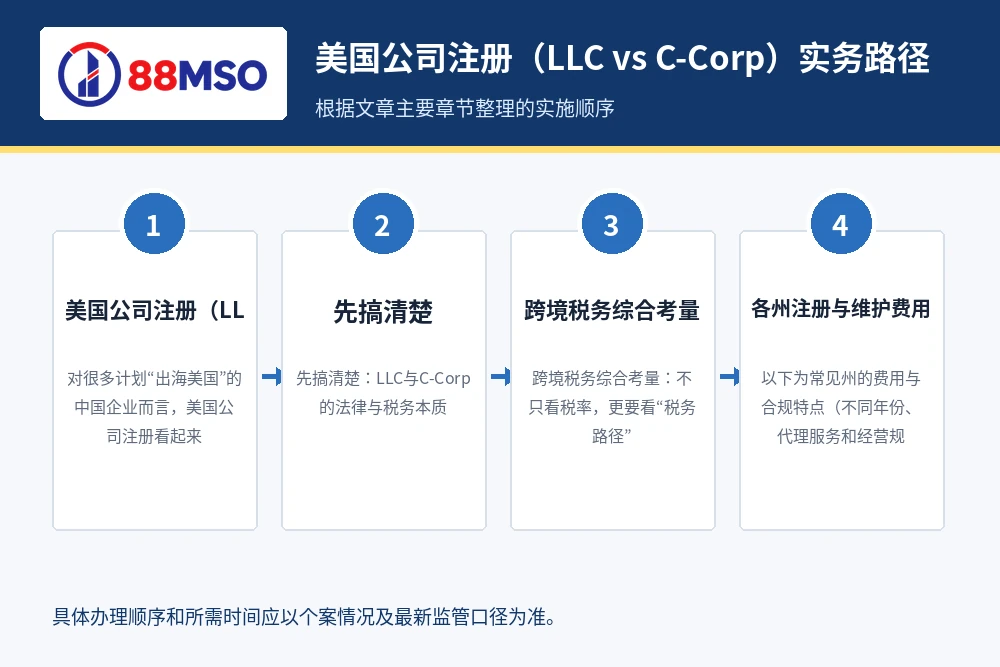
one、Find out first:The legal and tax nature of LLC and C-Corp
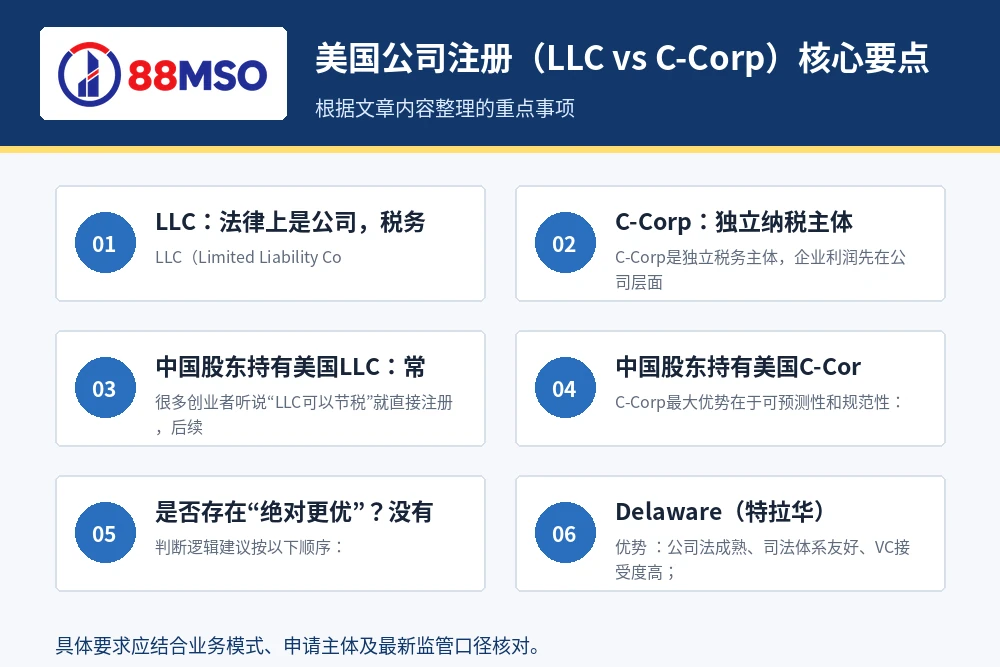
1)LLC:Legally a company,Can be "penetrated" for tax purposes
LLC (Limited Liability Company) has limited liability protection in terms of legal liability,However, it is generally regarded as a "Pass-through Entity" for U.S. federal tax purposes.:
- Single-member LLC is treated as "ignore entity" by default,Profits are taxed to the owner;
- Multi-member LLCs are treated as partnerships by default,Profits distributed to members taxed;
- You can also choose to be taxed as a company (check-the-box election)。
For non-U.S. tax resident shareholders,LLC “penetration” is not necessarily a good thing。Because this may trigger more complex U.S. tax filing obligations、Withholding tax processing and documentation filing requirements (such as K-1、1040NR/1120-F, etc. depending on the situation)。
2)C-Corp:independent tax entity,Typical "double taxation" structure
C-Corp is an independent tax entity,Corporate profits are first subject to federal (and state) corporate income tax at the corporate level.,Shareholders pay taxes when dividends are distributed to shareholders,Therefore it is often called "double taxation"。
- advantage:Clear legal and tax boundaries,Financing、options、Equity incentives、M&A path mature;
- shortcoming:If dividends are paid frequently,The overall tax burden may be higher than that of some LLC situations。
But in a cross-border structure,C-Corps tend to be more “standardized”,Especially when the company plans to introduce institutional investors、Develop local financing in the United States、or a future IPO,C-Corps are generally more accepted by the market。
two、Comprehensive consideration of cross-border taxation:Don’t just look at tax rates,Pay more attention to the "tax path"
1) Chinese shareholders hold U.S. LLCs:Common tax complexities
Many entrepreneurs register directly after hearing that “LLC can save taxes”,Later, I discovered that cross-border tax filing and tax collection have become very complicated.。Core risks include:
- Penetration taxation leads to increased tax filing obligations for individuals or overseas entities;
- Difficulty in connecting with China’s tax system,Recognition of overseas income and tax exemption arrangements are complicated;
- If there is effective U.S. connected income (ECI),May incur higher compliance costs;
- Differences between accounting standards and tax standards,Impact on auditing and capital repatriation。
therefore,LLC is not the “all-purpose solution to low taxes”。It is more suitable for simple business structures、Stable shareholder structure、And a team that can continue to cooperate with U.S. tax filings。
2) Chinese shareholders hold U.S. C-Corps:Tax burden is predictable,More standardized governance
The biggest advantage of C-Corp is predictability and standardization:
- Relatively standard company-level tax calculations,Facilitates the construction of budgets and financial models;
- The external financing document system is mature (Articles of Association、board governance、Preferred stock mechanism, etc.);
- bank、payment institution、Partners are more likely to be understood and accepted during due diligence。
If the business goal is to "operate first、post financing、Expand again”,C-Corps typically have longer-term strategic fit。
3) Is there an "absolute better"? No,Only “more consistent with your goals”
The judgment logic is recommended in the following order:
- first floor:Will we raise funds or issue options in the next three years?
- second floor:Are profits mainly reinvested or are dividends distributed frequently?
- third floor:Are shareholders willing to take on more complex personal/penetrating tax returns?
- fourth floor:Whether with a Hong Kong company、Offshore entities form a multi-layered structure?
In the joint layout of Hong Kong and the United States,Proposal to align U.S. entity selection with Hong Kong license、Capital flow design、Evaluate bank account strategies together,Avoid "U.S.A. Choose LLC to Save Registration Fees",But it adds long-term costs to global taxes.”。
three、Comparison of registration and maintenance fees by state (Practical version)
The following are fee and compliance characteristics of common states (different years、Agency services and business scale will change,The following is a directional comparison):
1) Delaware
- Advantages:Corporate law matures、friendly judicial system、VC acceptance is high;
- LLC costs:The annual fee is relatively fixed (Franchise Tax for LLC);
- C-Corp Costs:There are various ways to calculate franchise tax,May rise if capital structure is complex;
- Suitable:Financing orientation、Planning M&A/IPO team。
2) Wyoming
- Advantages:Low annual fee、Privacy friendly、Easy maintenance;
- LLC:Often used as a low-cost holding/operation vehicle;
- challenge:If actually operating in another state,Still need to register out of state and pay local taxes and fees;
- Suitable:cost sensitive、Early testing business。
3) Texas
- Advantages:No state personal income tax,Active business environment;
- Notice:There are state-level franchise tax rules (payment only after thresholds are met),But still need to declare);
- Suitable:Operated in the United States、An enterprise with personnel and customer layout。
4) Florida
- Advantages:No state personal income tax,Moderate registration and maintenance costs;
- C-Corp:State corporate tax exists;
- Suitable:E-commerce、Service type、Cross-border trade enterprises。
5) California
- Features:Big market,However, compliance costs are generally higher;
- LLC:The minimum tax and additional fee mechanism is not friendly enough to small teams;
- Suitable:Must be deeply involved in California customers/teams,Enterprises with sufficient budget。
6) New York (New York)
- Features:Strong financial ecosystem、Regulatory requirements are more detailed;
- LLC:There are special publication requirements (publication requirement);
- Suitable:finance、Professional services、Brand internationalization-oriented enterprise。
summary:Don’t just look at the “registration fee”,Depends on “Total Cost of Ownership (TCO)”
The total cost should include:Registration fee、annual fee、state tax、agent fees、Accounting and tax service fees、Out-of-state business registration costs、Bank compliance maintenance costs。Many companies underestimate the follow-up compliance budget at this step.,Leading to "cost distortion" starting in the second year。
Four、LLC vs C-Corp:Provide decision-making suggestions according to enterprise stages
Stage A:Test the US market (0-12 months)
If the business model is not yet stable、Small transaction volume、No short-term financing,LLC may be considered,But please confirm in advance:
- Can you afford the complexity of penetrating tax returns?;
- Is there ongoing support from a professional tax team?;
- Future tax and legal costs of converting to a C-Corp。
Stage B:Prepare for financing and team expansion (12-36 months)
If the goal is to raise funds、Introduce option pool、Improving the valuation narrative,C-Corps are usually better。A common preference among investors is Delaware C-Corp,This can reduce terms communication and legal friction costs。
Stage C:Cross-border group operations (United States + Hong Kong + other offshore locations)
this stage,The focus is no longer on a single entity,RatherGroup tax efficiency + regulatory explainability。It is recommended to consider simultaneously:
- Transaction Pricing and Segregation of Functions between U.S. Entities and Hong Kong Entities;
- Intellectual property rights holding place and revenue recognition path;
- Profit repatriation and reinvestment arrangements;
- KYC/AML supporting documents for bank accounts and payment channels。
This is why many companies choose to be coordinated and promoted by a team familiar with Hong Kong’s financial compliance and cross-border structures.。For example, 88MSO and its 88MSO consulting team are licensed in Hong Kong、Compliance governance and cross-border implementation experience,It can help companies put “U.S. registration decisions” into a more complete international compliance framework for evaluation.,Reduce subsequent rework。
five、Common misunderstandings:90% of overseas teams have stepped on it
- Myth 1:LLC is definitely more tax efficient than C-Corp
fact:in cross-border situations,LLCs may increase individual-level filing and overall tax uncertainty。 - Myth 2:It doesn’t matter which state you register in.
fact:If actually operating in another state,Out-of-state registration and tax obligations cannot be avoided。 - Myth 3:Register first and then talk,Change later
fact:Structural reorganization incurs legal and tax costs,Even affect the financing window。 - Myth 4:Only looking for registered agents,No tax rehearsal
fact:Registration decisions without tax models,Often "save a little money"、Spend big money”。
six、Practical Checklist:10 pieces of information you must prepare before registering
- 1. Forecast of income sources in the next three years (U.S./non-U.S. proportion)
- 2. Expected profit distribution strategy (dividend or reinvestment)
- 3. Shareholders’ tax residence status and shareholding structure
- 4. Whether you plan to raise funds (angel/VC/M&A)
- 5. Whether to set up an employee option pool
- 6. Actual operating states and customer distribution
- 7. Bank account opening and payment channel requirements
- 8. Accounting standards and auditing requirements
- 9. Transaction routes with Hong Kong/offshore entities
- 10. Annual Compliance Budget Cap
Conclusion:Company type is not a matter of preference,But a "strategic question"
US company registration in progress,LLC and C-Corp are not absolutely good or bad,Only if it is relevant to your business goals、Matching tax affordability and financing paths。A truly professional approach,It is necessary to know the law before registration、tax、bank compliance、Cross-border capital flows are deduced in the same picture。
If you are planning a "Hong Kong + United States" dual market layout,It is recommended to conduct cross-border compliance and tax linkage assessment as soon as possible。compared to post-patch,Front-end design often significantly reduces long-term costs and regulatory risks。For companies that want to steadily move towards internationalization,This step often determines the upper limit of operational efficiency in the next three to five years.。
FAQ:Quick answers to frequently asked questions
Q1:I am the founder of China,Going global with SaaS,Choose LLC or C-Corp?
If there is a financing plan within 12-24 months,Prioritize Delaware C-Corp;If it is only a small-scale test market and there is no financing arrangement,Assessable LLC,However, cross-border tax declaration planning must be done in advance。
Q2:Can I operate nationwide without paying fees in other states by registering in Wyoming?
Can't。If you have “substantial operations” (employees) in another state、office、Continuous trading),Usually requires local out-of-state registration and tax obligations。
Q3:Is C-Corp double taxation necessarily uneconomical?
uncertain。If profits are mainly used for reinvestment、And companies attach great importance to financing and compliance standardization,The overall strategic value of a C-Corp is often greater than the short-term tax differential。
Q4:Can I change my LLC to a C-Corp in the future?
Can,However, it will involve legal restructuring and potential tax implications.,Cost and complexity are high,It is recommended to plan the route before registering.。
Align the documents with the actual arrangements before submission
When applying for US company registration (LLC vs C-Corp),Plan the business first、Equity and management arrangements written as a one-page checklist,Then correspond to the regulations item by item、Proof of identity of shareholders and directors、Proof of registered address and authorization documents。If name spelling appears between files、address、Inconsistent investment methods or signing authority,It is usually easier to cause a fill-in than a missing attachment。
Overseas investors should also confirm in advance whether the documents require notarization、Certification or translation,and open an account、capital remittance、Tax registration and employment arrangements integrated into the same schedule。branch、Subsidiaries and offices have different legal responsibilities and business capabilities.,You cannot choose based on the establishment price alone。
Industry references:U.S. Small Business Administration Business Registration Guide。
Read more:How to choose the type of company in Taiwan? Ltd.、Co., Ltd.、Comparison between branches and offices、How long does it take to set up a Taiwan company? Legal person application information、Processing steps and timetable。