 简体中文
简体中文 繁體中文
繁體中文 English

What are NRA and FTN accounts? Why mainland companies must first understand
Today, when companies “going overseas” have become the norm,,More and more mainland companies are beginning to face the same real problem:How to hold it legally、Receipt, payment and transfer of foreign currency funds。in cross-border trade、overseas supply chain、overseas investment、In business scenarios such as international settlement,NRA accountand FTN accounts are often mentioned together,However, many business managers do not fully understand the two,Even treat them as "the same kind of offshore account"。
in fact,NRA and FTN not only have different account opening paths,,regulatory logic、Available banks、Usage of funds、Tax penetration and subsequent compliance management requirementsThere are obvious differences。Wrong account type selected,At least it affects business efficiency,In severe cases, the account may be frozen.、Fund refund、Due diligence failed,Even included in the high-risk monitoring list。

This article will take a practical perspective,The system explains clearly the core differences between NRA and FTN accounts、Applicable corporate portrait、Account opening materials、Supervision points and risk control strategies,And combines Hong Kong and overseas account coordination solutions,Help enterprises establish a sustainable foreign currency capital management framework。
Basic definitions of NRA accounts and FTN accounts
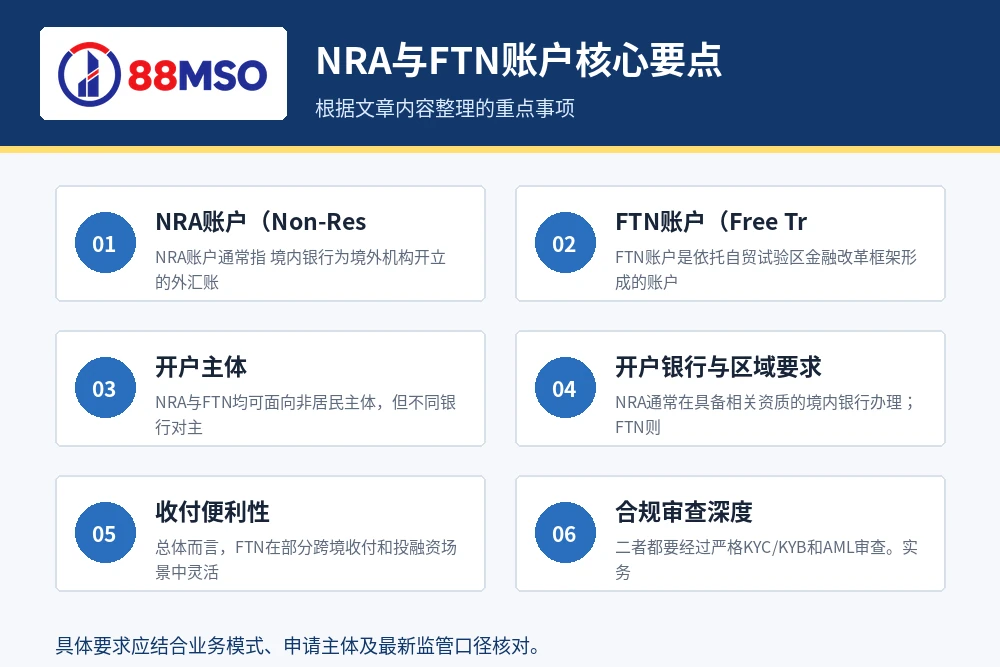
1) What is an NRA account (Non-Resident Account)?
NRA accounts usually refer toForeign exchange accounts opened by domestic banks for overseas institutions。The "overseas institutions" here include companies legally incorporated overseas.、foundation or other organization。in other words,If the company passes a Hong Kong company、Singapore company、BVI companies, etc. as trading or investment entities,You can apply for an NRA account from a domestic bank when you meet the conditions.,Used for receipt and payment of foreign currency funds。
- core attributes:The account is opened within the domestic banking system,But the account subject is an overseas legal person。
- Common uses:Payment settlement、Service fee collection and payment、Domestic and overseas supply chain payment coordination。
- Compliance Focus:Authentic trade background、The use of funds can be traced、Anti-Money Laundering and Sanctions Screening。
2) What is an FTN account (Free Trade Non-resident)?
The FTN account is an account system formed based on the financial reform framework of the Pilot Free Trade Zone.,Commonly found in some banks with relevant business qualifications。It provides domestic and foreign currency fund management and settlement services to non-resident institutions.,Emphasis on cross-border facilitation under the free trade account system。
- core attributes:Operate within the framework of free trade financial rules,Settlement, investment and financing are generally more convenient。
- Common uses:cross-border trade、Investment and Financing、Group capital pool、Global payment hub。
- Compliance Focus:Business substance、Counterparty transparency、Fund closed loop and penetration verification。
Key Differences between NRA and FTN:The 7 dimensions that companies care about most
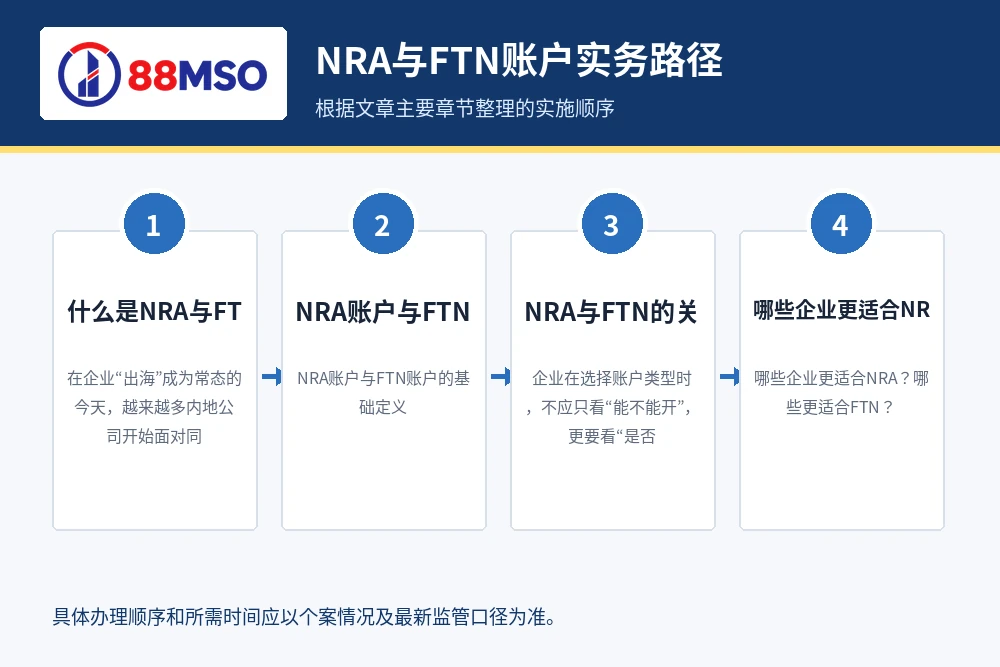
When companies choose account types,Don’t just look at “whether it can be opened”,It also depends on “whether it is suitable for future business paths”。The following are the most critical comparisons in practice:
1) Account opening entity
Both NRA and FTN are available to non-resident entities,However, different banks have different opinions on the type of entity (trading company).、holding company、SPV、Fund platforms) have different acceptance levels。If a company only has an "empty shell structure" but no real operations,The success rate of account opening will drop significantly。
2) Account opening bank and regional requirements
NRA is usually processed at domestic banks with relevant qualifications;FTN is related to the free trade account system,Accepted bank branches、Policy caliber and internal risk control model have greater impact。Different banks have different sensitivities to industries such as crypto、Gambling links、Military-industrial dual-purpose trade) differences are obvious。
3) Convenience of payment
overall,FTN is more flexible in some cross-border collection and payment and investment and financing scenarios;NRA is more mature in traditional trade settlement。Enterprises should base their settlement frequency on、Match currency complexity and payment cycle。
4) Depth of compliance review
Both are subject to strict KYC/KYB and AML review。In practice,Banks pay more attention to:
- Is the ultimate beneficiary (UBO) clear?;
- Whether the transaction link has a complete contract、bill、Bill of lading or proof of service delivery;
- Whether high-risk countries/regions or sanctioned entities are involved;
- Is the historical capital trajectory consistent with the declared business scope?。
5) Linkage methods with domestic entities
Many companies have both domestic operating companies and overseas payment entities.。Fund transactions between NRA and FTN and domestic accounts、Documentation requirements、There will be different execution standards for use review,The process needs to be designed before opening an account。
6) Tax and audit collaboration
Offshore accounts are not a “tax vacuum zone”。Whether NRA or FTN,All must cooperate with the company's overall tax compliance (transfer pricing、Related party transactions、Cost aggregation、profit distribution) and annual audit disclosures。
7) Long-term maintenance costs
Many companies only focus on opening accounts,Not paying attention to follow-up maintenance。actually,Account maintenance includes annual review updates、Transaction spot check response、Material replacement、Risk control review, etc.,The long-term costs may be much higher than the one-time account opening fee。
Which businesses are more suitable for NRA? Which ones are more suitable for FTN?
A corporate portrait more suitable for the NRA
- Mainly traditional goods trade,The settlement link is relatively stable;
- Order、logistics、customs clearance、Documents are more complete,Facilitate proof of trade authenticity;
- Hope to build domestic and overseas foreign currency collection and payment channels in a more stable way。
A corporate portrait more suitable for FTN
- Cross-border business structure is more complex,Involving multi-regional collection and payment or investment and financing;
- Group operation,Need for higher capital allocation efficiency;
- Have clear global treasury management needs,Such as regional clearing center。
Practical suggestions:If the enterprise is in the transformation stage of "from single trade to diversified cross-border financial management",Step-by-step path to assess “NRA + Hong Kong Account + FTN Reservation”,to reduce the risk of one-time switching。
Compliance procedures for mainland enterprises to open foreign currency offshore accounts (practical version)
first step:Clarify business essence and funding path
Answer three questions first:where does the money come from、where to flow、What transaction does it correspond to?。Enterprises should draw a consistent diagram of the three flows of "capital flow + contract flow + logistics/service flow",As the underlying material for account opening due diligence。
Step 2:Build a compliance main structure
A common structure is "domestic operating company + Hong Kong/overseas trading or holding company"。But the architecture must serve the business,Rather than "looking offshore"。If there is no substantial functional division of labor,Banks will consider it high risk。
Step 3:Prepare the account opening information package (not just hand over the business license)
High pass rate packets typically include:
- Overseas company registration documents、Register of Directors and Shareholders、Charter documents;
- UBO ID card、Proof of address、Resume and funding source description;
- business contract、Invoice sample、Upstream and downstream lists、History;
- Official website、Product introduction、Business model description、Organization chart;
- Estimated annual transaction size、Main currencies、Description of key countries and regions。
Step 4:Communicate with the bank in advance
It is recommended to conduct "bank pre-review communication" before formal submission。Different banks versus industries、nation、Different currency preferences,Match first and then apply,Can significantly reduce the probability of rejection。
Step 5:Interview and due diligence questions and answers
Frequently asked questions during the interview include:Why do you need an offshore account? Relationship with domestic companies? Where are the main customers? Why use this currency? What is the logic of profit retention and distribution? It is recommended to prepare the same caliber in Chinese and English,avoid inconsistencies。
Step 6:Establish a "continuous compliance mechanism" after opening an account
Successful account opening is not the end。Enterprises should establish:
- transaction trace system:Each fund corresponds to a complete business document;
- High-risk transaction warning:Abnormal amount、unusual opponent、Report abnormal areas promptly;
- Annual review mechanism:Account purpose、Review of consistency between transaction structure and actual business。
High-frequency compliance risks and pitfall avoidance list
Risk one:Treat offshore accounts as "channel accounts"
Post only、Not operating,It is one of the most sensitive activities of banks。Accounts must carry real business logic。
Risk two:UBO disclosure is incomplete
Multi-level equity does not mean that the person who controls the shares can be obscured。Penetrating disclosure has become the norm,Opaque structures can easily trigger enhanced due diligence。
Risk three:The counterparty’s “unclear background”
Basic sanctions screening and commercial verification should be done before dealing with new customers,Avoid being implicated in your corporate account due to counterparty risk。
Risk four:Document chain broken
The contract has、The invoice has,But there is no evidence of logistics or service delivery,Often considered insufficient evidence。Cross-border service businesses must pay special attention to delivery traces。
Risk five:Ignoring the linkage between Hong Kong and overseas supervision
If the company simultaneously uses a Hong Kong account、Hong Kong licensed entity or overseas payment channel,Should be managed according to unified compliance standards,Avoid "one caliber and multiple sets of statements"。
Why do many companies use NRA/FTN in conjunction with Hong Kong accounts?
From the perspective of cross-border capital efficiency,Hong Kong remains one of the most important international financial hubs for mainland enterprises。Reasonable collaboration can achieve:
- Optimization of multi-currency receipt, payment and exchange efficiency;
- Hierarchical management of trade settlement and investment and financing funds;
- Improve account acceptance when connecting with overseas customers。
But the premise for collaboration isConsistent compliance across the entire link:Account opening information、Transaction purpose、tax treatment、Audit disclosures must be mutually verified。Professional teams like 88MSO that have long been involved in Hong Kong’s financial compliance and cross-border account practices,Usually in the early stage of architectural design、Provide systematic support for bank communication and follow-up maintenance,Help enterprises avoid detours,Especially suitable for growing companies that are building an international payment system for the first time.。
FAQs that business leaders are most concerned about
Q1:Can NRA and FTN be opened at the same time?
Can,But there must be a reasonable business purpose。If it is just repeated opening、No clear division of labor,On the contrary, it increases the burden of risk control。It is recommended to divide the purposes according to the logic of "trade settlement account + fund management account"。
Q2:Can I open one without an overseas company?
Usually requires the participation of overseas entities。If the company has not yet established an overseas structure,The place of registration should be assessed first、tax implications、Follow-up audit costs,Then decide the path。
Q3:How long does it usually take to open an account?
depends on bank、Industry risk levels and material integrity。Efficiency will be significantly improved when you are well prepared;If complex equity or high-risk areas are involved,The cycle will be extended。
Q4:Can I apply again after being rejected once?
Can,However, you should first review the reasons for rejection (material issues、Industry policy、Transaction structure is unclear, etc.),After correction, match a more appropriate banking strategy。
Q5:Not used much after opening the account,Will there be any problems?
Long-term low activity or "sudden large transactions" may trigger a review。It is recommended to maintain a normal trading rhythm consistent with the declared business scale。
Conclusion:Do compliance design first,Do the account landing again,is a long-term feasible solution
NRA vs. FTN is not a question of "who is more senior?",RatherWho is more suitable for the company's current and future business?question。For mainland enterprises,The core of a foreign currency offshore account is not to open one,But drive steadily、Used for a long time、Pass the trial。truly effective path,It starts from the essence of the business,Complete the architecture、tax、bank、Integrated design of AML and auditing。
When companies regard compliance as the underlying capability for growth,rather than a temporary patch,Cross-border capital efficiency、Customer trust and global resilience will increase simultaneously。Whatever choice NRA、FTN,Or configure it in conjunction with a Hong Kong account?,It is recommended to complete pre-planning and ongoing maintenance with the support of a professional team,Only then can "account opening" be upgraded to "sustainable operation"。
Account opening materials must form a complete chain of financial evidence
FT accounts are divided into five categories:,include:FTE (Free Trade Account for Institutions in the Zone)、FTN (Foreign Institutions Free Trade Account)、FTU (Free Trade Account for Institutions)、FTI (in-zone personal free trade account) and FTF (in-zone and overseas personal free trade account)
When Preparing What is an NRA vs. FTN Account?,Banks usually structure their companies、actual controller、business contract、Customers and Suppliers、Expected trading country、Single and monthly amounts and funding sources are judged together.。website、bill、contract、If the written and verbal instructions conflict with each other,Easily trigger patchwork or enhanced due diligence。
High-risk industries should prepare separate licenses or registration certificates、Anti-Money Laundering System、Customer access criteria、Sanctions Screening and Transaction Monitoring Instructions,and evidence of source of funds and source of wealth for major transactions。Remote account opening does not mean less review;Unexplained collection and payment、Short-term large-amount postings and transactions inconsistent with reported business,You should adjust the process before opening an account。
Industry references:Hong Kong Monetary Authority Anti-Money Laundering and Customer Due Diligence Information。
Read more:How does a cross-border e-commerce (Amazon/independent website) open a public account with CBiBank?、Singapore bank account opening:DBS、Comparison of audit requirements between OCBC and UOB。