 简体中文
简体中文 繁體中文
繁體中文 English

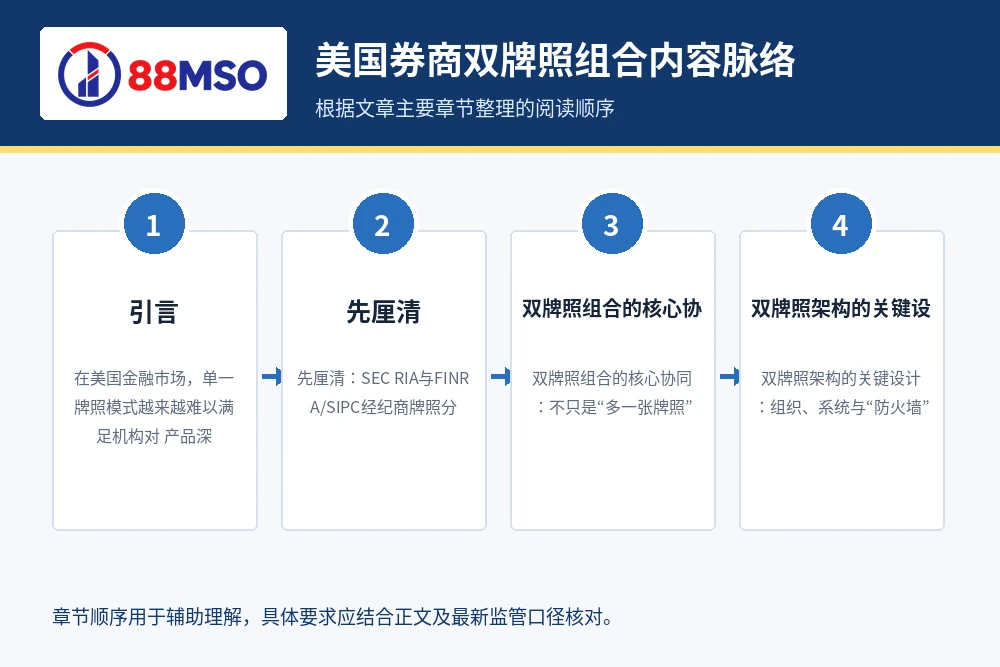
introduction:Why is the “U.S. brokerage dual license combination” becoming the standard for institutions?
Official verification update (August 2026):SIPC is a securities investor protection agency established in accordance with the law.,Membership is not a broker-dealer license。Conducting broker-dealer business typically involves SEC registration、FINRA Membership and Applicable State Requirements;RIA registration is applicable to investment advisory business,The two regulatory paths cannot be combined into a set of "SEC RIA and FINRA/SIPC dual licenses"。 For specific rules, seeU.S. Securities and Exchange Commission Investment Adviser Registration Information。
in U.S. financial markets,It is increasingly difficult for a single license model to meet the needs of institutionsProduct depth、customer experience、Revenue Diversification and Compliance Robustnesscomprehensive requirements。Especially for high net worth clients、Institutions for corporate clients and cross-border investors,It is often necessary to have both "consultant ability" and "executive ability"。This is exactlySEC RIA (Registered Investment Advisor)andFINRA/SIPC Broker LicenseReasons for the rapid rise in portfolio value。
For Asian companies that are planning to expand into the global market,Understanding the mix is not just a business issue,It’s more of a strategic issue:It’s about whether you can access U.S. capital markets with lower compliance friction、How to standardize cross-border customer service,and how to maintain sustainable growth in a high-pressure regulatory environment。
one、First clarify:What problems do SEC RIA and FINRA/SIPC broker licenses solve respectively?
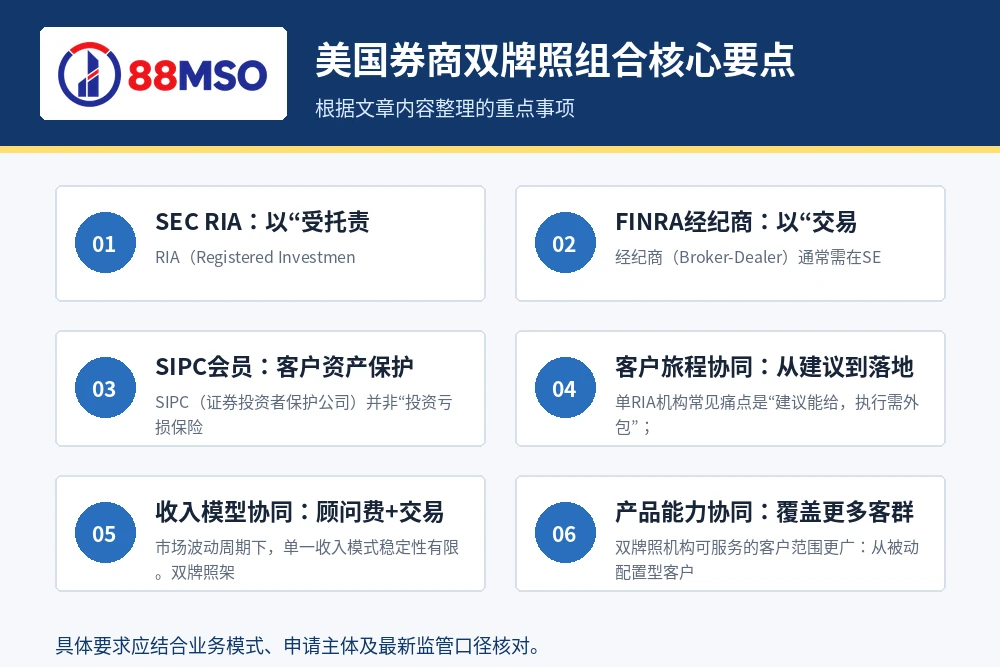
1. SEC RIA:Consulting license with "fiduciary responsibility" as the core
An RIA (Registered Investment Adviser) is regulated by U.S. Securities and Exchange Commission (SEC)and related laws and regulations,The core characteristic is responsibility to customersFiduciary Duty。This means organizations must prioritize client interests,manage conflicts、Full disclosure of fees and risks,Provide appropriate investment advice。
- Typical business:investment advisor、Asset allocation、portfolio management、Fund advisory services、Family wealth planning, etc.。
- income structure:With management fee (AUM fee)、Mainly advisory fee。
- Compliance keywords:ADV Disclosure、Conflict of Interest Management、Compliance Manual、annual review、Consultant conduct supervision。
2. FINRA Broker:With "transaction execution and sales compliance" as the core
Broker-Dealers usually need to register with the SEC and become members of FINRA。Its regulatory focus is on customer account opening、trade execution、sales behavior、market order、Capital adequacy and record keeping etc.。
- Typical business:Securities buying and selling matching、trade execution、Commission services、underwritten offering、Distribution channels, etc.。
- income structure:commission、Spread、Underwriting fee、Distribution service fees, etc.。
- Compliance keywords:Suitability、Reg BI、sales supervision、net capital rules、reporting obligations。
3. SIPC member:An important part of the trust mechanism for customer asset protection
SIPC (Securities Investor Protection Corporation) is not "investment loss insurance",But in the scenario of broker bankruptcy and liquidation,Provide compensation mechanisms within the legal scope for client securities and cash assets。This is critical for building customer trust,Especially for new brands entering the U.S. market。
two、Core synergy of dual license combination:Not just “one more license plate”
1. Customer journey collaboration:Integrated experience from suggestion to implementation
A common pain point for single RIA institutions is “can advice be given to,Execution needs to be outsourced”;A single broker may have “strong transaction execution”,Long-term advisory relationships are weak”。The dual license model can realize process connection under the compliance isolation framework:
- Complete risk assessment on RIA side、Goal planning and portfolio suggestions;
- Complete trade execution on broker side、Order management、Billing and reporting;
- Customers only need to face one brand system,A more complete experience。
2. Revenue model synergy:Optimization of the structure of advisory fees + transaction income
During market fluctuations,Single income model has limited stability。The dual-license structure can balance long-term management fees and transaction-related income under the premise of compliance.,Improve anti-cycle capabilities。at the same time,Institutions can more clearly distinguish between “advisory accounts” and “brokerage accounts”,Provide differentiated charging models based on customer characteristics。
3. Product capability synergy:Cover more customer groups and strategic scenarios
Dual-licensed institutions can serve a wider range of customers:From passive allocation customers to active trading customers,From personal wealth management to corporate cash management and capital markets services。For cross-border institutions,This means that a more complete product matrix can be formed in the United States.,Reduce customer churn rate。
4. Brand and Valuation Synergy:Compliance capabilities translate into capital premiums
In the M&A and financing markets,Institutions with complete regulatory licenses and operating systems usually have higher valuations。Because a license is not only a qualification for admission,more representativeauditable、Copyable、Expandableoperational capabilities。The dual-license model is often more likely to be recognized by institutional investors。
three、Key design of dual-license architecture:organize、System and "Firewall"
1. Legal person structure and business boundaries
in practice,Institutions often adopt the model of "same group, different legal persons" or "same legal person, multiple business lines",But no matter which path,must be clear:
- What types of customer relationships are managed by RIAs?,Which category is managed by the broker?;
- Fee charging basis、Service Agreement and Information Disclosure Attribution;
- conflict identification、Upgrade and resolution mechanism。
2. Division of personnel and functions
Dual licenses are not simply superposition of personnel,Instead, we need to build hierarchical governance:
- front desk:Consulting representative、Registered Representative (RR)、account Manager;
- Middle platform:suitability review、product committee、Transaction monitoring;
- Backstage:Compliance、legal affairs、finance、internal audit、Submission team。
Many institutions underestimate “compliance operating costs” in the early stages of expansion,As a result, business growth is rapid、The imbalance of slow regulatory preparedness。The sooner you establish a responsibility matrix,It will be easier to scale later。
3. Systems and Data Governance
Dual-licensed institutions must avoid compliance risks caused by "system fragmentation"。At least the following capabilities should be achieved:
- Unified base for KYC and risk rating;
- Consultant advice、Customer instructions、Traces of the entire transaction execution process;
- Expenses accrued、Commission Disclosure、Conflict disclosure is traceable;
- Linkage of abnormal transactions and AML warning。
Four、Regulatory focus:Six compliance issues that are most likely to be tripped up
1. "Consulting services" and "brokerage services" are confused
Many institutions overemphasize “all-in-one services” on the marketing side,But ignore the legal identity switch。Regulators are concerned about:In what capacity do you serve customers at a certain point in time? What is the basis for charging? Is it fully disclosed?
2. Insufficient fee transparency
In a dual license environment,Consulting fee、Transaction commission、Platform fees、Product distribution gains may co-exist。If the level of disclosure is unclear,Highly susceptible to complaints and regulatory inquiries。
3. Appropriateness inconsistent with Reg BI implementation
Recommended behaviors in brokerage business need to meet Reg BI and related appropriateness requirements,Don’t just “reuse the conclusions” just because the customer has completed the questionnaire on the RIA side.。Systems must be connected,There must also be boundaries。
4. AML/KYC framework fragmentation
Cross-border customers often involve complex capital paths and identities in multiple jurisdictions。If the RIA and the broker each do a set of KYC,Customer portrait conflicts are prone to occur、Monitoring thresholds are inconsistent、Delay in reporting suspicious transactions。create an integratedAnti-Money Laundering AML and KYC Due Diligencemechanism,It is a chassis for long-term stable operation with dual license plates.。
5. Incomplete record keeping and audit chain
During regulatory inspection,What I fear the most is “I can tell you clearly but I can’t provide any evidence.”。It is recommended to adapt to customers、Suggestion basis、Trading instructions、Fee collection、Establish an auditable file system for complaint handling。
6. Cross-border marketing triggers additional regulatory obligations
When an organization promotes to customers in non-U.S. regions,May involve local financial marketing、Data compliance、Tax disclosure and other rules。Cross-border institutions must simultaneously evaluate the dual constraints of “US rules + customer location rules”。
five、Practical implications for Chinese and Asian institutions:How to open the "US + Global" channel with dual licenses?
For people who want to serve overseas Chinese、high net worth family、For organizations that are cross-border business owners,The dual license model has three strategic values:
- First,Improve customer trust:Consultancy and execution capabilities coexist,And there is a SIPC protection framework,Customers are more likely to build long-term relationships。
- second,Improve business portability:Shift from single point product sales to ongoing advisory services,Higher customer lifetime value。
- third,Improve global layout efficiency:After the U.S.-side compliance structure matures,Easier to connect with Hong Kong、Singapore、Offshore entities form collaborative network。
This is why more and more organizations are planning U.S. license plates.,No longer look at "getting a certificate" in isolation,Rather, it should be integrated into the overall international landscape to coordinate the design.。Judging from the experience of 88MSO and the professional team behind it that have been deeply involved in overseas financial compliance for a long time,What really determines success or failure is often not “whether or not you get a license.”,It’s about “can it last after you get it?”、Safety、Can be operated at scale”。
six、Implementation road map:Build SEC RIA+FINRA/SIPC capabilities from 0 to 1
Stage 1:Strategic positioning and business model definition
- Define target customer groups (retail/high net worth/institutional);
- Define core revenue sources and cost structure;
- Determine the boundaries between RIA and brokerage business。
Stage 2:License path and physical structure construction
- Evaluate SEC/state level registration requirements;
- Prepare FINRA membership application materials and capital arrangements;
- Design associated entities、Holding structure and tax coordination。
Stage 3:Institution and system construction
- Prepare compliance manual、Supervisory procedures、Complaint mechanism;
- Deploy KYC/AML、Transaction monitoring and record keeping system;
- Create employee training、Code of Conduct and Accountability Mechanism。
Stage 4:Trial operation and continuous optimization
- Pass a small-scale customer pilot verification process;
- Conduct regular internal compliance inspections;
- Update disclosures and processes based on regulatory developments。
seven、FAQ
Q1:Only RIA license,Can it fully serve customers’ investment needs?
Can provide investment advice and management services,However, trade execution often relies on third-party brokers,Customer experience and revenue capture capabilities may be limited。
Q2:Have a FINRA broker license,Do you still need an RIA?
If you wish to develop a long-term advisory relationship、Asset management business、Trusted management capabilities,RIA is often necessary to supplement。The two have different focuses,Not a substitution relationship。
Q3:Is SIPC equivalent to "capital protection" or "income protection"?
no。SIPC is mainly used in the bankruptcy liquidation scenario of brokers,Provide protection for client securities and cash assets within statutory limits,Does not cover losses due to market price fluctuations。
Q4:What is the most difficult part of dual licenses?
Not the application document itself,RatherLong-term compliance operations:Include disclosure consistency、Transparent fees、AML/KYC linkage、Personnel supervision and audit traces。
Q5:How should cross-border institutions reduce landing risks?
It is recommended to adopt the integrated idea of "license application + system construction + operation and custody" from the beginning.,Avoid replenishing the system after obtaining the certificate。Choose a professional team that is familiar with regulatory coordination between Hong Kong and overseas,Often significantly reduces trial and error costs。
Conclusion:The essence of dual license plates,It is to build "growth" on "regulatory"
SEC RIA and FINRA/SIPC Broker License Combination,More than just a business expansion tool,It is also a reflection of the organization’s governance capabilities.。It helps you put investment advice、trade execution、Integrating customer protection and compliance risk control into a sustainable engine。The regulatory environment in the United States continues to tighten、Against the background of increasing complexity of cross-border business,Who can complete this systematic construction earlier?,Whoever has the better chance to take the initiative in the next round of global competition in wealth management and capital services。
For organizations planning to “go global”,The path is already clear:Taking dual license plates as the core focus,Build an auditable、Copyable、Scalable international compliance management system。so,Growth is not a sprint,But it will be compound interest in the long term。
First distinguish between investment advisory and brokerage trading functions
When designing a dual license portfolio for U.S. securities firms,Management or consulting fees should be charged、Provide investment advice、Solicitation or execution of securities transactions、Activities such as custody of client assets are listed separately,Rejuvenation by SEC or state registered investment advisers、What functions do FINRA member brokers and other entities perform?。RIA、FINRA members and SIPC members are not interchangeable licenses.。
Collaboration within the group requires a written agreement to handle client referrals、cost、conflict of interest、fitness or fiduciary duty、Publicity review、Recordkeeping and regulatory reporting。External pages should also accurately disclose the registration status and service boundaries of each entity,Avoid misleading customers into thinking all products have the same protection。
Read more:US Company Registration (LLC vs C-Corp):Comprehensive cross-border tax considerations and comparison of state fees、How much does it cost to apply for an overseas financial license? Ranking of license plate maintenance costs in mainstream countries。
Read more:U.S. RIA Investment Advisor License Application Guide。