 简体中文
简体中文 繁體中文
繁體中文 English
Great UK market opportunity,However, the compliance path cannot be "patted on the head"
For companies preparing to enter the UK financial market,The most common misunderstanding is:Confusing "foreign exchange business" with "payment business",Or directly apply the licensing experience of other jurisdictions。actually,Under the British financial regulatory system,Although foreign exchange-related business and payment-related business may be targeted at the same group of customers,,But its legal definition、License plate type、How to handle client funds、There are significant differences in both capital requirements and ongoing regulatory focus。
This is why more and more cross-border financial institutions are beginning to adopt "Dual-track compliance strategy”:One track revolves around foreign exchange/investment services compliance under the FCA framework,Another track revolves around the layout of EMI (electronic money institution) or PI (payment institution) payment license。Two tracks parallel,Not only can it cover a more complete business closed loop,On the premise that regulatory boundaries are clearer,,Reduce future rectification and enforcement risks。
For those who are familiar with Hong Kong MSO、SFC、For teams with high threshold regulatory systems such as insurance brokers and money lenders,The UK is no stranger to the dual-track strategy。Like many overseas companies served by 88MSO,Often it is with the help of "multiple license plates"、A multi-jurisdictional approach,Gradually build a sustainable international compliance structure。
First clarify:What exactly does the FCA foreign exchange license and EMI/PI govern?
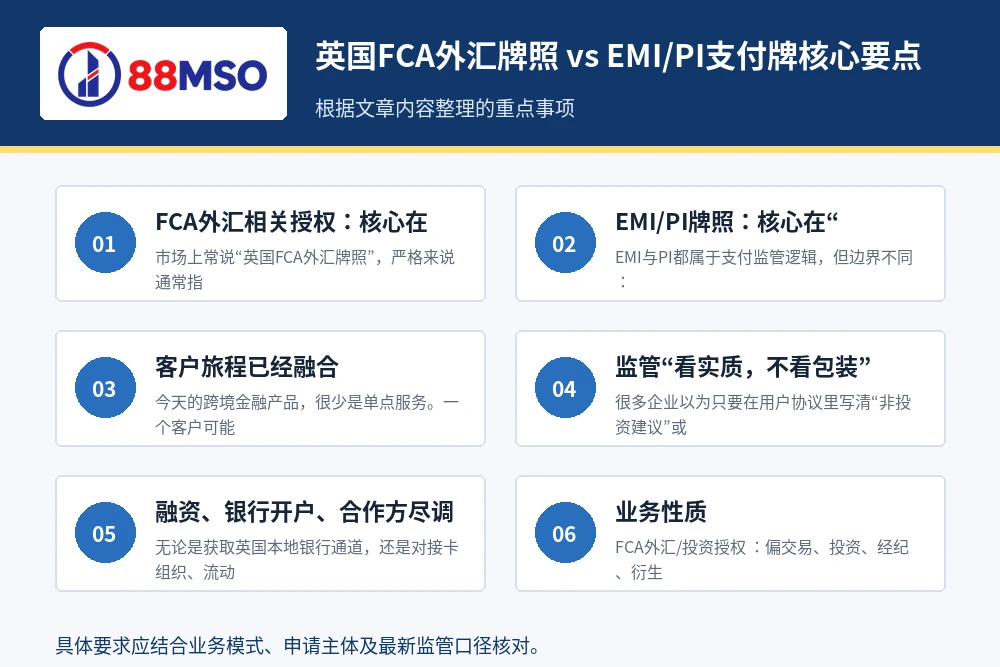
1) FCA foreign exchange related authorization:The core is "investment services" and "trading activities"
It is often said in the market that "BritishFCA foreign exchange license”,Strictly speaking, it usually refers to under the FCA regulatory framework,Licensed to conduct Contracts for Difference (CFDs)、Leveraged Forex、investment intermediary、Asset management and other relatedregulated investment activities。The essence of this type of business is the attribute of "investment products",rather than simply “fund transfer”。
- Typical business:Retail/Professional Client Foreign Exchange Margin Trading、CFD Brokerage、Market making or matching、Investment advice, etc.。
- Regulatory focus:Customer Classification、product suitability、Leverage limits、market behavior、Information disclosure、Transaction Records and Complaint Mechanism。
- risk characteristics:market risk、conduct risk、Risk of misleading sales、Derivatives Complexity Risks Higher。
2) EMI/PI license:The core is "payment execution" and "funding tools"
Both EMI and PI belong to payment supervision logic,But the boundaries are different:
- PI(Payment Institution):Remittance available、Acquiring、Payment services such as payment execution,However, in principle, no electronic currency is issued。
- EMI(Electronic Money Institution):Can issue electronic money,Supports richer scenarios such as electronic wallets,And can come with some payment services。
In other words,If your business model is "customers recharge their wallets - store them in their accounts - then use them for consumption/transfer",EMI tends to be closer;If it is just "transfer directly after receipt" and does not deposit electronic money,PI may be more simplified。
Why is “choosing one or the other” so often problematic?
1) The customer journey has converged
Cross-border financial products today,Rarely an a la carte service。A client may deposit money first、Exchange currency again、reinvest、redeem again、Pay globally。If you only get one type of license,Regulatory red lines are often stepped on when business expansion:
- The foreign exchange platform comes with a wallet function after opening an account.,Trigger electronic currency regulation;
- The payment platform adds exchange rate quotation and hedging mechanism,Trigger identification of investment activities;
- It is not clear that different functions in the same APP are carried by different legal entities,leading to consumer protection disputes。
2) Supervision “look at the essence”,Don’t look at the packaging”
Many companies think that as long as they write "non-investment advice" or "technical service platform" in the user agreement,to circumvent high-level regulation。In fact, FCA’s review logic is:See how you actually reach customers、How to control money、How to make profit。Only surface cutting,The cost of being required to renew a license or make rectifications later is extremely high.。
3) Financing、Bank account opening、Partners require greater transparency during due diligence
Whether it is to obtain local banking channels in the UK,Or a docking card organization?、Liquidity provider、Institutional clients,Compliance structures will be subject to in-depth due diligence。License plate path blurred、Functional boundaries are unclear,Directly affects the speed of business cooperation promotion。This is highly similar to Hong Kong’s financial industry – a license is just the starting point,Continuous compliance capabilities are the basis for valuation。
FCA foreign exchange license vs EMI/PI:Key differences at a glance
1) Nature of business
- FCA foreign exchange/investment authorization:Trading bias、invest、Broker、derivatives。
- PLUS/MINUS:partial payment、liquidation、Electronic currency issuance and fund transfer。
2) Customer fund processing logic
- investment services:Pay attention to the separation of customer assets、Transparent transactions、Risk disclosure、Negative balance protection (depending on business)。
- payment services:Pay attention to customer fund protection (Safeguarding)、segregated account、Fund traceability、Liquidation statute of limitations。
3) Profit model
- Foreign exchange/CFD platform:Spread、commission、Overnight fee、Liquidity management income, etc.。
- EMI/PI:Payment fee、exchange rates、Account service fee、B2B settlement service fees, etc.。
4) Compliance team capability requirements
Both types of licenses require strong AML/KYC systems,But the focus is different:
- Forex/Investment:More emphasis on sales compliance、Transaction monitoring、market behavior control;
- EMI/PI:More emphasis on identifying suspicious patterns in transactions、Fund source verification、Sanctions screening and ongoing monitoring。
How to design a dual-track compliance strategy? Give enterprises an executable framework
first step:First draw a “business map”,Re-determine license route
Don’t start by asking “which license should I apply for?”,But first sort out:
- Who is the customer (retail、mechanism、Merchant、platform)?
- How to transfer funds (deposit、storage、exchange currency、invest、Withdrawal)?
- Where do the profits come from (trading、pay、Account、value-added services)?
- Which links are self-operated?,Which ones are outsourced?
After completing the flowchart,It is common to see at least two regulatory links coexisting:Investment link and payment link。
Step 2:Build a hierarchical structure of “entity + license plate”
A common practice among mature institutions is to use different entities to undertake different regulatory activities,Avoid a single entity bearing too many regulatory responsibilities。for example:
- A entity:Undertake foreign exchange/CFD investment services;
- B entity:Undertake EMI/PI payment services;
- Group level:Unified risk control、audit、Data Governance and Board Oversight Framework。
This structure helps control risk contagion,It is also more conducive to future financing or mergers and acquisitions。
Step 3:Establish a unified AML base,Configuration rules by business
The dual-track strategy is not about two systems working independently.。The best practice is to establish a unified AML/KYC technology and institutional base,Then configure differentiation rules according to business lines:
- Unify customer identification standards and risk rating models;
- Unified sanctions list screening、PEP identification、Suspicious transaction escalation process;
- Configure different thresholds according to payment/transaction scenarios、Frequency and warning logic。
This type of "unified base + different configuration" model,It’s the key to cross-border compliance efficiency。
Step 4:Treat "license application" as "operation system construction"
Many companies treat the application stage as paperwork,The system will be replenished after approval.,Result in supervisory return visit、Weaknesses exposed during audit or cooperative due diligence。The correct order should be:
- Governance structure first (director responsibilities、three lines of defense、Compliance Officer/MLRO Mechanism);
- Linkage of institutional documents and systems (not “paper compliance”);
- Outsourcing management、Data traces、Complaint handling、Business continuity is implemented simultaneously。
The four most common misjudgments among China and Hong Kong overseas teams
Misjudgment one:Treat British license plates as a "passport" rather than a "responsibility system"
A license is not a one-time approval document,but an ongoing regulated operating commitment。If subsequent transaction monitoring、Failure of customer communication or fund protection mechanism,Law enforcement risks will quickly amplify。
Misjudgment 2:Only focus on application speed,Ignoring long-term maintenance costs
The real cost isn’t just during the application period,Still undergoing annual review、Report、audit、System upgrade and manpower allocation。If the early plan is radical,Subsequent maintenance costs may double。
Misjudgment three:Ignoring cross-border collaborative compliance
If headquartered in Asia、Customers in Europe、Channels in many countries,It’s impossible to just look at a single point in the UK for compliance。The anti-money laundering obligations of the parent company’s location need to be considered simultaneously.、Data Compliance and Group Governance。
Misjudgment four:Treat consultants as “agency agents” rather than “long-term compliance partners”
The value of a high-quality consultant is not in filling out forms,It’s about helping companies identify regulatory boundaries、Design a sustainable model、Establish auditable internal controls。For institutions planning to do large-scale cross-border business,This determines the quality of life after 3 years。
How to judge whether you are more suitable for "foreign exchange first and payment later" or "pay first and foreign exchange later"?
Suitable for companies that “pay first and then exchange foreign exchange”
- Currently, cross-border payment is used、Merchant Settlement、Wallet products as the core;
- Customer transaction needs focus on exchange and transfer,No emphasis on leveraged trading;
- We hope to establish stable cash flow and bank channels first.,Expand investment products。
Suitable for companies that “foreign exchange first and pay later”
- Already have a mature trading system、Liquidity resources and risk control model;
- Customers are mainly transaction-oriented,The payment function is part of the package;
- The team has strong investment business compliance experience。
Suitable for enterprises that “promote dual tracks in parallel”
- The group has sufficient resources,Pursuing integrated international financial services;
- Product path is clear,It is necessary to quickly form a closed loop of “payment + investment”;
- Already have cross-jurisdictional compliance management capabilities,Able to withstand higher governance complexity。
Conclusion:UK compliance is not about “selecting a license plate”,But "choose a strategy"
in UK market,FCA foreign exchange authorization and EMI/PI payment license are not simple substitutes,Rather, they are regulatory tools for different business entities.。What the company really wants to do,It’s not about chasing “which license is more popular?”,But back to the business model itself:Where is your customer value chain?、How the capital chain works、How to control the risk chain。
When companies plan their UK layout with “dual-track compliance” thinking,Ability to establish clear regulatory boundaries earlier、Gain the trust of banks and partners more steadily,There is also a greater chance of converting short-term implementation into long-term growth.。This is consistent with what 88MSO has long emphasized:The core competitiveness of cross-border financial overseas expansion,Not just getting a license,What’s more, it’s about turning compliance into replicable business capabilities.。For organizations aiming to globalize,This is the underlying method of crossing the cycle。
FAQ:UK FCA Foreign Exchange and EMI/PI FAQs
Q1:After I have EMI license,Can I do leveraged foreign exchange trading directly?
Usually can't。EMI mainly covers electronic money and payment services,Investment activities such as leveraged foreign exchange or CFD generally require corresponding FCA investment business authorization。
Q2:How to choose between PI and EMI?
The key depends on whether you need to "issue electronic currency/wallet deposit"。No need for long-term storage of electronic money、Focus on payment execution,PI can be prioritized;For wallet ecology and more complete account functions,EMI is more suitable。
Q3:Does a dual-track architecture require two companies?
uncertain,But in risk isolation、regulatory clarity、Financing and M&A convenience,Multi-entity layering is often more advantageous,Need to weigh business scale and cost。
Q4:What is the most overlooked thing after UK license approval?
Continuous compliance operations,Includes AML monitoring iteration、Customer Communication Compliance、reporting obligations、Outsourcing management and audit evidence retention。Many risks occur “after approval”。
The license type must correspond to the funds and account functions
When planning UK FCA foreign exchange license vs EMI/PI payment license,Payment should be made、transfer、Electronic currency issuance、wallet balance、Merchant Acquirer、Account information and card issuance functions are separated,Then determine whether it belongs to a payment institution、Electronic money institution or technology service。Only use "payment license" to summarize all businesses,Easy to miss capital、Client Fund Guarantee and Outsourcing Requirements。
Application documents generally need to cover the governance structure、suitability of person in charge、business plan、financial forecast、Customer fund protection、Anti-money laundering、information security、major events、Agency and Outsourcing and Exit Arrangements。The Access Card Organization is an independent commercial and technical audit,Holding an EMI or PI license does not automatically entitle you to Visa or Mastercard membership。
Industry references:UK Financial Conduct Authority (FCA):Electronic money institution application requirements。
Read more:How does the cross-border payment platform connect with international card organizations (Visa/Mastercard)? The main role of EMI license、Interpretation of EU PSD2 Directive:Open banking API compliance requirements and data exchange specifications for EMI licensed institutions。