 简体中文
简体中文 繁體中文
繁體中文 English
How does the cross-border payment platform connect with international card organizations (Visa/Mastercard)? The main role of EMI license
In cross-border e-commerce、Overseas SaaS、Against the backdrop of continued growth in digital services trade,More and more companies hope to build their own cross-border payment platform:Accepts global card payments,Multi-currency settlement is also possible、Share accounts、Refund and risk control management。However,When a company actually launches a project,Often get stuck on a core issue:How to access Visa/Mastercard in compliance with regulations,And what license entity should be used to undertake the funding and liquidation responsibilities?。
The first reaction of many entrepreneurial teams is to "do the technical interface first",But in the international card organization ecosystem,Technology is never the first threshold。The real threshold is:License qualification、Sponsor Bank Relationship、Fund security mechanism、Anti-money laundering (AML) system、Transaction monitoring capabilities、Dispute resolution and operational continuity。This is why the "EMI license (electronic money institution license)" plays a key role in the cross-border payment architecture。
This article will take a practical perspective,System dismantling of the complete path for cross-border payment platform to connect with Visa/Mastercard,And focus on explaining the main role of EMI license in business implementation,Help enterprises avoid detours、Reduce compliance and funding risks。
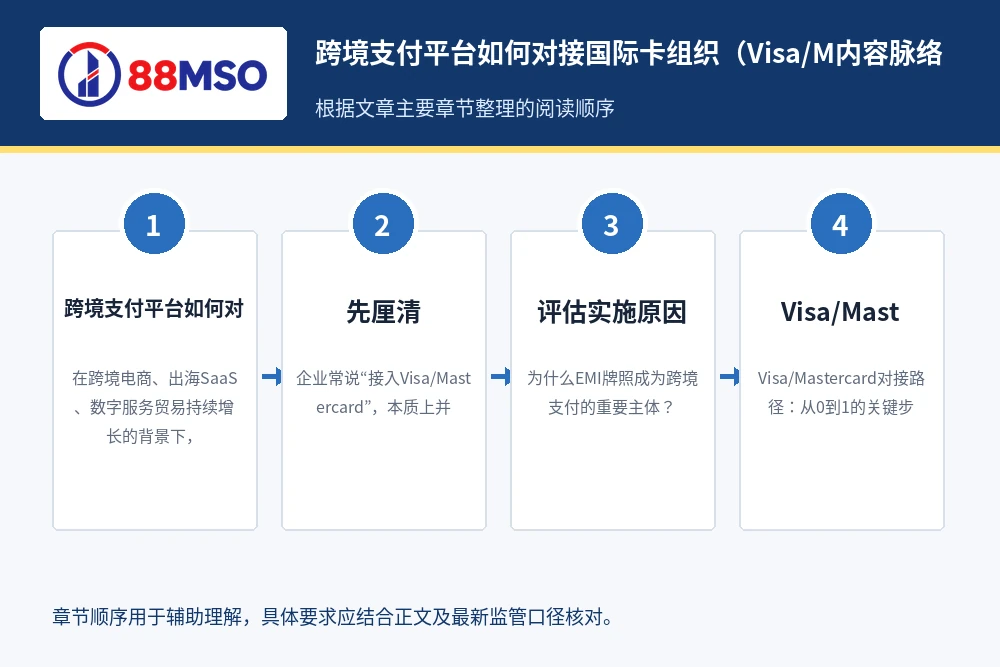
one、First clarify:What exactly are cross-border payment platform access card organizations doing?
Businesses often say “connect to Visa/Mastercard”,In essence, it is not directly “connect to the Internet and you can collect money.”,Instead, it enters a financial settlement system involving multiple parties.。Generally involves the following roles:
- Card Scheme:Visa/Mastercard,Make rules、clearing standards、Dispute process and risk control requirements。
- Issuer:Issue cards to cardholders and bear credit risk。
- Acquirer/Acquirer:Service merchant,Process transaction receipts。
- Payment Service Provider (PSP)/Aggregator:The technical and operational layers connect merchants and acquiring networks。
- Licensed entity (commonly EMI/PI, etc.):Accept client funds、electronic wallet、Settlement and partial compliance responsibilities。
- Sponsor Bank:in many areas,Non-bank institutions need bank sponsorship to participate deeply in the card network。
therefore,Cross-border payments are not “an API project”,But "License + bank + card organization + compliance system + technical system"Comprehensive project。
two、Why has EMI license become an important subject of cross-border payments?
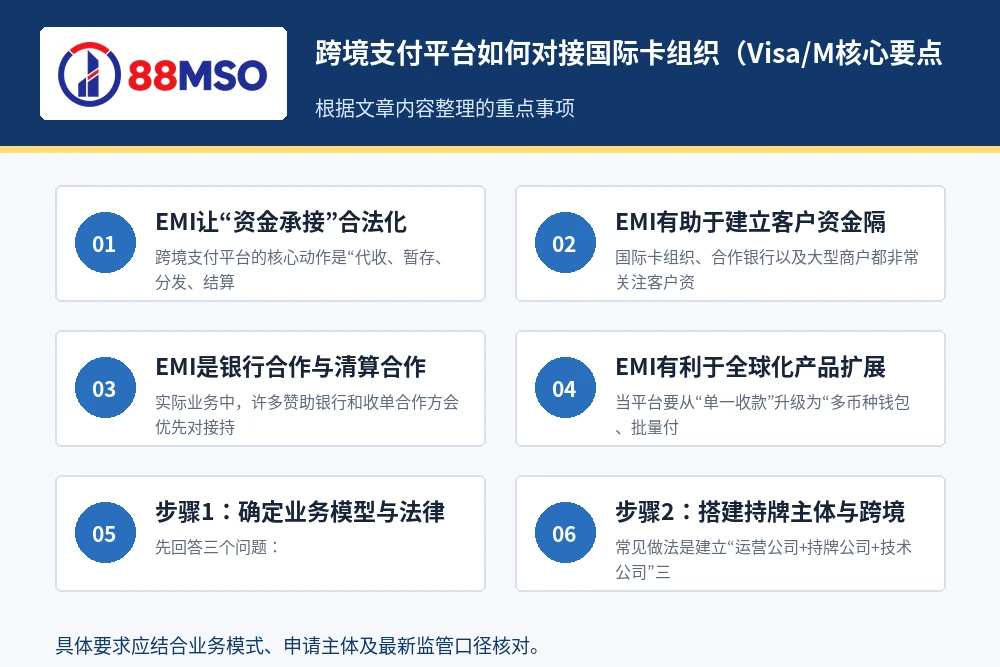
1) EMI legalizes “fund undertaking”
The core action of the cross-border payment platform is “collection on behalf of、temporary storage、distribution、Settlement"。If there is no corresponding licensed entity,The platform is easily exposed to the risk of "operating payment services without a license"。EMI licenses typically allow institutions to issue electronic money、Manage client fund accounts and execute payment instructions,Enable the platform to have a legal subject status in the capital link。
2) EMI helps establish a customer fund isolation mechanism (Safeguarding)
international card organization、Cooperative banks and large merchants are very concerned about the safety of customer funds.。EMIs are often subject to strict customer fund segregation requirements,For example, deposit client funds in designated segregated accounts、Restrict the mixed use of own funds。This is extremely critical to improving the platform’s credibility and passing bank due diligence.。
3) EMI is the “trust threshold” for bank cooperation and clearing cooperation
In actual business,Many sponsoring banks and acquiring partners will give priority to institutions that are licensed and have mature compliance regulations.。EMI license does not mean "automatic access card organization",But it significantly improves the efficiency of cooperation negotiations,Reduce repeated reviews caused by “insufficient qualifications”。
4) EMI is conducive to global product expansion
When the platform wants to upgrade from "single payment" to "multi-currency wallet"、Batch payment、Corporate card、virtual card、Global Settlement",EMI subjects have obvious advantages in product scalability,Can more smoothly connect payment networks and banking ecosystems in different regions。
three、Visa/Mastercard docking path:Key steps from 0 to 1
Step 1:Determine business model and legal positioning
Answer three questions first:
- are you doingPure technical service,Still willActual access to funds?
- You serve e-commerce merchants、Platform seller、Taking the game overseas,Or B2B trade?
- You mainly collect orders、Payment、wallet,Or is it a closed loop of "integrated collection and payment + separate accounts"?
This directly determines whether you need EMI、MSB、Combination of MSO or other regional licenses,Rather than a single license covering the whole world。
Step 2:Establishing licensed entities and cross-border corporate structures
A common approach is to establish a three-tier structure of "operating company + licensed company + technology company",Taking into account tax、Risk control and regulatory requirements。Synchronous planning is required at this time:
- Subject jurisdiction and license application path
- Director and Compliance Officer (MLRO) Configuration
- Group-level data compliance and internal control policies
If a company plans to expand into Hong Kong and overseas markets at the same time,Usually paired with a financial compliance node in Hong Kong,Increase bank and institutional acceptance of Asia business。
Step 3:Establish AML/KYC and transaction monitoring system
Card organizations and banks are in the process of due diligence,AML/KYC is not a “documentation item”,But "system capability items"。Should cover at least:
- Merchant access due diligence (UBO identification、Industry risk classification)
- Card transaction behavior monitoring (abnormal frequency、Regional deviation、equipment risk)
- Suspicious transaction reporting and escalation process
- Sanctions List Screening and Continuous Review
After the transaction scale increases,Lack of automated monitoring leads to increased chargeback rates、Account freezing or even suspension of cooperation。
Step 4:Connecting sponsoring banks and acquiring networks
in most cases,Non-bank entities must rely on sponsoring banks to enter the card clearing ecosystem。The bank will focus on:
- License validity and regulatory records
- Fund isolation and liquidation process
- Proportion of high-risk merchants and industry exposure
- Historical chargeback rate、Fraud rate、Refund time limit
The difficulty in this step is not "whether you are willing to accept it",And in terms of "How much business authority are you willing to give and what good rates are you willing to give?"。The higher the quality of compliance,Business conditions are usually better。
Step 5:Complete access to technology and operational rules
Technical aspects include authorization、liquidation、Reconciliation、Refund、Chargeback、3DS、Tokenization and other modules;The operational level includes dispute handling SLA、Risk control threshold、Merchant Management Manual、Emergency plans, etc.。It is recommended to conduct phased stress testing and risk control drills before officially increasing the volume.。
Four、Dismantling the “main role” of EMI license plates in the entire link
1) On the merchant side:Improve the credibility of settlement
For merchants,Whether there is a licensed entity is directly related to the stability of fund arrival.。EMI entities can provide more standardized merchant agreements、Settlement Arrangements and Dispute Mechanisms,Reduce merchants’ concerns due to “secondary clearance risks”。
2) On the bank side:Enhance auditability
Banks value auditable processes。EMI entities generally need to implement a compliance governance framework,Includes board oversight、Compliance Report、Internal audit random inspection、Fund isolation certificate, etc.。These can enhance bank credit and depth of cooperation.。
3) On the card organization side:Reduce cyber risk exposure
Card organizations are very concerned about fraud、money laundering、Chargeback、illegal trade。EMI entities pass institutionalized risk control and continuous compliance,Able to reduce cyber risk exposure,Improve business continuity。
4) On the regulatory side:Form a foundation for sustainable management
The payment industry is most afraid of “running business first”、Supplementary compliance”。The value of an EMI license is not just in “what you can do”,More importantly, “can do it for a long time”。It adds countries for subsequent、Product line expansion、Capital cooperation lays the institutional foundation。
five、The five most common misunderstandings among companies
- Misunderstanding 1:If you have technology, you can connect to card organizations
reality is:Technology is only the last mile,License and bank relationship are prerequisites。 - Misunderstanding 2:Get a license and travel around the world
The regulatory standards of different markets vary greatly.,Often requires coordinated deployment across multiple jurisdictions。 - Misunderstanding 3:AML can be supplemented later
No real-time monitoring and due diligence process,It is very easy to experience high chargebacks and account restrictions after increasing the volume.。 - Misunderstanding 4:Only look at the rates and not the terms
liquidation cycle、retainer、Recourse to liability、Termination clause,Often affects profits more than rates。 - Misunderstanding 5:Neglecting local compliance team building
Relying solely on outsourcing cannot support rapid growth,Need to establish internal compliance and risk control center。
six、Practical suggestions:Roadmap from "can go online" to "can be scaled"
Stage A:Compliance and licensing first
After clarifying the target market,Prioritize the completion of license path assessment and company structure design。If an enterprise focuses on cross-border collection and payment,EMI is often a key piece of the puzzle。
Stage B:Ecosystems of banks and card organizations are advancing simultaneously
Don’t wait for the license to be “completely implemented” before initiating bank communication。Preparation of due diligence materials should be promoted in parallel、Business data sample、Risk control policy output,Shorten the overall cycle。
Stage C:Technical systems are designed according to regulatory requirements
Transaction monitoring、List screening、Audit log、Permission management should be built in during the architecture phase,Rather than plug-in after going online。Compliance “Shift Left” Can Significantly Reduce Rework Costs。
Stage D:Establish an ongoing compliance mechanism
Includes regular training、Model iteration、Regulatory filing、External audit and incident review。Payment is not a one-time item,But the ability to continue operating。
seven、Why more and more overseas companies choose professional compliance service partners
Laws involved in cross-border payment docking with Visa/Mastercard、finance、technology、Operational multi-dimensional collaboration。Relying solely on in-house legal or a single technical team,It is often difficult to cover the full link requirements。in practice,Enterprises prefer to cooperate with professional organizations with cross-license experience,Especially in the dual-line layout scenario in Hong Kong and overseas。
Take 88MSO and the 88MSO service system behind it as an example,It has long been involved in financial compliance in Hong Kong and overseas.,Covering MSO、SFC、insurance broker、Money lender and other types of licenses and practical scenarios。For companies planning to enter the cross-border payment track,The value of this type of team is:Transform complex regulatory requirements into executable implementation paths,and open a bank account、License plate maintenance、Provide continuous support for AML system construction and other aspects,Reduce trial and error costs。
Conclusion:EMI is not "optional",It is the hub of cross-border payment compliance capabilities.
Cross-border payment platforms must have stable access to Visa/Mastercard,Don’t just focus on interface documentation,It is necessary to build an integrated system of "license subject-bank cooperation-card organization rules-AML risk control-operation governance" from the beginning.。The core significance of EMI license,It is in this link that it serves as the key entity for legal fund acceptance and sustainable operations.。
If your goal is to do "long-term、Can be increased in volume、Financing available、Globally scalable” payment business,Then compliance should not be a cost center,Instead, growth infrastructure。The sooner we finish this set of bases,The more you can build a real moat in cross-border payment competition。
FAQ:Quick answers to frequently asked questions
Q1:After having EMI license,Can I become a Visa/Mastercard member directly?
uncertain。Whether you can join directly depends on regional rules、Capital strength、Risk control capabilities and organizational requirements。Many institutions still need to operate through the sponsored banking model。
Q2:No EMI,Can I do cross-border collection first?
Technical services or channel access can be provided through cooperative licensed institutions.,But if you reach the financial link,Compliance licenses still need to be matched in the long term,Otherwise, the business risk will be higher。
Q3:Which is more important, EMI or anti-money laundering system?
Both are indispensable。EMI solution subject qualifications,AML resolves going concern。Lack of AML capabilities will directly affect the stability of cooperation between banks and card organizations。
Q4:How long is the typical project implementation cycle?
Due to large differences in market and business complexity,It usually takes anywhere from a few months to a year。Parallel advancement of licenses、bank、System and Policy Documents,Can significantly shorten the cycle time。
The license type must correspond to the funds and account functions
EMI in LuxembourgPay licenseProvides a stable regulatory environment for fintech companies,Enable it to legally carry out electronic money and payment services in the European market。
When planning how the cross-border payment platform will interface with international card organizations (Visa/Mastercard),Payment should be made、transfer、Electronic currency issuance、wallet balance、Merchant Acquirer、Account information and card issuance functions are separated,Then determine whether it belongs to a payment institution、Electronic money institution or technology service。Only use "payment license" to summarize all businesses,Easy to miss capital、Client Fund Guarantee and Outsourcing Requirements。
Application documents generally need to cover the governance structure、suitability of person in charge、business plan、financial forecast、Customer fund protection、Anti-money laundering、information security、major events、Agency and Outsourcing and Exit Arrangements。The Access Card Organization is an independent commercial and technical audit,Holding an EMI or PI license does not automatically entitle you to Visa or Mastercard membership。
Industry references:European Commission:Payment services and PSD2 official information。
Read more:Interpretation of EU PSD2 Directive:Open banking API compliance requirements and data exchange specifications for EMI licensed institutions、European EMI license application comparison:Lithuania、Estonia、Cyprus、Which Poland is more suitable for you?。