 简体中文
简体中文 繁體中文
繁體中文 English
Official verification (August 2026):VARA’s current application process requires companies in Dubai (except DIFC) that plan to carry out virtual asset activities to obtain a VASP license before operating.。New applications usually complete the ATI stage first,Then proceed to the complete license review;ATI only allows completion of company establishment、Office and personnel preparation for operations,Enterprises are not allowed to carry out virtual asset activities。See detailsVARA license application process and two-stage requirements。
Dubai VARA vs Hong KongSFC:Why is this comparison even more critical in 2026?
Entering 2026,Global crypto asset regulation has shifted from “whether to regulate” to “how to regulate with high quality”。For exchanges planning to go overseas、OTC platform、custodian、market maker、For Web3 payment companies,Dubai VARAandHong Kong SFCare the two compliance paths that receive the most attention:The former uses "emerging international financial center + special virtual asset supervision" to quickly attract projects to land.,The latter relies on Hong Kong’s mature financial legal system and cross-border capital advantages.,Promote the integration of “traditional finance + virtual assets”。
Many companies fall into misunderstandings when choosing a location:Compare only "application speed" or "license fee",but ignores deeper regulatory variables,For example, customer access、product boundaries、Escrow responsibilities、market conduct、Anti-Money Laundering (AML) Strength、and subsequent license maintenance costs.。The common result is “obtaining a license but being unable to expand the business”,Or “after the business went online, we were required to make rectifications due to insufficient internal control systems.”。
This article will explain the differences between the Dubai VARA and Hong Kong SFC frameworks in 2026 from a practical perspective.,And provide executable compliance strategies based on the enterprise life cycle。For institutions looking to build long-term competitiveness,This is not a simple "choose one",It is a regulatory strategy design。
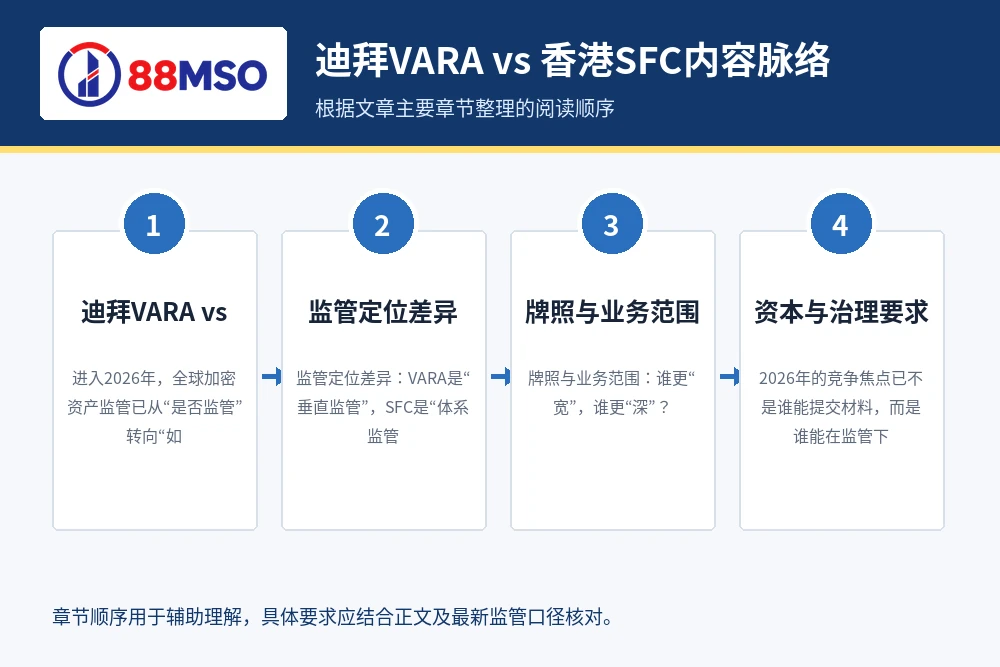
one、Differences in regulatory positioning:VARA is "vertical regulation",SFC is "system supervision"
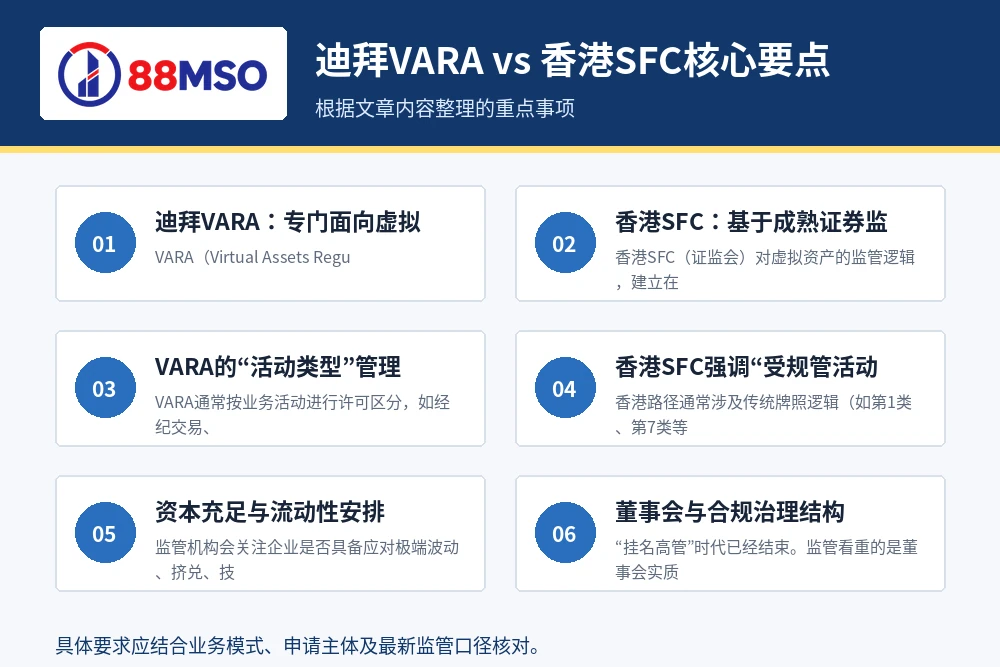
1. Dubai VARA:Regulatory agency dedicated to virtual assets
VARA (Virtual Assets Regulatory Authority) is Dubai’s special regulatory design in the field of virtual assets.,Its advantage lies in the focus of rules、Fast response、Relatively high tolerance for innovative business formats。For early stage projects,The VARA path usually emphasizes "explainable business model + controllable risks"。
- Features:Hierarchical supervision for virtual asset business,Modular license plate。
- guide:Encourage institutional development,But it requires a clear governance structure and risk isolation。
- Suitable:Hope to quickly establish an encryption platform and Web3 service provider as a business bridgehead in the Middle East。
2. Hong Kong SFC:Based on the extension of mature securities regulatory system
Hong Kong SFC (Securities and Futures Commission) regulatory logic for virtual assets,Build on the existing securities and futures regulatory framework,Supporting requirements are usually more detailed、more institutionalized。Especially in investor protection、market conduct、Hosting specifications、Continuous disclosure,Hong Kong’s approach places greater emphasis on “auditable、Accountable、"sustainable"。
- Features:Supervision is closely connected with the traditional financial system,High degree of standardization。
- guide:Compliance first,Focus on long-term stability and recognition by international institutions。
- Suitable:Target institutional clients、Cross-border capital business、Or plan to enter medium and large platforms in multiple jurisdictions。
two、License and business scope:Who is "wider",Who is "deeper"?
1. VARA’s “activity type” management is more flexible
VARA generally differentiates licensing by business activity,such as brokerage trading、hosting、consult、loan、Management and investment services, etc.。The advantage is that companies can apply in stages,Do core business first,Extend the license plate module。
But this does not mean "low threshold":Regulatory authorities will focus on whether business boundaries are clear、Are client funds and own funds isolated?、Is technical risk control verifiable?。If the institution plans to offer high-risk derivatives,The intensity of censorship will increase significantly。
2. Hong Kong SFC emphasizes “regulated activities + additional requirements for virtual assets”
The Hong Kong route typically involves traditional licensing logic (e.g. Category 1、Category 7 and other related activities) and the combination of virtual asset platform systems。For the platform,The core challenge is to not only meet the "permit to open",Must also meet "continuing operational compliance"。
- The currency listing review and due diligence mechanism must form a closed loop;
- Client suitability assessment、Risk disclosure must not be a mere formality;
- Transaction monitoring、Market manipulation identification、Exception reporting needs to be systematic;
- audit、record retention、Clear division of responsibilities among compliance officers。
in other words,Hong Kong is not “harder”,But "deeper" - more testing of the company's internal control engineering capabilities。
three、Capital and governance requirements:From "can apply" to "can operate"
The focus of competition in 2026 is no longer who can submit materials,But who can stably run the business model under supervision?。Whether VARA or SFC,The following three types of capabilities are high-frequency review points:
1. Capital adequacy and liquidity arrangements
Regulators will focus on whether companies are equipped to cope with extreme fluctuations、run、Financial buffer for technical incidents。Businesses should prepare:
- Proof of minimum capital and working capital;
- Liquidity stress testing and emergency financing plans;
- Separation mechanism for customer assets and company assets。
2. Board of Directors and Compliance Governance Structure
The era of the “frontman executive” is over。What supervision values is the substantive participation of the board of directors、Three lines of defense (business、Risk control compliance、Internal Audit) Effective Operation,and whether personnel in key positions have experience and independence。
3. Technical and operational resilience
System availability、Private key management、Hot and cold wallet strategies、Permission classification、Disaster recovery、Third-party outsourcing management,They are all the focus of regulatory spot checks.。especially in Hong Kong,Operational resilience and customer asset protection are often given high priority。
Four、AML/KYC comparison:Anti-money laundering is not a “documentation project”
Against the backdrop of tightened global law enforcement,AML has become a key variable in the long-term survival of licenses。Both VARA and SFC emphasize a risk-based approach (RBA),However, the focus of implementation is slightly different。
1. Customer Due Diligence (KYC) Depth
Both places require identity verification、Beneficial owner identification、Sanctions screening and ongoing monitoring。High-risk clients (such as complex offshore structures、Cross-border high-frequency capital flows) need to strengthen due diligence and review frequency。
2. Transaction monitoring and suspicious reporting
Compliance is not achieved just by deploying a set of monitoring software。Supervision pays more attention to:Do the rule parameters match the business pattern? Are alarms handled effectively? Is there a problem of "just reporting and ignoring it" or "only leaving traces without rectification"?
3. Travel Rule and on-chain compliance
2026,Cross-platform transfer information transmission and on-chain traceability requirements are further strengthened。Enterprises need to integrate on-chain analytics、Address risk score、Blacklist joint defense is incorporated into daily processes。The Hong Kong market attaches particular importance to the auditable evidence chain。
five、Investor protection and market access:Retail business is a watershed moment
Many companies focus on “whether they can be retail customers”,But what really affects operations is “under what conditions、What products can be made、How to demonstrate appropriateness on an ongoing basis”。
- VARA path:May have room for faster iteration in business innovation and product design,However, supervision will simultaneously require risk disclosure、Marketing Code、Customer hierarchical management。
- SFC path:More emphasis on institutional prerequisites for the feasibility of retail participation,Includes asset access、investor education、Risk assessment、Complaint handling and compensation arrangements。
If the company targets high net worth and institutional clients,Hong Kong’s institutional trust often has advantages;If the company is in the stage of rapid product trial and error,Dubai path could be more strategically resilient。
six、tax、Banks and Ecology:"Hidden costs" beyond licenses
The real difficulty in landing is often not in the application,And within "90 days after obtaining the certificate":Was opening a bank account smooth? Is the legal currency channel stable? Are audit and legal resources sufficient? Is talent recruitment sustainable?
Comparison points
- Bank collaboration:Hong Kong is more mature in connection with the traditional banking system and cross-border settlement experience,However, the requirements for account opening and ongoing due diligence are strict.;Dubai has obvious advantages in international capital network and regional expansion。
- Professional services:Both places have mature law firms and audit resources,Hong Kong has greater depth in connecting the mainland and Asia-Pacific capital markets。
- Brand endorsement:Hong Kong SFC license in institutional cooperation、Usually have strong identification in investment and financing due diligence scenarios。
seven、2026 Practical Decision Framework:How does an enterprise choose VARA or SFC?
It is recommended to score from the following four dimensions:,Instead of just looking at “time and cost”:
1. Customer structure
A high proportion of institutional customers、Those who plan to enter the traditional financial cooperation chain,Prioritize assessment of Hong Kong;Oriented towards regional growth、Innovative product verification,Dubai may be given priority。
2. product complexity
If hosting is included、loan、Derivative strategies、Market making and cross-platform liquidity management,Need to assess regulatory acceptance and ongoing compliance costs。
3. Compliance maturity
If mature compliance is already in place internally、Risk control、Internal audit team,Can undertake the systematic requirements of SFC;If you are still in the building stage,A two-location route of "easy first and then difficult" can be used。
4. Cross-border roadmap
Enterprises should include licenses in their 3-year plan:Next stop is the European Union、UK or North America? Different regulatory labels will affect subsequent access and cooperation efficiency。
eight、Common misunderstandings and countermeasures
- Myth 1:Treat the license plate as the end point。
response:Productize regulatory requirements、Streamlined,Establish a quarterly compliance review mechanism。 - Myth 2:Only respect the law,Not focused on operations。
response:Compliance、technology、customer service、Finance must be coordinated,Avoid "the system has、"Weak execution"。 - Myth 3:Underestimating AML ongoing costs。
response:Single column transaction monitoring in budget、screening system、Independent audit and staff training costs。 - Myth 4:Neglecting license maintenance and regulatory communication。
response:Establish a regulatory communication ledger,Conduct assessment and pre-communication before major changes。
Conclusion:There is no “easiest” place to regulate,Only the “best fit” compliance strategy
Dubai VARA and Hong Kong SFC,Represents two different but rapidly maturing crypto regulatory paradigms:A flexible governance that emphasizes the virtual asset track,An emphasis on robust integration under the financial system。The winner in 2026 is not "who gets the certificate first",And in "Who can turn compliance into growth capabilities?"。
For businesses,The optimal solution is often a hierarchical layout based on business stages:First clarify the boundaries between customers and products,Reconfigure the license plate path、AML system、Banking and Tax Structure,Finally, regulatory pressure is transformed into market trust through continuous governance.。
in this process,Have cross-licenses、The value of professional teams with cross-jurisdictional experience will continue to be amplified。Judging from the long-term financial compliance practices of 88MSO and its 88MSO team in Hong Kong,What can really help companies get through the cycle?,Not a "templated declaration",Instead, apply for a license、Implementation of the system、Staffing、Follow-up maintenance is opened up as an integrated project。For organizations preparing to enter the second half of Web3,This system capability,Often the barriers to competition themselves。
Check with regulatory agencies first、Legal name and available business
Dubai VARA License is an official regulatory authorization issued by the Virtual Assets Regulatory Authority (VARA),Enabling Virtual Asset Service Providers (VASPs) to operate within Dubai’s vibrant digital financial ecosystem。
When studying Dubai VARA vs Hong Kong SFC,The first step is to identify the local authority、License's official name in law、Permitted activities and public inquiry methods。Companies are often registered in the market、Industry registration、Regulatory licenses and private sector memberships are collectively referred to as "licences",If you don't disassemble it first,Costs and available business will be overestimated。
When comparing different regions,The same set of dimensions should be used:Where customers can be located、Can I hold client assets?、Capital and guarantees、local directors and personnel、Entity operation、Audit declaration、Banking and payment channels,and whether major markets recognize the license。When it comes to fees and processing times,The current form and fee schedule of the regulatory agency shall prevail.。
Industry references:Dubai Virtual Asset Regulatory Authority (VARA):License application。
Read more:Going to Europe,Choose CySEC、FCA or MFSA? Comparison of the strengths and costs of the three major regulatory bureaus、Application Guide for Mwali Offshore Banking License in Comoros:Compliance path for setting up a digital bank at low cost。
Read more:Hong Kong VASP Virtual Asset Services License Application Guide。