 简体中文
简体中文 繁體中文
繁體中文 English

Application Guide for Mwali Offshore Banking License in Comoros:Compliance shortcut for setting up a digital bank at low cost
Official verification update (August 2026):A Central Bank Notice published by the Comoros Ministry of Finance clearly warns:Mwali International Services Authority listed as a fictitious institution claiming to issue banking and financial institution licenses,Related offshore banking activities should not be considered authorized by the Central Bank of the Comoros。Companies should not use the so-called license to carry out regulated banking business or advertise to customers that it has sovereign regulatory effect。 For specific rules, seeCentral Bank Warning published by the Comoros Ministry of Finance。
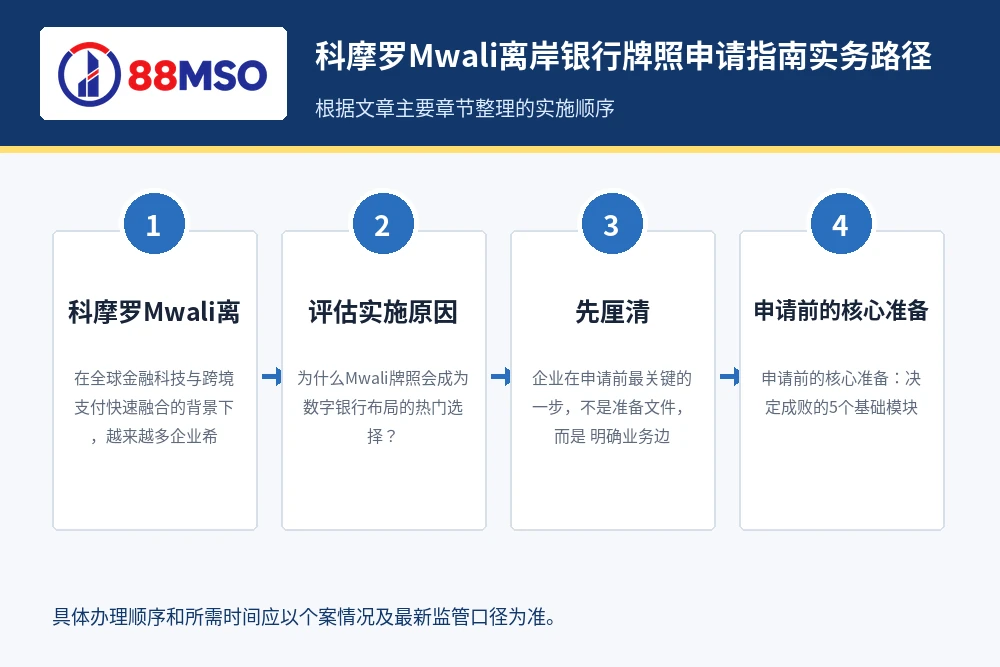
In the context of the rapid integration of global financial technology and cross-border payments,More and more enterprises hope to enter the "digital banking" track at lower costs。Compared with traditional high threshold jurisdictions,Comoros Mwali (Moheli) offshore banking licenseBecause the application cycle is relatively short、Entry cost is relatively friendly、High flexibility in business scenarios,It has become an option that many start-up financial institutions and cross-border capital focus on.。
But "low threshold" does not mean "no threshold"。Many companies are actually promoting,Often due to neglect of anti-money laundering systems、Shareholder Background Disclosure、Due to the substantive operational requirements, it is “easy to obtain a certificate”.、The dilemma of "difficulties in developing business"。This article will take a practical perspective,A complete breakdown of the positioning of Mwali license plates、Application path、fee structure、Common misunderstandings and key points for subsequent maintenance,and combined with the experience of Hong Kong’s compliance system,Help you build a more robust cross-border financial structure。
one、Why will Mwali license become a popular choice for digital banking layout?
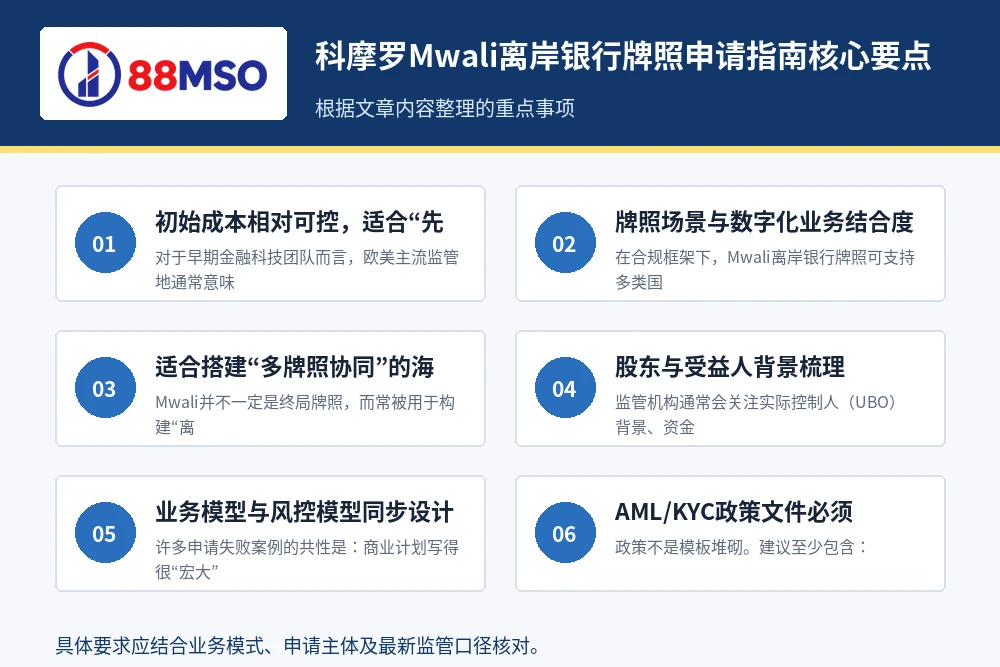
1. Initial costs are relatively controllable,Suitable for "landing first and then expanding"
For early stage fintech teams,Mainstream European and American regulatory locations usually mean higher capital requirements、Long audit cycle and continuous compliance investment。The advantage of Mwali is that:
- Company and license application fees are relatively friendly;
- Suitable for small and medium-sized institutions to establish compliance entities first;
- Can be used as the “first stop” for cross-border business testing of markets and product models。
2. The license plate scenario is highly integrated with digital business
under the compliance framework,Mwali offshore banking license can support a variety of international financial service scenarios,Such as cross-border payment、Corporate settlement、Electronic account management, etc.。For those who want to enter B2B cross-border payment、Global Merchant Services、For the team of Digital Wealth Portal,Have strong appeal。
3. Suitable for building an overseas structure with "multi-license collaboration"
Mwali is not necessarily the final license,It is often used to build a multi-layered structure of "offshore parent body + core market license"。For example, companies can firstoffshore licenseImplement business prototype,and then gradually expand into Hong Kong、Singapore or European local compliance channel,To match the cooperation requirements of different customer groups and banks。
two、First clarify:What can Mwali offshore banking license do?、What not to do
The most critical step for companies before applying,Not preparing documents,RatherClarify business boundaries。From a regulatory and commercial practical perspective,Usually you need to pay attention to the following principles:
- Can be done:International client-oriented account services、Cross-border settlement support、Some offshore financing and trade finance auxiliary functions (subject to the license approval content)。
- Need to be cautious:For customers in high-risk countries、Anonymous transactions、Large transfers of funds from unknown sources。
- cannot be ignored:Even offshore,An AML/KYC system must also be established、Customer risk stratification、Suspicious transaction monitoring and reporting mechanism。
in other words,The value of Mwali license lies in "compliance and operation",Rather than "regulatory gap arbitrage"。If companies use it as a "quick collection shell",Open a bank account later、Channel docking、Risks will be quickly exposed during the annual audit inspection。
three、Core preparation before application:5 basic modules that determine success or failure
1. Background review of shareholders and beneficiaries
Regulators often focus on the background of the actual controller (UBO)、Clarity of funding sources、Past financial career record。It is recommended to complete before submitting:
- Equity Path Penetration Diagram;
- Documents proving sources of funds and wealth;
- Key Personnel No Criminal Crime and Compliance Statement。
2. Synchronous design of business model and risk control model
What many failed application cases have in common is that:The business plan is written very "grandly",But the risk control system is extremely weak。Supervision is more concerned about:
- Which countries and industries do customers come from?;
- How to do customer access and continuous due diligence;
- How to spot money laundering、Fraud、Sanctions List Risk。
3. AML/KYC policy documents must be “implementable”
Policies are not templates。It is recommended to include at least:
- Customer Identification (KYC/KYB) Process;
- Enhanced due diligence (EDD) for high-risk customers;
- Transaction monitoring rules and early warning thresholds;
- Suspicious Transaction Reporting (STR) Mechanism;
- Staff training and internal audit arrangements。
4. Configuration of key positions:Compliance officer and risk control officer
Supervision cares about “who is in charge”。Even a lightweight team,It should also be clear at least:
- Compliance person (corresponding to AML execution);
- Risk control/audit support role;
- Board-level compliance oversight responsibilities。
5. Pre-planning of bank accounts and payment channels
Obtaining a license does not automatically mean that you will receive bank support。It is recommended to proceed in parallel:
- Operating account and reserve account solutions;
- Collection and payment settlement path design;
- Cooperative bank/EMI/PSP due diligence package preparation。
Four、Mwali license application process (practical version)
Step 1:Structural design and feasibility assessment
Confirm the target customer group first、Country coverage、Transaction type and annual transaction size,Then backtrack on whether it is suitable for the Mwali license plate。The most important thing at this stage is to avoid "register first"、A waste of time to "correct later"。
Step 2:Offshore company establishment and governance framework construction
After completing company registration,Determine directors simultaneously、shareholder、secretary、Authorized signatory,and form a compliance governance map。The clearer the governance structure,The smoother the follow-up review。
Step 3:Prepare application documents and compliance manual
including but not limited to:business plan、financial forecast、risk management policy、AML/KYC Handbook、Due diligence materials for shareholders and management、Technical system description, etc.。
Step 4:Formal submissions and regulatory inquiry responses
Regulatory inquiries will often focus on the source of the customer、Transaction authenticity control、sanctions screening mechanism、Fund custody logic and other issues。Response speed and professionalism directly affect the pace of review and approval。
Step 5:Correction after approval (if any) before going online
Some institutions need to supplement their internal processes before and after approval、Update system permissions、Improve reporting mechanism。It is recommended to conduct "pre-launch compliance stress testing"。
Step 6:Ongoing maintenance and annual compliance
The real challenge begins after the cards are dealt。Including annual review、audit、Policy updates、staff training、Suspicious transaction reports, etc. need to be implemented continuously。
five、Cost and cycle:The two issues that companies are most concerned about
Different service providers、Business complexity and people background make the difference,But it can usually be evaluated according to the following framework:
- upfront cost:Setup、License application、Legal and Compliance Documents、Due diligence notarization and certification, etc.;
- medium term cost:System construction、Risk control tools、Compliance Consulting and Staffing;
- Later costs:annual review、audit、Renew license、Policy maintenance、regulatory communications。
cyclical aspect,If the information is complete、Clear shareholder structure、Prompt response to inquiries,The overall rhythm will be more controllable;on the contrary,If the equity is complex or historical transactions are opaque,The approval cycle may be significantly lengthened。
six、Common misunderstandings:Why do some people “get a license but can’t do it”
Myth 1:Treat license as the only threshold
in reality,Bank cooperation、clearing channel、Customer trust、Payment success rate,Often more than the “certificate itself” determines the life or death of a business。
Myth 2:Ignore the construction of anti-money laundering system
Institutions without a complete AML mechanism,Opening an account、Channel review and cooperation due diligence processes will be frequently rejected。Compliance is not a cost item,It’s a business access ticket。
Myth 3:Business plans are divorced from operational capabilities
Many teams have written global expansion into their plans,But there is no corresponding compliance、customer service、Dispute resolution and technical capabilities,Resulting in continuous points loss during the landing phase。
Myth 4:Underestimating cross-border regulatory linkage
Even an offshore license,Just reach customers in other markets,may trigger local financial supervision、Data Protection and Consumer Protection Rules。
seven、How to synergize Mwali license with Hong Kong’s compliance system?
For organizations that want long-term development,Mwali is recommended as a “starting platform”,and gradually introduce higher standards of governance,In particular, please refer to Hong Kong’s AML、Licensed operation、Proven experience in audit disclosures。
For example,Many cross-border financial companies will adopt the following paths:
- first stage:Verify business model and customer acquisition capabilities with offshore licenses;
- second stage:Strengthen the licensing layout in Hong Kong or other core jurisdictions;
- The third stage:Forming a group regulatory response capability of “multiple licenses + unified risk control center”。
in this process,The value of an advisory team with practical experience in financial compliance in Hong Kong will be very obvious。Judging from the experience of 88MSO/88MSO long-term service companies going overseas,The truly efficient solution is not to “just pursue getting the certificate as quickly as possible”,But from the beginningLicense application、Bank account opening、AML system、Subsequent annual reviewDesigned for the same roadmap,Avoid repeated rework at a later stage。
eight、Practical suggestions:Action Checklist for Businesses Preparing to Apply
- Do a compliance physical examination first:Evaluate shareholders、funds、Whether the customer structure is suitable for license application;
- Define your target market:Don’t use a single offshore license to cover all country operations;
- Synchronously prepare bank materials:Establish a risk control narrative in advance that can be understood by banks;
- Set aside operating budget:Don’t spend all your budget on the “certification” stage;
- Establish an annual maintenance mechanism:Treat compliance as an ongoing project,rather than a one-time project。
Conclusion:Low cost is not low standard,Compliance capabilities are the long-term moat for digital banks
Comoros Mwali offshore banking license attracts attention,Essentially, it provides a more flexible starting path for cross-border financial entrepreneurs.。But from industry practice,An organization that can truly succeed,All have one thing in common:While entering the market at low cost,Adhere to high standards of compliance governance。
If your goal is to create a sustainable、Financing available、Scalable digital banking,then the licensing strategy should be integrated from day one、AML system、Bank cooperation and cross-border regulatory linkage are included in the overall design。so,Mwali license will become an "accelerator" for enterprises' global financial layout,Rather than "island assets" based on short-term trial and error。
FAQ:Frequently asked questions about Mwali offshore banking license
Q1:What businesses are Mwali licenses suitable for?
Suitable for scenarios with clear cross-border payment or international financial services、Fintech companies looking to validate their models at lower initial costs、Payment service providers and offshore financial platforms。
Q2:Can I start business on a large scale immediately after obtaining the license?
Not recommended。Bank account should be completed first、channel access、AML process stress test,Then gradually increase the amount,Avoid account restrictions due to immature risk control。
Q3:Do I still need to do anti-money laundering and customer due diligence?
Must do。Offshore licenses also need to comply with anti-money laundering、Sanctions Screening、Basic obligations such as suspicious transaction monitoring,This is a prerequisite for continued operations。
Q4:Can the Mwali license replace Hong Kong or other mainstream financial licenses?
Usually cannot completely replace。A more reasonable approach is to coordinate multiple licenses based on market and customer needs.,Gradually improve global compliance coverage capabilities。
Check with regulatory agencies first、Legal name and available business
Such plans must first undergo regulatory authenticity verification。Comoros Ministry of FinanceThe published central bank circular clearly lists Mwali International Services Authority as a fictitious institution claiming to issue licenses for banks and financial institutions.,And remind that relevant offshore banking activities are illegal;Therefore, the so-called Mwali license cannot be regarded as authorized by the Central Bank of Comoros.。
When studying the Comoros Mwali offshore banking license application guide,The first step is to identify the local authority、License's official name in law、Permitted activities and public inquiry methods。Companies are often registered in the market、Industry registration、Regulatory licenses and private sector memberships are collectively referred to as "licences",If you don't disassemble it first,Costs and available business will be overestimated。
When comparing different regions,The same set of dimensions should be used:Where customers can be located、Can I hold client assets?、Capital and guarantees、local directors and personnel、Entity operation、Audit declaration、Banking and payment channels,and whether major markets recognize the license。When it comes to fees and processing times,The current form and fee schedule of the regulatory agency shall prevail.。
Read more:What is the difference between Dubai DMCC digital asset registration and VARA license? Comparison of Web3 enterprise implementation solutions、El Salvador vs Bahamas (DARE):Comparison of the advantages of emerging digital currency licenses in Latin America and the Caribbean。