 简体中文
简体中文 繁體中文
繁體中文 English
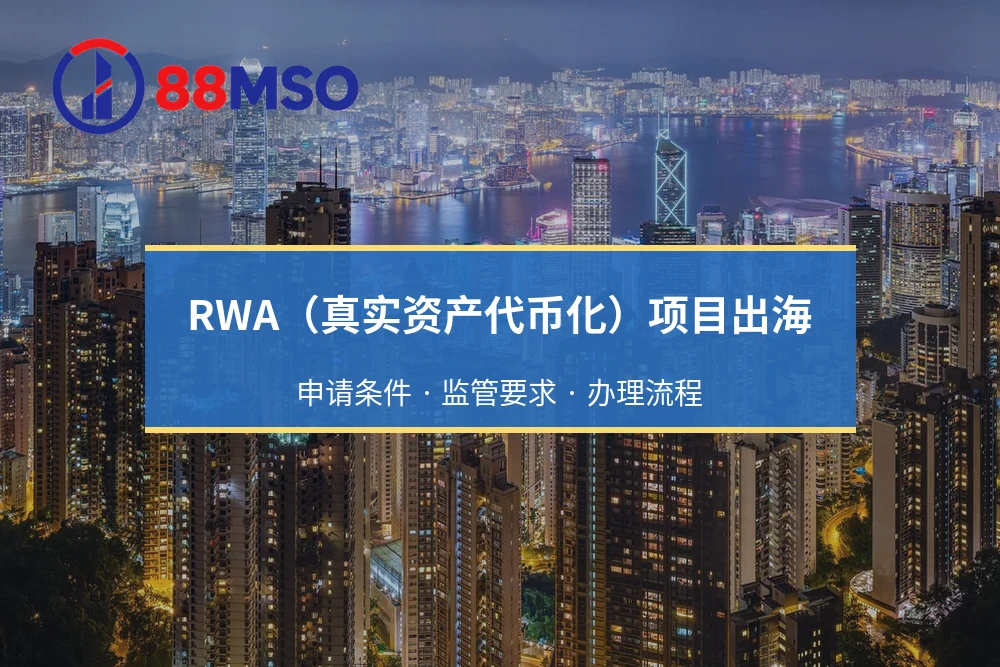
RWA (real asset tokenization) project goes overseas:Why does “license plate path” determine life or death?
RWA (Real World Assets) is becoming a new growth engine for the digital asset industry。Whether it is real estate income rights、accounts receivable、private placement credit、Fund shares,Or commodities and treasury bonds?,More and more asset management institutions、Both the FinTech platform and the Web3 team hope to increase liquidity through "tokenization"、Expand financing radius and reach global investors。
But the reality is:The technical threshold of RWA may not be the highest,Regulatory thresholds are often the biggest moat and elimination line。If the project party makes a wrong step in the licensing strategy,At worst, it may not be possible to trade online.、Unable to open bank account,In severe cases, cross-border law enforcement will be triggered、fine、Business interruption and even criminal liability risks。
therefore,Going overseas for RWA projects should not be about “product first”、Post-compliance”,Rather, it should be “Business Model、legal characterization、"License Plate Matrix" Synchronous Design。For institutions that want a robust layout,Use a professional team with practical experience in cross-border compliance (such as 88MSO/88MSO system, which has long been involved in the field of financial licensing in Hong Kong and overseas) to carry out pre-architecture planning,Often it can significantly shorten the implementation cycle and reduce trial and error costs.。
one、First clarify:What exactly is your RWA project legally?
Before discussing “which license plate to choose?”,The first step is not to look at which country is cheaper,But doLegal attribute split。Also called RWA project,Different structures may have completely different regulatory requirements。
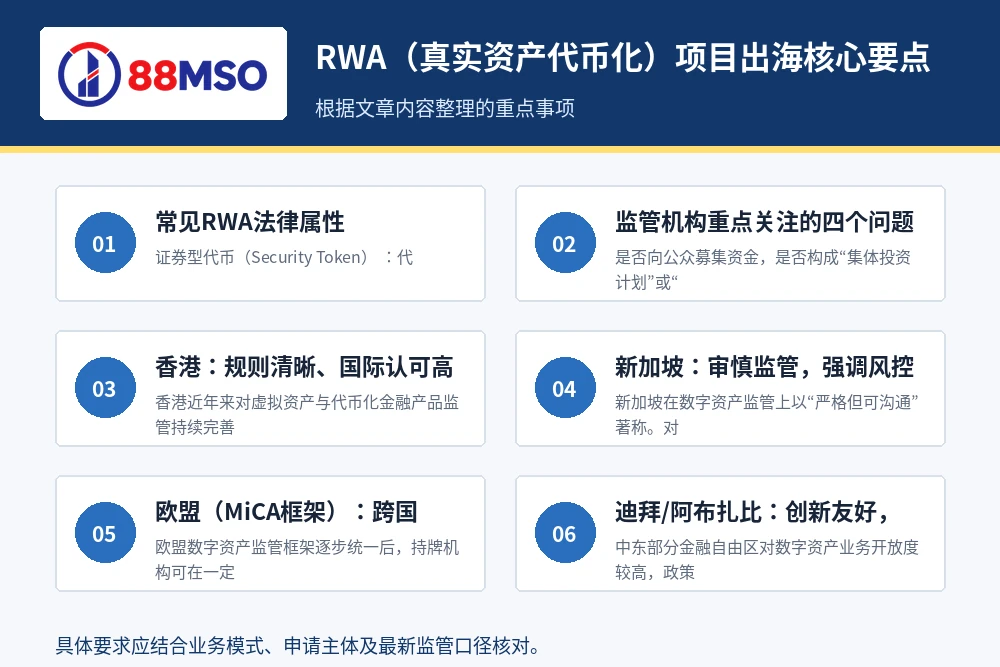
1) Common RWA legal attributes
- Security Token:Represents income rights、Dividend rights、debt、Fund shares, etc.,often fall under securities regulation。
- Payment/electronic money tokens:for payment settlement、Stored value、exchange,May trigger payment license or electronic money license requirements。
- Commodity/Derivatives Mapping Token:Track gold、crude、Carbon credits, etc.,May involve commodity regulation or derivatives rules。
- Platform matching and hosting services:If the platform provides transactions、market making、matchmaking、hosting、liquidation,Often requires additional permission。
2) Four issues that regulatory agencies focus on
- Whether to raise funds from the public,Does it constitute a "collective investment scheme" or a "public offer"?
- Can investors expect returns?,Is there an operator to manage and distribute profits?
- Whether the token can be circulated in the secondary market,Does it involve exchange/over-the-counter brokerage behavior?
- KYC、AML、Sanctions Screening、Are fund custody and information disclosure up to standard?
in conclusion:RWA cannot be covered by a “universal license”。What you need is the matching logic of "business links - regulatory obligations - license combination"。
two、How to choose the global mainstream RWA regulatory jurisdiction?
The following is a comparison of the five dimensions that project parties are most concerned about::regulatory clarity、Licensing feasibility、Bank account opening friendliness、Taxes and operating costs、International recognition。
1) Hong Kong:clear rules、High international recognition,Suitable for institutional RWA
Hong Kong has continued to improve its supervision of virtual assets and tokenized financial products in recent years.,SFC and related regulatory systems are forming a “predictable、Executable、Auditable” framework。For professional investors who want to serve、For the RWA team that connects Asian capital and traditional financial institutions,Hong Kong has obvious advantages。
- Advantages:Mature legal system、In line with international asset management standards、High acceptance by institutional investors。
- challenge:Detailed compliance requirements,RO (Responsible Officer)、Compliance officer、Internal Control Manual、High requirements for audit traces。
- Suitable for objects:Medium and large asset management、Brokerage technology、Family office platform、Teams looking for long-term financing and M&A exit。
If the project involves securities attribute tokens、asset Management、Distribution and trading services,It usually needs to be promoted simultaneously with the SFC-related license path and product compliance documents.。
2) Singapore:prudential supervision,Emphasis on risk control and substantive operations
Singapore is known for its “strict but communicative” approach to digital asset regulation.。to pay、hosting、Transaction and other business,Regulators attach importance to substantive governance、Directors’ Responsibilities and Anti-Money Laundering Mechanisms。
- Advantages:Strong international financial reputation、Highly recognized by institutional customers。
- challenge:The approval cycle and ongoing regulatory costs are relatively high。
- Suitable for objects:Pay attention to the Southeast Asian market、A team with strong institutional-level compliance capabilities。
3) European Union (MiCA Framework):Great potential for cross-border travel,Suitable for large-scale expansion
After the EU digital asset regulatory framework is gradually unified,Licensed institutions can expand regional services under certain conditions (“passporting” idea)。For RWA platforms planning to cover multiple EU countries,This model has strategic value。
- Advantages:Large market capacity、Rules are gradually unified。
- challenge:There are still differences in the implementation standards of different member states.,Compliance documents and localization requirements are heavy。
- Suitable for objects:Have a long-term budget、A team with multi-jurisdictional operational capabilities。
4) Dubai/Abu Dhabi:innovation friendly,Suitable for international pilot
Some financial free zones in the Middle East are relatively open to digital asset businesses,Positive policy support,Suitable as an innovation pilot and regional center。
- Advantages:Quick policy response、Ecologically active、International talent concentration。
- challenge:Need to accurately match free zone rules,Avoid "inconsistency between license scope and actual business"。
- Suitable for objects:Hope to quickly build an international business window、Institutions with link needs for Middle East funds。
5) North America (United States/Canada):Big market,But the density of law enforcement is high
North American market depth is high、Large amount of institutional funds,But compliance complexity and enforcement intensity are also significantly higher。Especially in the United States, there are multiple regulatory structures at the federal and state levels.,Business design needs to be very careful。
- Advantages:Capital market matures、Broad investor base。
- challenge:Rule fragmentation、High compliance costs、High law enforcement risk。
- Suitable for objects:Sufficient legal budget、A mature institution with long-term license operation capabilities。
three、Common "license combination" ideas for RWA projects
Real business is often not a “single license model”。The following are combination paths that appear frequently in practice::
Combination A:Issuance + Distribution + Asset Management
- Applicable:Tokenization of Fund Shares、Private Placement Credit RWA、Income rights products
- core requirements:Issuance compliance、investor suitability、continuous disclosure、Manager Responsibilities
Combination B:Trading platform + custody + clearing
- Applicable:RWA secondary circulation platform、Institutional matching market
- core requirements:market monitoring、Customer asset isolation、Cold/hot wallet risk control、Accident emergency plan
Combination C:Payment settlement + cross-border capital channel
- Applicable:RWA income distribution、Cross-border subscription and redemption、Stable currency settlement interface
- core requirements:Fund source verification、Suspicious transaction monitoring、Counter-sanctions screening、Bank channel stability
In 88MSO service case,Many projects mistakenly believe that “just get a lower-cost license first”,It was later discovered that the core business could not be covered,Doubling refactoring costs。The correct approach is to first make a "regulatory map",Then decide the initial jurisdiction and the pace of subsequent expansion.。
Four、Six decision-making dimensions for choosing a license plate (practical version)
1) Business model and revenue sources
Supervision will focus on "how you make money":management fee、Transaction fees、spread、Escrow fee、Distribution commission? Each type of income may trigger different regulatory obligations。
2) Customer types and fundraising methods
Is it for professional investors or retail investors? Private solicitation or public marketing? Do you want to expand your business across borders? This directly determines whether you can be exempted from some requirements。
3) Token circulation mechanism
Will the secondary market be allowed to trade freely? Is there a lock-in period? Are buybacks allowed? Do you want to access DEX/CEX? Circulation arrangements determine regulatory risk levels。
4) Bank account opening and fund settlement
No stable bank account,No matter how good the RWA design is, it cannot operate for a long time.。The feasibility of opening an account should be assessed as a prerequisite,Rather than "let's talk about it after we get the license plate."。
5) Taxation and entity structure
Where is the SPV located? Where is revenue recognized? How to arrange investor tax declaration? It is recommended to co-design tax planning and licensing strategy,Avoid later tax burdens from eroding profits。
6) Team and governance capabilities
Is there a compliance officer?、Risk control、internal audit、technical security、Legal document update capability? Regulators increasingly value "continuous compliance capabilities",Not a one-time application material。
five、The eight most common pitfalls for RWA when going overseas
- Treat "technical white papers" as "legal documents":Technical logic cannot replace regulatory disclosure。
- Ignoring the judgment of security attributes:Improper design of income commitment and return structure,Easily recognized as a securities offering。
- Operating with a borrowed license or operating beyond the scope:The license plate says "consultant",But they are doing "deal-making"。
- Only KYC and no transaction monitoring:AML is a continuing obligation,It is not a one-time verification when opening an account.。
- Mixing of funds and client assets:Custody isolation is not in place,Very high risk。
- Overreliance on a single jurisdiction:Lack of backup path when policy changes。
- Ignore marketing compliance:Cross-border social media promotion may trigger "illegal solicitation"。
- No exit and contingency plans:Unable to quickly stop losses and communicate when regulatory incidents occur。
six、Suggested landing path:90-Day Compliance Kick-off Framework
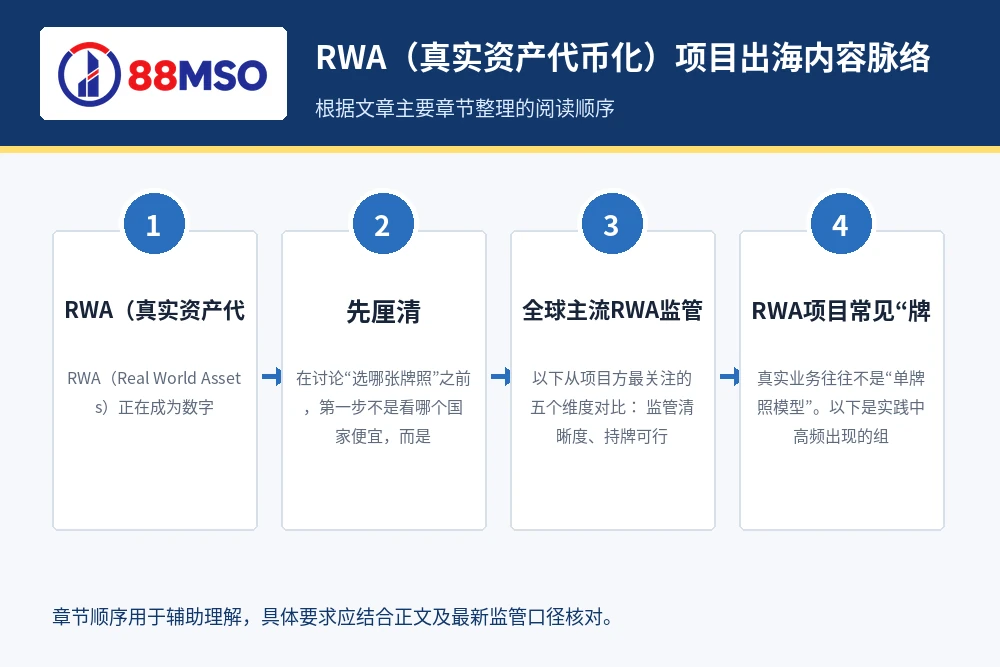
Phase 1 (1-3 weeks):Regulatory Feasibility Diagnosis
- Sort out the product structure、capital flow、Token rights and obligations
- Complete preliminary judgment of legal attributes and risk classification
- Screen 2-3 candidate jurisdictions
Phase 2 (4-8 weeks):License plate and architectural design
- Determine parent company、operating company、SPV、Hosting and Technical Services Entity Relationship
- Develop license application path and timetable
- Prepare for AML/KYC、Sanctions Compliance、Information disclosure、Core documents such as customer agreements
Phase 3 (9-12 weeks):Application preparation and operation in parallel
- Personnel appointments (e.g. compliance officer、RO/MLRO etc.)
- Set up transaction monitoring、audit trail、Accident emergency mechanism
- Promote the connection between bank account opening and payment channels
in this process,The value of professional service organizations is not only in “submitting applications”,More importantly, the law、license、bank、tax、Operation becomes an integrated project。88MSO has long-term focus on the implementation of Hong Kong financial licenses and related cross-border compliance,It is through "pre-compliance design + continuous hosting services" that helps enterprises reduce repeated rectifications and time loss。
seven、Is Hong Kong still the priority for RWA projects to go overseas?
For Chinese Capital Circle、Asian Investors Network、For family offices and cross-border asset management institutions,Hong Kong still has high strategic value。The reason is:
- Closely connected with international capital markets,Institutional language and institutional standards are mature;
- Regulatory framework becomes increasingly clear,Suitable for long-term licensed operations;
- Complete legal and financial services ecosystem,Facilitate the introduction of auditing、hosting、Law Firm and Bank Resources。
certainly,Whether to “prioritize Hong Kong” still depends on your customer base、Asset Classes and Trading Scenarios。The optimal solution is usually not "just pick one place",It is a hierarchical layout of “core licenses + regional supplementary licenses”。
Conclusion:RWA globalization,Win by preempting compliance rather than remediating it afterwards
RWA is the key bridge connecting traditional finance and on-chain finance,But its essence is not to “issue a token”,But to reshape asset issuance、hold、The entire process of trading and clearing。The more it is geared towards global investors,More and more, licenses and compliance should be regarded as the underlying infrastructure。
If you are promoting RWA projects overseas,It is recommended to do three things as early as possible:Clear legal characterization、Build license plate matrix、Establish a continuous compliance system。This will ensure business continuity during regulatory upgrade cycles,Realize the long-term value release after assets are put on the chain。
Determine first which activities actually require registration or licensing
Evaluating RWA (real asset tokenization) projects when going overseas,Should be exchanged for legal currency and virtual assets、Currency exchange、transfer、hosting、Check the trading platform and issuance-related services item by item,Instead of directly applying the VASP license just because the project uses blockchain。software development、Unmanaged technology services and self-operated distribution are treated differently in different jurisdictions。
Application materials usually focus on explaining equity and control rights、Directors and Compliance Officers、business plan、Customer and geographical risks、Real-time transaction monitoring、Wallet and private key control、Customer asset protection、network security、complaint、Outsourcing and auditing。Before starting cross-border business, you should also check whether there are any licensing or solicitation restrictions in the customer’s location.。
Industry references:Hong Kong Monetary Authority:Ensemble project and tokenized applications。
Read more:Comprehensive comparison of the world’s five largest cryptocurrency licenses in 2026:Hongkong、Singapore、Dubai、Estonia、Gibraltar、Vanuatu VFSC Digital Currency License:Compliance Path for Offshore Crypto Derivatives Exchanges。
Read more:Global digital currency license application and supervision topics。