 简体中文
简体中文 繁體中文
繁體中文 English

2026,Why is “License Selection” Determining the Life and Death of Crypto Companies?
From “barbaric growth” to “compliance competition”,The global encryption industry has entered a new stage in 2026:Capital no longer focuses on just technical stories,Ratherregulatory sustainability、Bank accessibility and cross-border scalability。For exchange、Hosting platform、OTC、payment channel、For stablecoin related service providers and Web3 infrastructure companies,Getting a license is not the end,It is the “ticket” for commercialization and institutional cooperation.。
in many jurisdictions,Hongkong、Singapore、Dubai、Estonia、Gibraltar is often listed as a "high frequency candidate"。But these five places are not simply "which one is easier to get",Rather, it represents five different regulatory philosophies:
- Hongkong:high standards、strong prudence、Bridging supervision between China and international capital。
- Singapore:risk stratification、Fintech friendly、Emphasis on sound operations and consumer protection。
- Dubai:Positive policies、Ecological advancement is fast、byBEForm regional competitiveness。
- Estonia:Tighter governance under the EU framework,Emphasis on substantive operations and anti-money laundering。
- Gibraltar:Establishing a DLT regulatory tradition early,Suitable for refined operations of specific business models。
This article will start from the regulatory framework、Application threshold、cycle cost、Feasibility of opening a bank account、Comprehensive comparison of five dimensions of tax and operational matching,Helping you make more strategic licensing decisions in 2026。
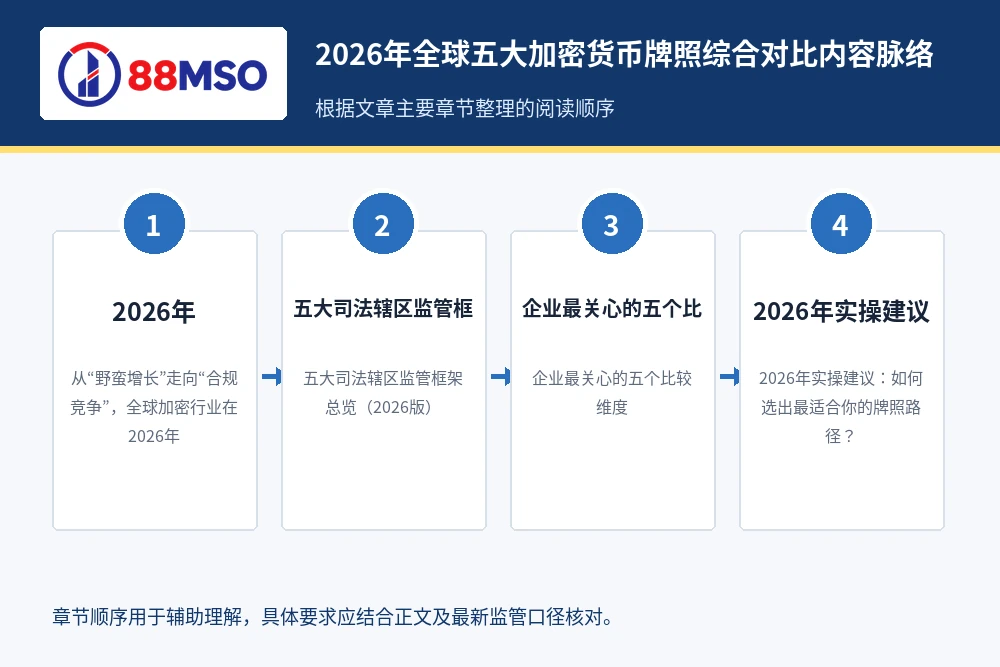
one、Overview of regulatory frameworks in the five major jurisdictions (2026 edition)
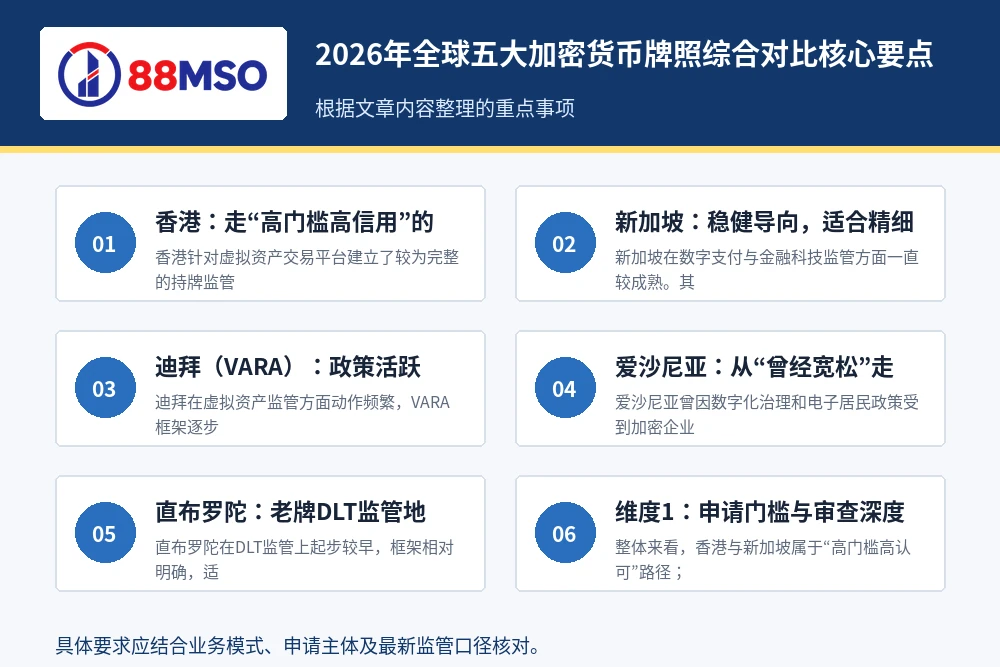
1) Hong Kong:Take the institutional route of “high threshold and high credit”
Hong Kong has established a relatively complete licensing supervision system for virtual asset trading platforms.,The core features areStrong AML/KYC、Strict governance structure、High ongoing compliance requirements。For those looking to connect with traditional financial institutions、Home office、Funds、For companies in the brokerage channel,Hong Kong licenses have strong brand endorsement value。
- regulatory characteristics:Strict pre-licensing review,Continuing intensive supervision after licensing。
- Adapt business:Compliance trading platform for professional and retail clients、Institutional service platform。
- Key capabilities:Compliance officer system、Transaction monitoring、Wallet security、Customer asset isolation。
If the company plans to expand into security tokens in the future、Fund distribution or more complex financial products,Hong Kong’s regulatory ecosystem has strong connectivity。To "do long-term、A team that works as an institutional client,This is a plus。
2) Singapore:Steady orientation,Suitable for refined financial technology operations
Singapore has always been relatively mature in regulating digital payments and fintech.。Its advantage lies in the stability of the system、The rule of law is clear、Complete international financial network;The difficulty lies in the detailed review of the application、High requirements for management team qualifications and risk control practices。
- regulatory characteristics:Focus on business model sustainability and consumer risk warnings。
- Adapt business:Payment encryption service、Institutional settlement、Regional financial technology hub layout。
- Key capabilities:Compliance system implementation capabilities、Pay equal attention to technology and risk control、Continuous reporting mechanism。
Singapore does not pursue “multiple dealing cards”,And more emphasis is placed on "to whom it is sent"、Can it operate in compliance with regulations for a long time?”。
3) Dubai (VARA):Active policy,Ecological construction is fast
Dubai takes frequent actions in regulating virtual assets,The VARA framework is gradually improving,Attracted a large number of international project sites。Its advantage is that the policy is open、Active investment promotion、Strong market narrative;The challenge is that businesses need to keep up with rapidly evolving regulatory details,Don’t just stop at the level of “getting cards”。
- regulatory characteristics:Clear classification of phased licensing and activities,Emphasis on local substantive operations。
- Adapt business:Regional expansion trading business、Web3 ecological project、Cross-border service platform。
- Key capabilities:Local team building、License activity boundary management、Cross-jurisdictional collaborative compliance。
4) Estonia:From "once loose" to "substantial compliance"
Estonia has attracted attention from crypto companies for its digital governance and e-residency policies,However, in recent years, supervision has become significantly stricter。The current logic is:It's not that you're not welcome,Rather, it requires companies to havereal business、real team、Real risk control。
- regulatory characteristics:More emphasis on AML/KYC、Review of funding sources and local business essence。
- Adapt business:Small and medium-sized European oriented business、A team focused on cost and digital governance efficiency。
- Key capabilities:Anti-money laundering system enforcement、Documentation and process auditability。
5) Gibraltar:Old DLT supervision place,fit specific model
Gibraltar started early in DLT regulation,The framework is relatively clear,Suitable for companies that require regulatory certainty and professional depth.。Although small in size,However, differentiated advantages can be formed in certain business segments.。
- regulatory characteristics:Emphasis on governance、Risk Management and Customer Protection。
- Adapt business:Professional trading or custody services、Institutions that value regulatory dialogue。
- Key capabilities:board governance、Technology risk management、Continuous Information Disclosure。
two、The five comparison dimensions that companies are most concerned about
Dimension 1:Application threshold and review depth
overall,Hong Kong and Singapore belong to the "high threshold and high recognition" path;Dubai is on the path of “rapid development but requires gradual refinement”;Estonia and Gibraltar prefer the "specific model + substantial operation" path。If the team wants to get the certificate quickly but internal governance is weak,It is easy to audit later、Renew license、Bank due diligence is blocked。
Dimension 2:Timeframe and budget pressure
The speed of approval in different regions、Consultancy costs、There is a big difference in local staffing costs。Enterprises should calculate based on "cost before obtaining the license + continuing cost after obtaining the license",Rather than just looking at the application fee。A common misunderstanding is to underestimate the cost of compliance maintenance after obtaining a license,Such as system upgrade、independent review、staff training、Trade monitoring tool subscriptions and more。
Dimension 3:Feasibility of bank account opening and fund settlement
No bank access,The value of the license will be significantly reduced。Generally speaking,The higher the regulatory reputation、The stronger the internal control,The higher the bank’s due diligence pass rate。Especially when it comes to fiat currency deposits and withdrawals、Merchant Acquirer、Institutional settlement business,KYC due diligence and transaction traceabilityis the key。
Dimension 4:Business boundaries and scalability
What you are doing today is spot trading,Hosting may be expanded tomorrow、financial management、Derived services、Cross-border payment。Different licenses have different definitions of business activities,If you choose the wrong jurisdiction early,Subsequent expansions will face repeated applications、Structural reorganization and even customer migration risks。
Dimension 5:Brand Credit and Financing Narrative
For institutional investors,"Which jurisdiction is the license in?、"Sustainable compliance" will affect valuation and transaction terms。Hongkong、Singapore is generally more recognized on the Asian institutional side;Dubai has unique advantages in terms of capital and ecological resources in the Middle East。Companies should incorporate “licenses” into their financing strategies,and not just as a legal matter。
three、Practical recommendations for 2026:How to choose the license path that’s best for you?
1) Determine the business model first,Redefinition of regulatory jurisdiction
Don’t start by asking “Which license is easiest?”,answer first:
- Who are the clients (retail/institutional/high net worth)?
- Core revenue comes from transaction fees、Escrow fee or payment settlement?
- Do you need multi-currency fiat currency channels?
- Do you plan to expand to multiple locations in the next 12-24 months?
Business model is unclear,Certain deviations in license plate selection。
2) Establish organizational capabilities of “compliance is product strength”
Regulatory trends in 2026 are already clear:Anti-money laundering capabilities are market access capabilities。It is recommended that enterprises assign MLRO/compliance managers as early as possible、Building tiered KYC、Deploy on-chain and off-chain transaction monitoring、Establish an auditable data retention mechanism。These abilities are a plus when applying for a license,After getting the card, it is the survival line。
3) Adopt the combined strategy of “main license + supplementary license”
It is often difficult for a single jurisdiction to take care of all businesses。A common strategy in practice is to use a highly reputable jurisdiction as the main license,Then undertake regional operations or specific functional modules through entities in other jurisdictions,To enhance global service flexibility and regulatory resilience。
4) Pay equal attention to "pre-application review" and "post-licensing annual review"
Many projects invest their budget in the licensing stage.,But ignore the follow-up maintenance。actually,Continued compliance determines license life。Includes internal control updates、regulatory communications、Compliance training、Independent reviews, etc. require an annual plan。A service team like 88MSO that has long been involved in financial compliance in Hong Kong and overseas,Usually, "application + implementation + annual review + optimization" are integrated,To prevent enterprises from “stalling after obtaining the certificate”。
Four、Concise decision-making matrix for five places (suitable for quick discussion by management)
- Pursuing institutional credit and core Asian markets:Prioritize assessment of Hong Kong/Singapore。
- Pursuing Middle East expansion and policy window:Focus on evaluating Dubai VARA。
- Budget sensitive and focused on small and medium-sized businesses in Europe:Assess Estonia and strengthen AML construction。
- Pursue DLT regulatory tradition and professional operations:Assessing Gibraltar。
If a company wants to take into account "brand credit + expansion speed" at the same time,A phased approach is recommended:First establish regulatory endorsement in core jurisdictions,Then make localization reinforcements in the target market。
five、Common Misunderstandings and Risk Tips
Myth 1:Treat the license plate as a "marketing label"
Regulators look at actual operations,What banks look for is transparency in the path of funds,What customers care about is asset safety。No substantial compliance,Licenses are difficult to convert into revenue。
Myth 2:Ignore cross-border data and privacy requirements
Customer data in different jurisdictions、transaction history、Audit traces have different requirements。If the cross-border system architecture is not designed well in the early stage,,Subsequent rectification costs are very high。
Myth 3:Only one-time application,No ongoing management
License plate maintenance is a long-term project。Enterprises need to review compliance incidents quarterly、Annual Upgrade Policy Manual,and maintain a communication mechanism with regulators。
Conclusion:2026,The real competition is “compliance execution”
Hongkong、Singapore、Dubai、Estonia、There is no absolute “best” in Gibraltar,Only "best match"。In a cycle of continued tightening of regulations,Licensing strategy should serve business strategy:available、Operable、Expandable、Financing available,Is the high-quality way to go overseas?。
For companies planning to develop cryptocurrency and Web3 businesses,It is recommended to complete the license feasibility assessment as soon as possible、Compliance gap diagnosis and bank channel plan design。Judging from the practical experience of 88MSO and the 88MSO behind it in the field of financial licenses in Hong Kong and overseas,Align regulatory logic and business logic in the early stage,It is often better to reduce long-term costs than "blindly getting cards quickly",And significantly improve the international implementation success rate of the project。
FAQ:Frequent issues for management
Q1:Which of the five places is easiest to apply for?
"Easy" depends on your business complexity and team foundation。If AML、KYC、Weak governance structure,Any jurisdiction becomes difficult。
Q2:Is it possible to get one license first and then apply for other regions?
Can,This is also a common path。But we need to design the company structure and customer migration mechanism in advance,Avoid subsequent duplication of construction。
Q3:Can I apply without a local team?
Most jurisdictions place increasing emphasis on local substantive operations。It is recommended to configure at least key compliance and management positions,Improve the stability of approval and license renewal。
Q4:What is the most likely problem after getting a card?
Usually continuous AML execution、Suspicious transaction monitoring、Internal training、Record retention and regulatory submissions are not timely。It is recommended to establish an annual compliance calendar。
Determine first which activities actually require registration or licensing
Evaluating the top five global companies in 2026Crypto & VASPWhen comparing comprehensively,Should be exchanged for legal currency and virtual assets、Currency exchange、transfer、hosting、Check the trading platform and issuance-related services item by item,Instead of directly applying the VASP license just because the project uses blockchain。software development、Unmanaged technology services and self-operated distribution are treated differently in different jurisdictions。
Application materials usually focus on explaining equity and control rights、Directors and Compliance Officers、business plan、Customer and geographical risks、Real-time transaction monitoring、Wallet and private key control、Customer asset protection、network security、complaint、Outsourcing and auditing。Before starting cross-border business, you should also check whether there are any licensing or solicitation restrictions in the customer’s location.。
Industry references:International Financial Action Task Force (FATF):Virtual asset regulatory information。
Read more:Vanuatu VFSC Digital Currency License:Compliance Path for Offshore Crypto Derivatives Exchanges、BVI Virtual Asset Service Provider (VASP) Act:Offshore Web3 project compliance requirements。