 简体中文
简体中文 繁體中文
繁體中文 English
Why are exchange shops “most afraid of surprise inspections”? Let’s first look at the regulatory logic of Hong Kong Customs
For Hong Kong Money Services Operators (MSOs),A surprise inspection does not mean "something happened",But the regulatory norm。Especially providing exchange、money transfer、Cross-border financial service stores,Because of its frequent transactions、Large cash flow、The customer structure is complex,Naturally at the forefront of anti-money laundering (AML) and counter-terrorism financing (CFT) regulation。Hong Kong Customs and Excise DepartmentAs one of the main regulatory agencies of MSO,The focus is not on “do you have a business?”,RatherAre you doing business in a compliant manner?。
Many operators misunderstand the surprise inspection because:Thinking that “as long as the license plate is valid, there will be no problem”。actually,Customs usually assesses multiple aspects simultaneously on site:Is the license plate display standardized?、Is customer due diligence (KYC) in place?、Is there a mechanism for monitoring suspicious transactions?、Are transaction records and vouchers complete?、Do employees understand internal policies?、Whether the person in charge can immediately cooperate with inquiries, etc.。Once the on-site answer is confusing、File cannot be retrieved、The program cannot be explained clearly,The risk rating will rise significantly。
therefore,What a money changer really does,Not a "temporary inspection",Instead, establish an implementable、Can be reviewed、Sustainable implementation of compliance operation system。For many companies that plan to operate financial businesses in Hong Kong for the long term,This is where the value of professional advisors lies:Translate regulatory language into everyday actions,Avoid "The system is well-written",If asked on the spot, he will tell you the truth.”。
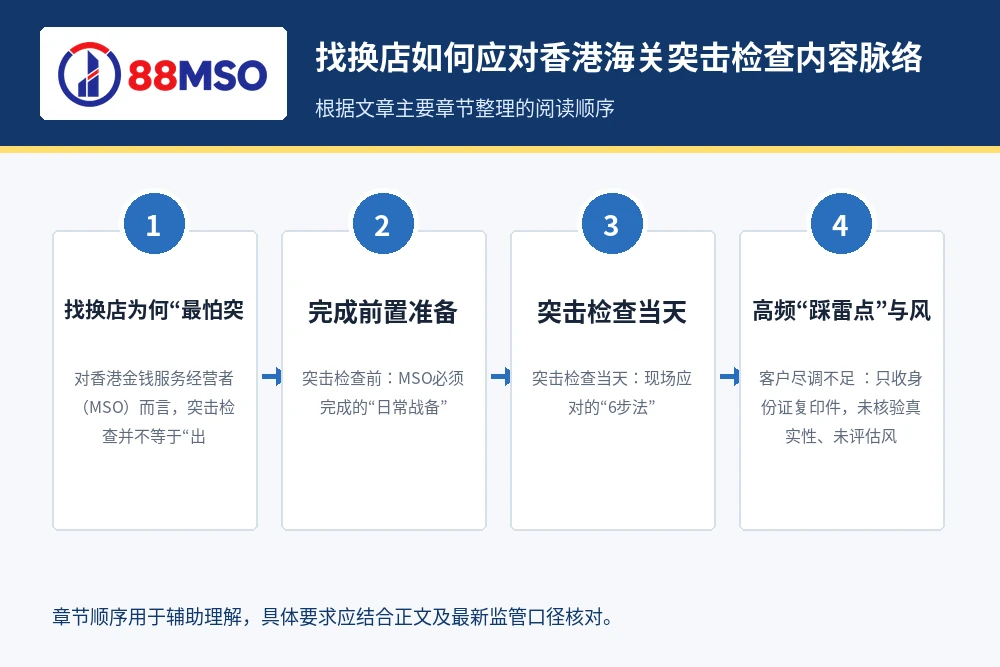
before surprise inspection:"Daily combat readiness" that MSO must complete
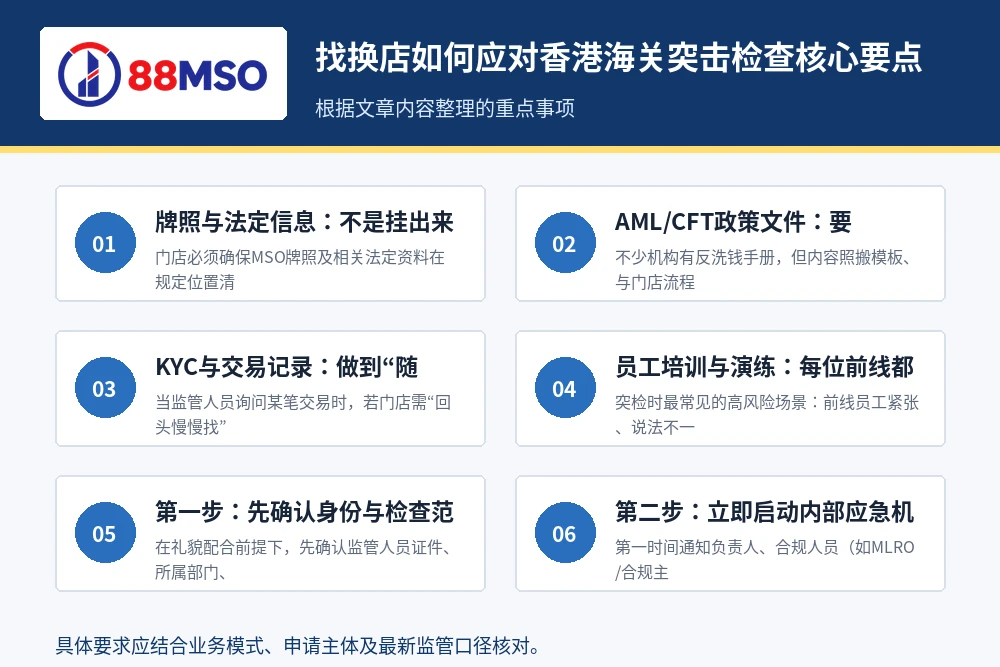
1. Licensing and statutory information:It doesn’t mean it’s completed just by hanging out.
Stores must ensureMSO licenseand relevant statutory information are clearly displayed in the prescribed location.,And the information is consistent with the actual operating entity。Frequently asked questions include:Branch address changes not synchronized、Business scope changes not updated、The information of the person in charge is inconsistent with the application documents, etc.。Such questions may seem like administrative details,may be considered a sign of weak internal controls.。
2. AML/CFT Policy Document:Be "executable",Not "printable"
Many institutions have anti-money laundering manuals,But the content copies the template、Out of touch with store processes。Truly compliant documents should be clear:
- Customer tiering criteria (low、middle、high risk)
- Amounts and circumstances that trigger enhanced due diligence (EDD)
- Internal reporting path for suspicious transactions (frontline → supervisor → compliance officer)
- Deal Rejection and Relationship Termination Criteria
- Record retention period and recall mechanism
What the customs cares about is:Do employees act according to this set of rules?,instead of file thickness。
3. KYC and transaction records:Be "available for withdrawal at any time"
When regulators ask about a transaction,If the store needs to "look back and find it slowly",points have usually been lost。It is recommended to establish a unified archiving system,Include at least:
- Customer identity information and verification records
- Transaction application form、Receipt、Remittance routing certificate
- Description of funding sources (if high-risk criteria are triggered)
- Exception handling records and internal approval traces
- Traces of suspicious transaction reports (if applicable)
The key is not just “having information”,Rather, it can accurately call up and explain in a short time。
4. Staff training and drills:Every frontline worker must know the "first words"
The most common high-risk scenarios during surprise inspections:Frontline staff are nervous、Different opinions、Feel free to commit、Information deleted by mistake。It is recommended to conduct a short exercise every quarter,Clarify the following division of labor:
- receptionist:Verify the identity of the visitor,Reception politely and notify the person in charge
- docking person:Unified communication from designated supervisor/compliance officer
- Get witnesses:Retrieve data by list,Avoid missing information
- Recorder:Record the key points of the inquiry、Timeline and Document Submission Checklist
The day of the surprise inspection:The "6-step method" for on-site response
first step:Confirm identity and scope of inspection first
On the premise of polite cooperation,Confirm the supervisor’s certificate first、Department、Check topic and scope。Not "confrontation",Rather, make sure the information is accurate,Avoid internal miscommunication and out-of-order responses。
Step 2:Immediately activate the internal emergency mechanism
Notify the person in charge immediately、Compliance personnel (such as MLRO/Compliance Officer) are present or remotely connected。If the company has an external compliance consultant,Notifications should also be synchronized,To quickly determine data integrity and response boundaries。
Step 3:Unified external caliber,Avoid "multiplayer and multiple versions"
Institutional questions should be answered from a single window。Frontline employees can explain the operating procedures truthfully,but should not explain the policy、legal judgment、Subjective speculation based on past cases。
Step 4:Deliver data according to the "request-retrieve-review-submit" process
Before submitting any documents,First internally review the version and completeness,and prepare a submission list。It is recommended to keep copies and time records,Ensure that “what was handed in” can be traced afterwards、When to hand in、To whom?”。
Step 5:to uncertain questions,Use careful expressions
The most taboo thing on site is to “take things for granted”。Compliance expressions can be used:For example, "This matter needs to be supplemented with a written reply after checking the records."。This is more professional than giving a hasty answer,It can also better reflect the awareness of internal control.。
Step 6:Leaving traces throughout the process,Prepare for subsequent rectification
Convert the inspection process into event files:Includes visit time、Question points、Retrieve information、On-site opinions、Subsequent replacement requirements。Many administrative penalties do not stem from "on-the-spot problems",But it comes from "failure to follow up"。
High-frequency “thunder spots” and risk consequences:Management must know
- Insufficient customer due diligence:Only photocopies of ID cards are accepted,Unverified authenticity、Risk level not assessed。
- No explanation for large/frequent transactions:Abnormal transaction pattern but no explanation of the source of funds and internal upgrade processing。
- No internal reporting mechanism for suspicious transactions:Employee 'feels weird' but doesn't know who to report it to、When to report。
- Record keeping confusion:Paper and electronic files are inconsistent,Missing page、Missing signature、Missing timestamp。
- Training becomes a mere formality:Only sign-in sheet,No assessment、No job content。
- Branches are disconnected from headquarters:The headquarters has a system,Stores operate based on “experience”。
Once these problems are identified,May trigger increased regulatory attention,Follow-up includes rectification orders、additional review、business restrictions,Serious cases may affect license renewal and continued operations.。For exchange shops that rely on capital flow efficiency,Compliance risk is essentially operational risk and reputational risk。
72 hours afterwards:Turn "being inspected" into "ability upgrade"
1. Convene a review meeting,Restore facts according to timeline
An internal review should be completed as soon as possible after the inspection.,Organize according to "What happened - why it happened - how to correct it"。Avoid holding individuals accountable,and ignore process flaws。
2. Create a CAP (correction and prevention) checklist
It is recommended that the rectification be divided into three levels:
- Fix now:Missing documents、Display is not standardized、File archiving error
- short term optimization:Update SOP、Supplementary training frontline、Improve approval thresholds
- long term mechanism:Systematic monitoring、Regular internal audits、external independent evaluation
3. Designate responsible persons and deadlines
If there is no responsible person and deadline for rectification,Usually "putting it off until next time"。The person responsible for each action should be clearly identified、milestone、Verification standards。
4. Bring in external compliance support when necessary
When an enterprise faces multi-store management、Cross-border customer structure is complex、Incomplete historical data, etc.,It may be difficult for internal teams to supplement capabilities in the short term。At this time, a professional team familiar with Hong Kong’s regulatory practices is introduced.,Can quickly transform “regulatory opinions” into executable plans。
From "payable inspection" to "sustainable compliance":Long-term strategies for MSO operators
A truly mature MSO will not treat unannounced inspections as accidental events,Rather, think of it as a stress test of governance levels。It is recommended to continue investing in the following four directions::
Institutional level:Annual Compliance Policy Update
regulatory requirements、sanctions list、Risk scenarios are changing,Institutional documents should be updated at least annually,and keep version records。
organizational level:Clarify the compliance governance structure
Director/Shareholder、Management、store supervisor、Compliance Officer、Frontline personnel should have clear boundaries of responsibilities,Avoid "everyone is responsible = no one is responsible"。
process layer:Embed critical control points into the system
For example, transaction threshold warning、Automatic customer risk stratification、Certificate validity reminder、Secondary approval of abnormal transactions, etc.。Be as systematic as possible,Reduce human omissions。
cultural layer:Let employees understand the “why”
Training should not just focus on “how to fill in the form”,Also talk about "Why do you do this?"。When employees understand the relationship between anti-money laundering and corporate survival,Execution ability will be significantly improved。
88MSO perspective:How professional hosting can help exchange shops reduce the impact of surprise inspections
In Hong Kong Financial Compliance Practice,Many companies do not lack business capabilities,What is lacking is the experience of “translating regulatory requirements into operational actions”。Judging from 88MSO’s long-term service experience,The most common difficulties faced by MSO organizations include:There is a disconnect between the system and store execution、The person in charge’s compliance responsibilities are unclear、Data trace standards are not unified、Rectify closed-loop deficiencies, etc.。
Through one-stop license and compliance custody ideas (including license application/maintenance)、AML framework construction、File template localization、Employee training and mock inspections、Annual review and rectification guidance),We can make surprise inspections a passive response,Move forward as a daily controllable management mechanism。For those who hope to steadily expand their capital business in Hong Kong、And for enterprises that simultaneously deploy overseas markets,This “compliance first” approach,Often less costly than remediation afterwards、More certainty。
FAQ:4 practical issues that exchange shops are most concerned about
Q1:During a surprise customs inspection,Can I refuse to provide information?
Should cooperate in accordance with the law。If you have questions about the scope of your request,Can be politely confirmed and recorded,Then provide it under the guidance of the person in charge of compliance。The focus is on “orderly cooperation、Complete traces”。
Q2:Will an employee's wrong words directly lead to punishment?
A single statement deviation may not directly trigger punishment,But it will expose insufficient training and internal control issues,Increase the intensity of follow-up review。Unifying the caliber and job drills is very important。
Q3:Only small amount exchange business,Do we still need a complete AML system?
need。What supervision looks at is whether the risk management framework matches the business,rather than size。Small stores may also involve high-risk transaction scenarios。
Q4:How often is appropriate to conduct an internal mock inspection?
It is recommended to do this at least once every six months,If the transaction volume is large or there are many stores,It is recommended to quarterly。A rectification list should be formed after each drill and followed up for closure。
Conclusion
"Raid inspections" are never an exception to MSO operations,It is a routine issue in Hong Kong’s financial compliance environment.。The real competitiveness of exchange shops,Not only in exchange rates and efficiency,What matters more is whether it can be proven from a regulatory perspective:Your business processes are trustworthy、Complete records、Team professional、Risk controllable。Make preparations as usual,Make response a process,Make rectification a mechanism,Only in this way can we maintain operational certainty in uncertain regulatory scenarios.。this,This is the underlying capability for MSO’s long-term and steady development.。
First determine whether the business falls within the scope of MSO based on capital flow.
When assessing how currency exchange shops respond to surprise inspections by Hong Kong Customs,What should be handed over from the customer to the company?、How the company exchanges or remits、Which accounts do the funds go through?、What assets are finally delivered to start drawing the capital flow?。Just looking at the product name is not enough to determine the scope of regulation;Involving legal currency exchange、Cross-border remittance、When collecting and paying virtual assets or third parties,It is also necessary to check separately whether other regulatory systems are applicable at the same time.。
Application and going concern information should cover actual business location、Equity and ultimate owners、fit and proper person、business plan、risk assessment、Customer due diligence、Sanctions Screening、Transaction monitoring、Report suspicious transactions、Record keeping and staff training。During on-site inspection,Institutional documents、Sampled customer files and bank statements must be mutually corroborative。
Read more:VASP license combined with MSO license:Compliance plan for stablecoin exchange business、Hong Kong MSO license application fee details:Register from company、Full breakdown of hidden costs from capital verification to license acquisition。