 简体中文
简体中文 繁體中文
繁體中文 English
introduction:Why is PSD2 reshaping the global payment and electronic money license landscape?
Pay across borders、digital wallet、Today’s rapid development of electronic money and embedded finance,EU PSD2 (Payment Services Directive 2)It is no longer just the regulatory rules of the European market,It is an important reference framework for compliance design of global financial technology companies.。For planning to apply or operate EMI (Electronic Money Institution,For companies with electronic money institution licenses,PSD2 is not just a question of “should you comply?”,But the key is "how to transform compliance capabilities into business competitiveness"。
Especially under the trend of Open Banking,API interface access、Third-party payment service provider (TPP) authorized access、Customer data protection、Strong Customer Authentication (SCA) and transaction monitoring mechanisms,It constitutes the core regulatory scenario for the daily operations of EMI institutions.。If the company also deploys in Hong Kong、EU and other international markets,It is even more necessary to establish a set of replicable、auditable、Scalable cross-jurisdictional compliance system。
This article will fully explain the open banking API compliance requirements under PSD2 from a practical perspective,And focus on the regulatory boundaries of EMI licensed institutions in data interaction、Technical specifications and risk control points,Help enterprises avoid detours in global business expansion。
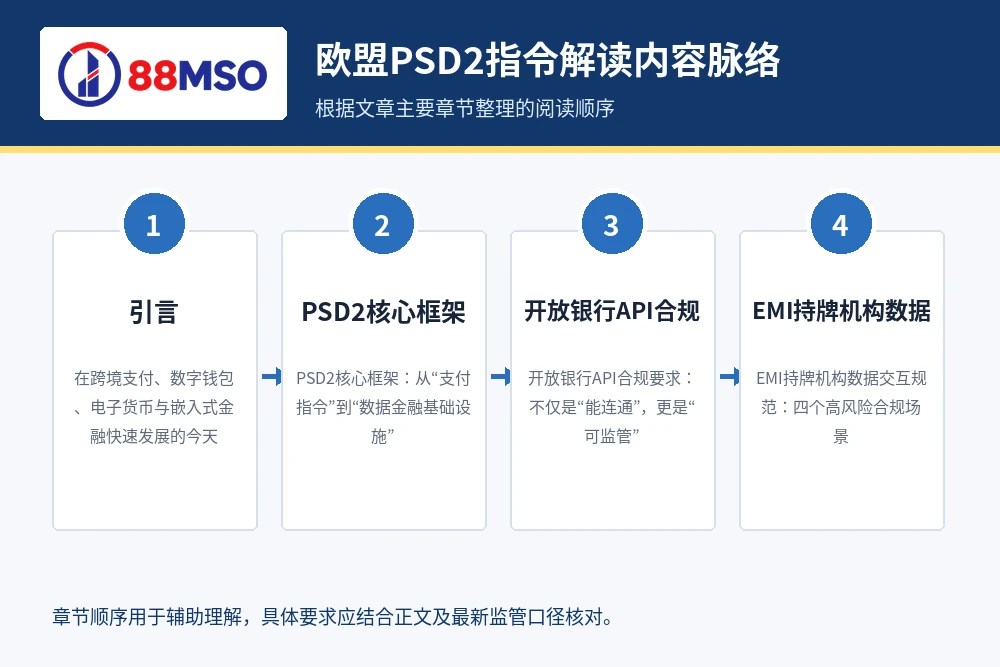
one、PSD2 core framework:From "payment instructions" to "data financial infrastructure"
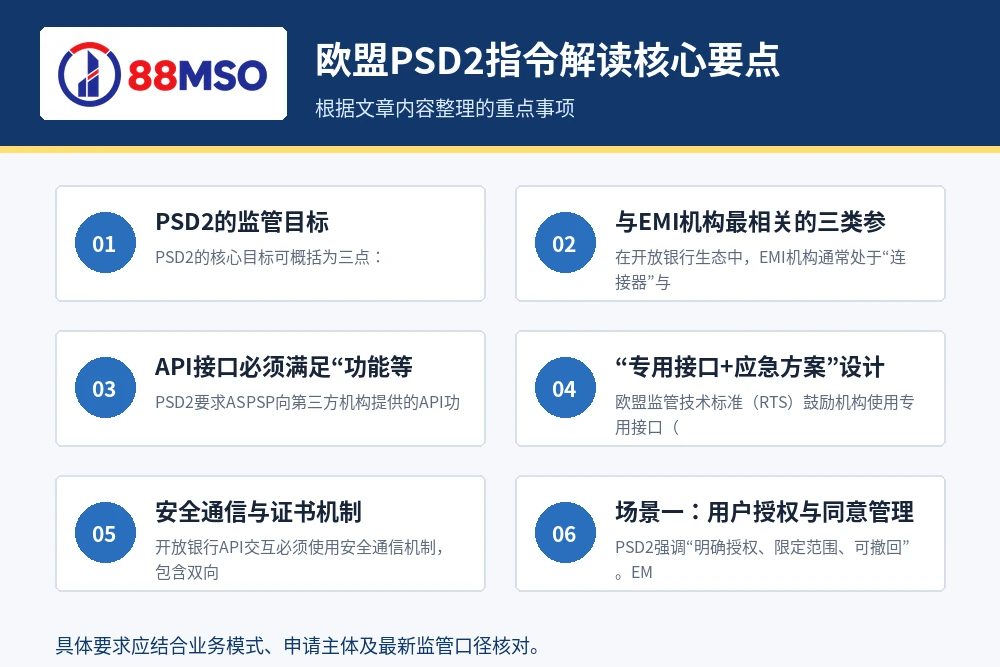
1. Regulatory objectives of PSD2
The core goals of PSD2 can be summarized in three points::
- Increase competition:Via Open Banking Interface,Allow authorized third parties to access account information and payment initiation services。
- Enhance security:Through SCA and secure communication standards,Reduce the risk of fraud and unauthorized transactions。
- protect consumers:Strengthen users’ right to know and control over data access and payment authorization。
2. The three types of participants most relevant to EMI institutions
In the open banking ecosystem,EMI organizations usually play the dual role of "connector" and "responsible body",Requires high-frequency interaction with the following organizations:
- ASPSP(Account Servicing Payment Service Provider):Usually a bank or payment institution that provides account services。
- AISP(Account Information Service Provider):Account information service provider,Can aggregate user’s multiple bank account data。
- PISP(Payment Initiation Service Provider):Payment initiation service provider,Can initiate payment instructions on behalf of users。
If EMI itself provides AISP/PISP services,then its compliance obligations will significantly increase,Includes interface availability、Authorization record、audit trail、Abnormal transaction identification, etc.。
two、Open Banking API Compliance Requirements:Not just "connected",It’s even more “regulatory”
1. API interfaces must meet the principle of "functional equivalence"
PSD2 requires ASPSP to provide API functions to third-party organizations,Must not be significantly inferior to its own online banking channels。in other words,"My own App can complete the operation" cannot appear.,Third-party interface is not supported" or "Interface delay、The failure rate is obviously high"。
For EMI organizations,This means that when choosing a partner bank or payment channel,Don’t just look at rates and settlement time,Also review the stability metrics of its open banking interface,For example:
- API success rate and average response time
- Concurrent processing capacity during peak hours
- Failover and emergency recovery mechanisms
- Version upgrade compatibility and documentation completeness
2. “Dedicated interface + emergency plan” design requirements
EU Regulatory Technical Standards (RTS) encourage institutions to use dedicated interfaces (Dedicated Interface),But the premise is that the interface quality is stable enough。If the interface fails to meet standards for a long time,Regulation may require emergency fallback mechanism (Fallback)。
In practice,EMI organizations should establish an API supplier management system,Write interface SLA terms into the contract,and set continuous monitoring thresholds,Ensuring that processes can be quickly switched in the event of a failure,Avoid payment interruptions and customer complaints。
3. Secure communication and certificate mechanism
Open banking API interactions must use secure communication mechanisms,Contains mutual TLS、Compliance Certificate Identification、Request signature verification, etc.。EMI organizations need to establish unified key and certificate life cycle management,cover:
- Certificate application、Update and revocation process
- Interface access permission classification (principle of least privilege)
- Abnormal call interception and log tracing
If only security capabilities were outsourced to technology vendors,The lack of internal audit and review mechanism,Often identified as governance deficiencies during regulatory inspections。
three、Data exchange specifications for EMI licensed institutions:Four high-risk compliance scenarios
Scene one:User authorization and consent management (Consent Management)
PSD2 emphasizes “clear authorization、Limited scope、Can be withdrawn”。Before the EMI institution collects account information or initiates payment,must ensure:
- Users have clearly understood the purpose of data、Access period、Shared objects;
- The scope of authorization is consistent with the business purpose,Do not collect excessively;
- Users can easily revoke authorization,and take effect immediately;
- Authorization records have time stamps and evidence retention capabilities。
The compliance pain point for many companies is not “whether there is an authorization page”,And in "Whether the authorization evidence is auditable"。It is recommended that consent management be integrated into the backbone of the compliance system,Rather than front-end interactive patch。
Scene 2:Strong Customer Authentication SCA Implementation
SCA is the most common in PSD2 implementation、It is also the most technically challenging requirement。In principle,Certification should be based on at least two of the following three elements:
- Knowledge elements (what the user knows,such as password)
- Possessed elements (owned by the user,Such as mobile phone token)
- Intrinsic elements (user characteristics,such as biometrics)
EMI institutions also need to pay attention to exemption conditions (such as low-risk transactions、Low amount scenario) and establish a transaction risk analysis model (TRA),Otherwise, it is easy to have two polar problems: "over-certification affects conversion" or "insufficient certification leads to violations"。
Scene three:Data Minimization and Usage Limitation
PSD2 and GDPR are highly coupled in data governance。Even if the user authorizes,It does not mean that organizations can retain or reuse data without restrictions.。EMI needs to establish a data classification and grading system,clear:
- What data is necessary for payment execution?;
- Which data is only used for risk control?,Not for marketing expansion;
- Data retention period and deletion trigger conditions;
- Legal basis and encryption standards for cross-border transmissions。
Scene four:Third-party service providers and outsourcing chain risks
Open banking business highly relies on technology middle platform、cloud services、Anti-fraud engine、Identity authentication service provider。The focus of supervision is not “whether there is outsourcing”,It’s about “whether the responsibility can still be traced after outsourcing?”。
EMI institutions should implement the following mechanisms in outsourcing management:
- Due diligence and access assessment (qualifications、finance、information security)
- Compliance clauses in contracts (audit rights、Data ownership、Incident notification time limit)
- Continuous monitoring (KPI、KRI、Penetration Test Report)
- Exit Plan (Service Interruption Alternatives、Data migration plan)
Four、Cross-border business perspective:How can EMI companies transfer PSD2 experience to other jurisdictions?
More and more companies adopt the multi-region license layout of "EU + Hong Kong + offshore structure"。at this time,PSD2 framework can be used as a base template,But it cannot be simply copied。The reason lies in the regulatory standards in various places、Differences in review focus and enforcement methods。
Take the Hong Kong market as an example,Businesses are paying、money transfer、electronic money、In business such as capital flow monitoring,Local anti-money laundering considerations also need to be considered simultaneously、Customer due diligence、suspicious transaction report、Continuous monitoring and other requirements。For institutions looking to build long-term cross-border business capabilities,The best path is usually:
- First use PSD2 standards to build “high-water level” technologies and processes;
- Then make local adjustments according to the target market regulations.;
- Form a unified group compliance governance and branch execution mechanism。
This is also the reason why many professional compliance service agencies emphasize “full case custody”:What businesses really need is more than license application documents,But from the admission、system、system、Integrated closed loop from personnel to follow-up audit。
five、EMI organization’s PSD2 implementation roadmap (practical version)
Stage 1:Compliance Gap Analysis
Organize existing business processes、System architecture、Authorization mechanism、API call logs and risk control model,Identify gaps with PSD2/RTS requirements。
Stage 2:target architecture design
Build a four-layer architecture of "business process - authority control - data governance - audit traces"。Make it clear which modules are built internally,Which modules can be outsourced for compliance?。
Stage 3:System and document system construction
should contain at least:
- Open Banking API Management Policy
- SCA and certification exemption policy
- Customer authorization and withdrawal management procedures
- Data life cycle and cross-border transmission specifications
- Outsourcing and Third-Party Risk Management Policy
- Incident response and regulatory notification mechanism
Stage 4:test、Exercises and audits
Functional testing before going online、Security testing、stress test、Abnormal transaction drill;Establish quarterly internal review and annual external review mechanisms after launch,Ensure ongoing compliance。
Stage 5:License maintenance and continuous optimization
Compliance is not a one-time project。EMI institutions should set up dedicated compliance positions and cross-departmental working groups,Continue to track regulatory updates、Interface indicators、Fraud landscape and complaint data,Dynamic optimization rules。
six、Common misunderstandings:Why Many Organizations “Technically Go Online”,But it’s still not compliant”?
- Myth 1:Treat PSD2 as a pure IT project
actually,PSD2 is a trinity project of "Legal + Operation + Technology"。 - Myth 2:Only do front desk authorization,No background evidence chain
No auditable evidence,It means that the compliance basis is not established.。 - Myth 3:Over-reliance on a single supplier
Lack of alternatives and oversight mechanisms,Outsourcing risks will be magnified。 - Myth 4:Ignoring the coordination of anti-money laundering and transaction monitoring
Open data improves efficiency,It also amplifies the pressure to identify suspicious transactions.。
Conclusion:Turn PSD2 compliance capabilities into a "passport" for global financial business
EU PSD2 is not a simple regulatory threshold,But the digitization of financial services、standardization、A key turning point for interoperability。For EMI licensed institutions,Who can take the lead in establishing a robust open banking API governance system?,Whoever is more likely to win long-term trust and scale advantages in cross-border payments and data finance scenarios。
strategically,Enterprises should advance PSD2 requirements into the product design and license planning stages,Rather than "making up for work" after business expansion。In the context of multi-jurisdictional operations,Rely on a professional team with cross-border practical experience,Can significantly reduce trial and error costs、Improve review pass rate,and accelerate the replication of compliance systems。Integrated support provided by professional platforms (such as 88MSO/88MSO system) that have long been involved in Hong Kong and overseas financial licensing and compliance services,It is an important help for many companies to complete the closed loop of "license application-system construction-continuous supervision"。
The sooner compliance is achieved、deeper,The higher the ceiling for business growth。This is the most realistic revelation that PSD2 has given to the global payment and electronic money industry.。
The license type must correspond to the funds and account functions
When planning the interpretation of the EU PSD2 directive,Payment should be made、transfer、Electronic currency issuance、wallet balance、Merchant Acquirer、Account information and card issuance functions are separated,Then determine whether it belongs to a payment institution、Electronic money institution or technology service。Just use "Pay license"Summary of all business,Easy to miss capital、Client Fund Guarantee and Outsourcing Requirements。
Application documents generally need to cover the governance structure、suitability of person in charge、business plan、financial forecast、Customer fund protection、Anti-money laundering、information security、major events、Agency and Outsourcing and Exit Arrangements。The Access Card Organization is an independent commercial and technical audit,Holding an EMI or PI license does not automatically entitle you to Visa or Mastercard membership。
Industry references:European Commission:Payment services and PSD2 official information。
Read more:European EMI license application comparison:Lithuania、Estonia、Cyprus、Which Poland is more suitable for you?、UK FCA foreign exchange license vs EMI/PI payment license:A dual-track compliance strategy for entering the UK market。