 简体中文
简体中文 繁體中文
繁體中文 English
European EMI license application comparison:Lithuania、Estonia、Cyprus、Which Poland is more suitable for you?
If you are planning cross-border payment、digital wallet、Corporate acquiring or multi-currency settlement,EuropeEMI(Electronic Money Institution,Electronic Money Institution) LicenseIt’s almost an inevitable step。The problem is:There are many countries to choose from in Europe,Why the market is always talking about Lithuania、Estonia、Cyprus、These four jurisdictions in Poland? More importantly,,Which of them is more suitable for your business stage and risk appetite?
Official verification:The regulatory scope covered by this article、Application Information and Ongoing Obligations,should beCyprus Securities and Exchange Commission Investment Company InformationThe current published information shall prevail。
When many companies make decisions,Just focus on "which one is faster" and "which one is cheaper",As a result, I got the license plate,But in the follow-up bank account、System audit、Anti-money laundering checks、Frequently encounter thunder when expanding cross-border。A truly professional route,Not "cheapest",RatherRegulation is explainable、Operational sustainability、Expandable and replicable。This article will start from the regulatory logic、Entry threshold、Implementation cost、time period、Business supporting facilities、Six dimensions of compliance pressure,Help you make an executable EMI site selection guide。
one、Find out first:Why do you need EMI,Instead of PI or other license?
In the European financial license system,EMI is often associated with PI (Payment institution license) are mentioned together with。Both can provide payment services,But EMI has the additional ability to issue electronic currency.,Suitable for wider payment ecological design,For example:
- Stored Value Wallet
- prepaid card、Virtual card issuance and balance management
- Platform-type fund collection and accounting (under legal structure)
- Multi-currency account system and corporate payment tools
If your business model involves "user balance", "wallet deposited funds" and "recurring payment within the platform",EMI is usually more strategic than PI。certainly,Regulatory requirements are correspondingly higher,in particularAnti-Money LaunderingAML、KYC due diligence、Fund isolation、IT security and governance structure。
two、Overview of the four countries:Let’s look at the conclusion logic first from a picture (text version)
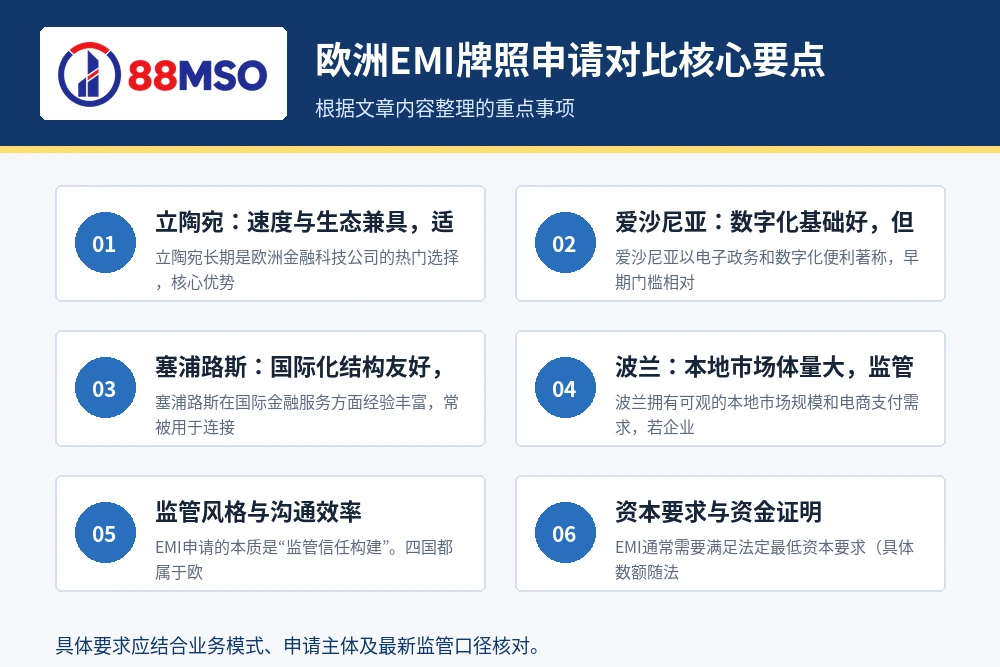
1) Lithuania:Both speed and ecology,Suitable for teams that “think fast but also need stability”
Lithuania has long been a popular choice for European fintech companies,The core advantage lies in:Supervisory communication is more efficient、The financial technology ecosystem is mature、English friendly working environment。For payment teams who want to obtain a license and enter the EU market in a shorter period,Lithuania is often the first choice。
Adaptation image:Already have a product prototype、Technical team taking shape、Medium and large start-up teams that hope to start compliance operations as soon as possible and connect with EU customers。
2) Estonia:Good digital foundation,However, after the supervision becomes stricter, “the threshold becomes more substantial”
Estonia is known for its e-government and digital convenience,The early threshold is relatively friendly。However, in recent years, under the background of high pressure on the EU’s overall anti-money laundering,Censorship has become significantly stricter。Estonia today,It is no longer synonymous with "low threshold and quick access to cards",Instead, it pays more attention to substantive operational capabilities and risk control systems.。
Adaptation image:Pay attention to digital management、Willing to invest substantial team and compliance resources、Enterprises that can accept the pace of prudential supervision。
3) Cyprus:Friendly international structure,Suitable for business collaboration in multiple locations
Cyprus has extensive experience in international financial services,Often used to connect Europe and the Middle East、african market。Its licensing path is more friendly to teams with experience in offshore structures or international shareholder backgrounds.,However, complete governance and risk control certificates are also required.。
Adaptation image:Hope to use an EU license to connect multi-regional businesses、An enterprise group with strong legal and tax planning capabilities。
4)Poland:The local market is large,Supervision emphasizes substantive operations
Poland has considerable local market size and e-commerce payment demand,If the company’s goal is not only to “obtain an EU license”,We also hope to deeply cultivate users in Central and Eastern Europe,Poland deserves major consideration。Supervision of local substantive operations、Staffing、Internal control processes usually require more clarity。
Adaptation image:Plan to do localized operations in the long term、Willing to build local team、Payment institutions that value physical market penetration。
three、key comparison dimensions:Don’t just ask “Is it fast?”,You have to ask, "Can I run for a long time?"
1) Supervision style and communication efficiency
The essence of EMI application is "regulatory trust building"。All four countries belong to the EU regulatory framework,But the style difference is obvious:
- Lithuania:Deep understanding of financial technology,The communication mechanism is relatively mature。
- Estonia:The review places more emphasis on “substantial compliance”,High document quality requirements。
- Cyprus:Rich experience in international business,Pay attention to structural transparency and risk boundaries。
- Poland:Cautious and steady,Pay more attention to proof of local operations。
suggestion:If it is your first time to be EU licensed,Priority will be given to jurisdictions with high “regulatory communication predictability”。
2) Capital requirements and proof of funds
EMI usually needs to meet statutory minimum capital requirements (the specific amount changes with legal updates and business scope)。But companies should pay more attention to:Capital sources explained、Ongoing capital adequacy planning、Customer fund isolation mechanism。Some teams only prepare "static capital verification",But ignored the capital replenishment plan for subsequent growth,It is easy to get stuck during the annual review or project expansion stage。
3) Local substance requirements (personnel、office、Governance)
The four countries generally demand that "it is not a paper company"。Common requirements include:
- Verifiable resumes of directors and senior executives,Have financial or risk control background
- Compliance officer、Head of AML、Clear configuration of internal audit functions
- Local office and operation records are traceable
- Key outsourcing arrangements have compliance management mechanisms
Businesses must realize:EMI is not a “one-time application project”,Rather, it is a continuous compliance management project。
4) Application cycle and uncertainty
The market often hears "a certain country gets a license in X months",But the truth depends on three things:
- Material Integrity (Business Plan、Risk Control Manual、IT security documentation)
- Shareholder and capital path transparency
- Supervisory inquiry rounds and response quality
Experience,The more solid the preparation in advance,The fewer late-stage supplements,The overall timeliness is faster。Blindly pursuing the “quickest path” is usually the beginning of slowing down progress.。
5) Bank and payment channel matching
getEMI licenseDoesn’t mean automatically having high-quality bank cooperation。Different jurisdictions in the banking ecosystem、Liquidate cooperation resources、Differences are evident in local partner networks。You need to design in advance:
- Main operating account and backup account strategies
- Client funds segregated account solution
- Multi-regional payment channel redundancy
- Transaction Monitoring and Suspicious Reporting Process
Four、Match by business stage:Which country is right for you?
Stage A:0Start at 1,The goal is to go online in compliance with regulations as soon as possible
If you are a financial technology team whose product has been launched or is about to be launched,Prioritize regulatory communication efficiency、Service provider maturity、English environment and technology outsourcing ecology。Usually Lithuania is more suitable。
Stage B:Already have cross-border transaction volume,The goal is steady-state expansion
The focus of this stage is to reduce compliance friction costs and improve cross-border replication capabilities。Structural comparisons can be made between Lithuania and Cyprus,Pay attention to taxes、Shareholder structure、target market connectivity。
Stage C:Group layout,The goal is to coordinate multiple licenses
When you not only do EMI,Also planning securities、Funds、When doing business such as insurance or lending,License coordination and regulatory coordination capabilities are critical。At this time, we should start from the "total cost of the group structure",Don’t just look at a single EMI application fee。
five、The three most overlooked risks
1) Treat license application as a “paperwork item”
EMI approval depends on "whether you can handle customer funds safely",It’s not who writes more beautifully。No real risk control process、Transaction monitoring logic and team responsibility matrix,It is difficult to pass regulatory inspections in the long term。
2) Neglecting the construction of AML/KYC system
In a high-pressure environment against money laundering,The most sensitive regulatory issues include:Customer identification、Beneficiary identification、Suspicious transaction identification、Sanctions list screening、Continuous due diligence and reporting timeliness。System is imperfect,Subsequent rectification costs are extremely high。
3) There is no “12-month operation plan after obtaining the license”
Getting cards is just the starting point。you need to be clear:Target transaction size in first year、Compliance budget、audit plan、Key partner organizations、Staff expansion path。No operational roadmap,The value of the license plate will depreciate quickly。
six、Practical suggestions:How to improve the success rate of EMI application
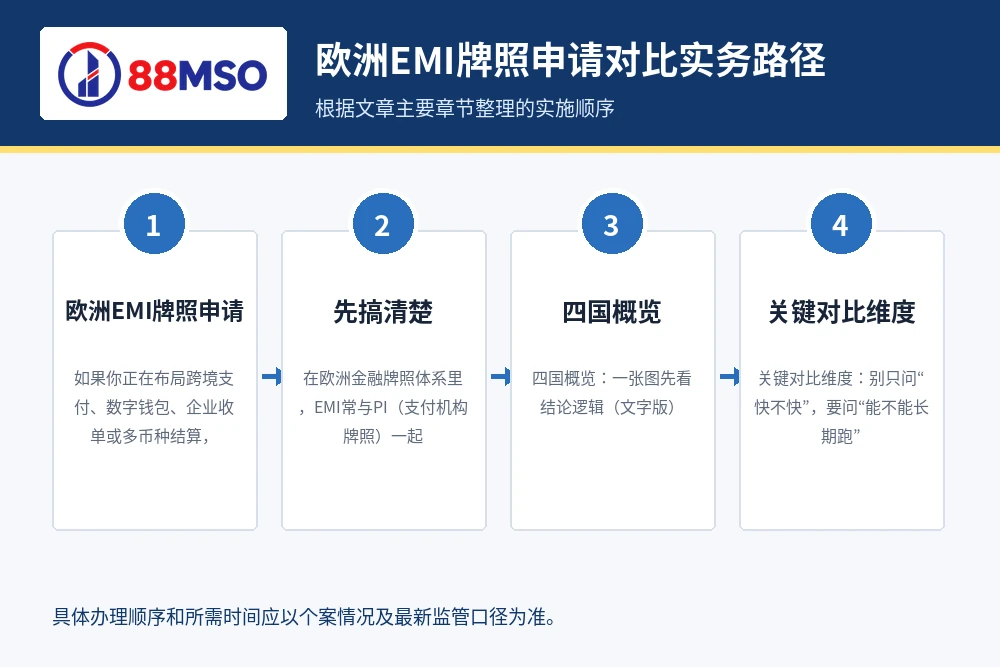
- Do regulatory adaptation diagnosis first:Confirm whether the business model involves electronic currency issuance、wallet balance、Cross-border clearing and settlement。
- Build three sets of core documents in advance:business plan、AML/KYC Policy、IT and Data Security Handbook。
- Establish a governance structure:Board Responsibilities、Compliance reporting path、The outsourcing management system must be implementable。
- Prepare regulatory inquiry packet:Equity、Source of funds、target market、Transaction flow path forms standard reply template。
- Parallel Planning for Bank Account Opening:License and account strategies are advanced simultaneously,Avoid "having a license but no account"。
In complex projects like this,It is particularly important to select consultants with cross-jurisdictional experience。Like the 88MSO team that 88MSO relies on,Long-term handling of Hong Kong and overseas financial licensing and compliance projects,Can open up "pre-application design - approval communication - post-licensing maintenance" into an integrated path,Help enterprises reduce the risk of repeated parts replacement and later compliance rework。This ability is often more critical in cross-border payment projects than "superficial low price"。
seven、in conclusion:There is no "best country",Only "best matching path"
Back to the title question:Lithuania、Estonia、Cyprus、Poland,Which one is more suitable for you? The answer depends on four key words:business model、Team maturity、regulatory preferences、expansion goals。
If you want speed and ecology,Lithuania usually takes precedence;If you emphasize digital governance and accept greater scrutiny,Estonia may be considered;If you want international structural coordination,Cyprus is more flexible;If you want to take root in the local market of Central and Eastern Europe,Poland is more strategic。
A truly professional approach to decision-making,The first step is to make a “business-supervision matching diagram”,Determine the landing area,Rather than selecting a country first and then forcibly changing the business。Treat compliance as part of product strength,Your EMI license will become a growth engine,rather than cost center。
FAQ:The 4 most frequently asked questions by companies
Q1:After obtaining the EMI license, can it directly cover the entire EU?
Services can often be expanded through cross-border mechanisms within the EU framework,However, the notification/filing process still needs to be completed according to the rules.,and meet the local requirements of the target market。
Q2:Registered capital is ready,Will it be successfully approved?
not enough。Supervision pays more attention to transparency of funding sources、governance structure、AML system、IT Security and Sustainability。
Q3:Can it all be outsourced?
Some functions can be outsourced,But key control responsibilities cannot be outsourced。The board of directors and management remain ultimately responsible for compliance results。
Q4:What should you do first before applying?
Do a compliance feasibility review first (License Feasibility Review),Find out whether your business requires EMI、Which country has the best regulatory fit?,Then enter the formal application。
The license type must correspond to the funds and account functions
When planning European EMI license applications for comparison,Payment should be made、transfer、Electronic currency issuance、wallet balance、Merchant Acquirer、Account information and card issuance functions are separated,Then determine whether it belongs to a payment institution、Electronic money institution or technology service。Only use "payment license" to summarize all businesses,Easy to miss capital、Client Fund Guarantee and Outsourcing Requirements。
Application documents generally need to cover the governance structure、suitability of person in charge、business plan、financial forecast、Customer fund protection、Anti-money laundering、information security、major events、Agency and Outsourcing and Exit Arrangements。The Access Card Organization is an independent commercial and technical audit,Holding an EMI or PI license does not automatically entitle you to Visa or Mastercard membership。
Industry references:European Commission:Payment services and PSD2 official information。