 简体中文
简体中文 繁體中文
繁體中文 English
Stable currency exchange business enters "strong supervision era":Why do I need to look at VASP and MSO at the same time?
past few years,Stablecoins are rapidly evolving from “intermediaries for crypto trading pairs” to cross-border payments、OTC clearing、Web3 is an important infrastructure for deposits, withdrawals and global fund transfers.。For service providers targeting corporate clients or high-net-worth clients,The exchange chain of "fiat currency-stable currency-fiat currency" is no longer a gray area.,Instead, the focus of supervision is on areas。
In Hong Kong and related cross-border scenarios,Many teams initially only focus on one license:Or just watchVASP (Virtual Asset Service Provider),Or just watchMSO(Money Service Operator,money service operator)。But when the business reaches "stable currency exchange + fund transfer + customer custody + cross-border settlement",Single-license thinking often leads to structural compliance gaps,Typical consequences include:Bank account is restricted、Transaction link is cut off、AML review failed、and even trigger law enforcement investigations.。
therefore,The truly sustainable path is not “which license plate to choose”,but to establishFunctional collaboration model between VASP and MSO:Give license plate boundary、business process、Customer stratification、Risk control rules、Funding paths correspond to each other,form an interpretable、auditable、Implementable compliance system。
First clarify the underlying logic:What do VASPs and MSOs do?
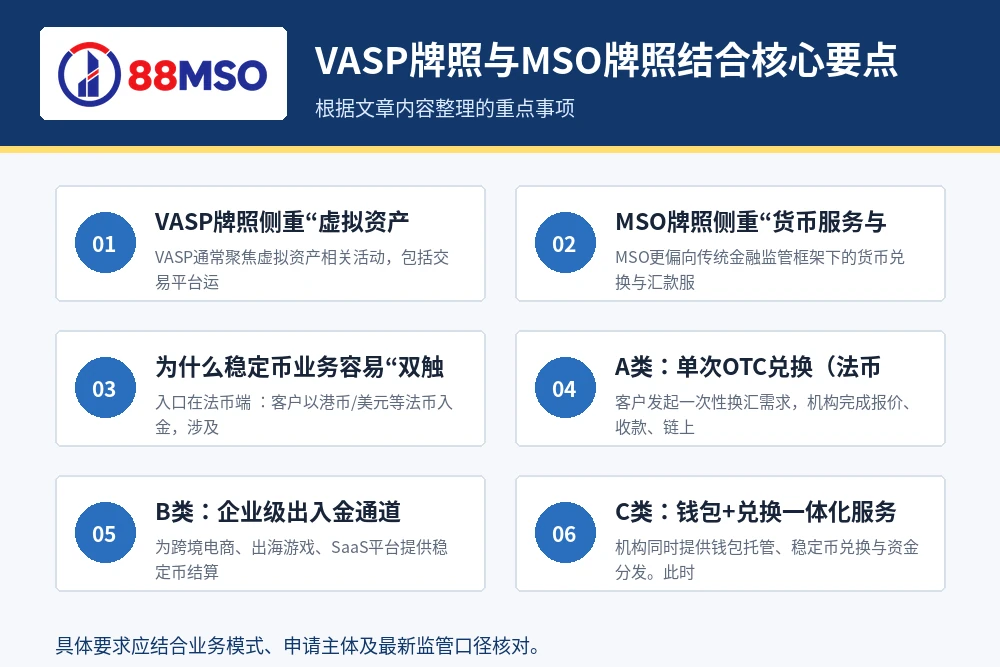
1) The VASP license focuses on “virtual asset activities themselves”
VASPs typically focus on virtual asset-related activities,Including trading platform operations、Virtual asset matching、Escrow arrangements、Related transaction execution, etc.。If your business involves stablecoin buying and selling,、Exchange within the platform、Virtual asset wallet interaction、On-chain transaction monitoring, etc.,VASP is one of the core thresholds。
2) The MSO license focuses on “money services and fund transfer”
MSO prefers currency exchange and remittance services under the traditional financial regulatory framework。If your scenario involves legal currency collection and payment、Remittance on behalf of customers、Cross-border funds transfer、Cash flow or electronic funds flow management,MSO compliance requirements are often triggered。Once the stable currency exchange business is connected to the legal currency side,The MSO dimension is almost unavoidable。
3) Why is the stablecoin business prone to "double triggering"?
- The entrance is on the legal currency side:Customers deposit funds in legal currencies such as Hong Kong dollars/US dollars,Involving money services regulation。
- The middle is at the top of the chain:Convert to stablecoins such as USDT/USDC,Triggering virtual asset regulation。
- Export at the cross-border end:Stablecoins can be liquidated or liquidated into overseas accounts,Triggering AML and fund flow review。
Typical business model and regulatory mapping of stable currency exchange
In order to understand the dual license synergy more intuitively,We can divide common businesses into four categories:
Category A:Single OTC exchange (fiat currency ↔ stable currency)
A customer initiates a one-time currency exchange request,Agency completes quotation、Collection、Transferring coins on the chain。This type of pattern seems simple,But if there is no clear customer due diligence and funding source explanation,,Easiest to trigger AML alerts。
Category B:Enterprise-level deposit and withdrawal channels
For cross-border e-commerce、Overseas games、The SaaS platform provides stablecoin settlement and repayment services。This model has high transaction frequency、The path is complex,The focus of supervision has been upgraded from "single legality" to "systemic risk control capabilities"。
Category C:Wallet + exchange integrated service
The institution also provides wallet custody、Stable currency exchange and fund distribution。At this time, in addition to license plate adaptation,Also solve private key management、Transaction authorization、Higher-level compliance technical issues such as suspicious transaction identification。
Category D:Agency matching and liquidity intermediary
The platform itself does not directly hold currency,But it matches buyers and sellers and assists with settlement。Many teams mistakenly believe that "if I don't touch the assets, I won't be supervised.",In fact, as long as you participate in key aspects of the transaction process,May still be considered a regulated activity。
Dual license compliance plan design:From "license application" to "operation closed loop"
first step:Business boundary reconstruction (business first,rear license plate)
It is recommended to draw the complete transaction link first:Acquire customers、Open an account、payment、exchange、transfer out、Reconciliation、Refund、Dispute handling。Then label it step by step:
- Who contracts the client?
- Who actually collects the money?
- Who performs on-chain transfers?
- Who is responsible for KYC and transaction monitoring?
Only the boundaries are clear,Only then did I know how to configure the principal in VASP and MSO、Authority and Responsibilities,Otherwise, it is easy to appear that "the contract is in Company A"、Payment is received at Company B、Risk control is in the C-team’s supervisory high-risk structure。
Step 2:Main structure construction (company level + license level)
In practice,Mature institutions usually adopt the approach of “stratified entities + unified risk control”:Different entities carry different regulated activities,But in AML、audit、Alignment of data retention and management accountability。This can not only meet the regulatory penetration requirements,It is also conducive to future business expansion (such as new payment、Security tokens or fund-related services)。
at this step,Service organizations like 88MSO that have long been involved in financial compliance in Hong Kong,The value is not in "filling in forms",It’s about helping companies translate their business models into something that regulators can understand.、Can approve、Structured solutions for sustainable operations。
Step 3:Implementation of AML/KYC system (determines whether you can survive)
The core of regulation for stablecoin business is anti-money laundering,Not marketing。An auditable system usually includes:
- Customer layer due diligence:personal、enterprise、high risk industries、Differentiated Review of Politically Exposed Persons (PEP)。
- Proof of source and purpose of funds:Not just "see ID card",Also “look at where the money comes from”、Where to go?”。
- On-chain address risk screening:Identify high-risk wallets、Coin mixing service associated address、Sanctions List Related Transactions。
- Suspicious transaction reporting mechanism:Set trigger threshold、manual review、Internal upgrade and external declaration process。
- Continuous monitoring:It’s not the end of the account opening process.,Rather, it is a full-cycle review of the transaction.。
The reason why many institutions fail is not because they have no institutional documents,It’s that the system cannot be mapped to actual operations。Supervision pays more attention to “whether you actually implement it”。
Step 4:Bank account opening and fund routing compliance
Can Stablecoin Business Scale?,The key depends on whether the bank accepts your trading model。Banks usually focus on reviewing:
- Is the license consistent with the business?;
- Is the customer portrait clear?;
- Is the closed loop of funds traceable?;
- Is there an evidence chain for abnormal transaction processing?。
therefore,Companies should prepare a “compliance narrative package” before opening an account:business description、Risk control flow chart、Transaction Monitoring Rules、Audit trace example、Description of management responsibilities, etc.。If you wait until the bank inquires, you can temporarily provide the materials.,Often miss the window period。
Frequent misunderstandings:Why do many stablecoin projects “have licenses but are still high-risk”?
Myth 1:Treat licenses as "marketing endorsements" rather than "operational constraints"
Getting a license is just the starting point。If the subsequent operation does not comply with the declared scope,Or the new business has not been evaluated for compliance.,Risks accumulate quickly。
Myth 2:KYC only performs formal review
Just keeping the ID card and company registration certificate is not enough。Regulators and banks pay more attention to beneficial owners、Transaction purpose、Historical behavior and fund authenticity。
Myth 3:On-chain monitoring is separated from legal currency monitoring
Only look at data on the chain,Don’t look at bank statements;Or just use fiat currency turnover,Don’t look at wallet behavior,will lead to monitoring blind spots。Stablecoin scenarios must undergo "on-chain + off-chain" linkage review。
Myth 4:Neglect of employee and management responsibilities
Compliance is not a one-man show for legal departments。business、Risk control、customer service、Finance must be included in training and accountability,In particular, the abnormal transaction upgrade mechanism must be run through。
An actionable 12-month compliance roadmap (practical version)
0-3 months:Diagnosis and architectural design
- Complete inventory of business processes and license trigger points;
- Determine the main structure、Contract path and funding path;
- Establish basic KYC and high-risk customer access standards。
4-6 months:Institutions and systems go online
- Due Diligence for Online Customers、Transaction monitoring、Address screening tool;
- Establish SOP for suspicious transaction identification and reporting;
- Prepare bank account opening materials and regulatory communication drafts。
7-9 months:Stress testing and audit drills
- Simulate peak trading scenarios,Test risk control threshold;
- Sampling review of KYC file integrity;
- Conduct internal audit and management accountability drills。
10-12 months:Optimize and expand
- Optimize risk rules based on actual cases;
- Assess regulatory differences for business in new countries/regions;
- Establish an annual license maintenance and ongoing compliance mechanism。
How should companies choose a compliance partner?
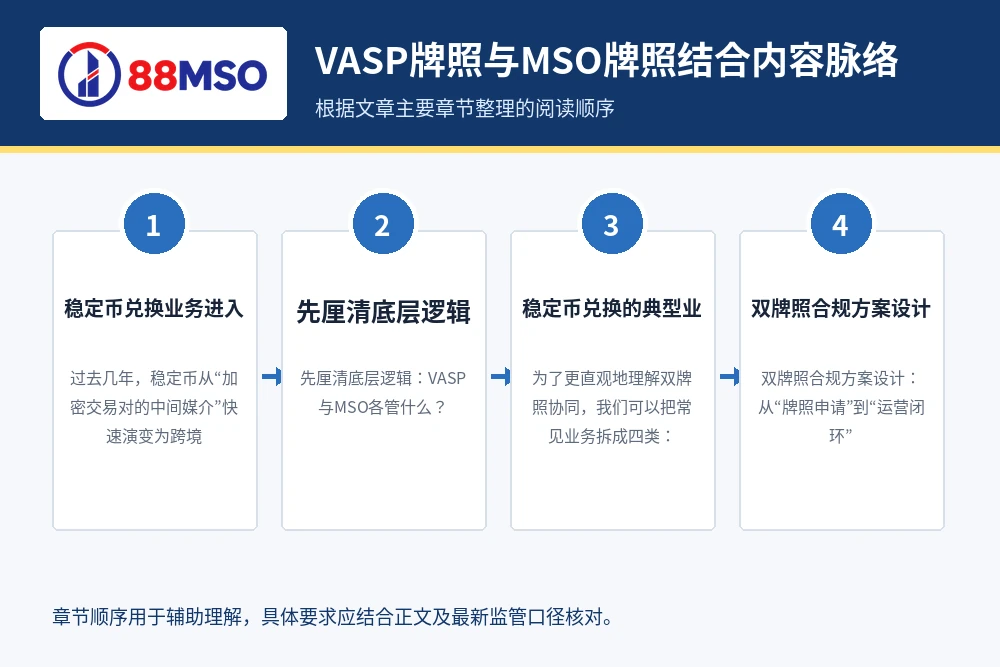
Stablecoin exchange is not an a la carte service,Often involves license application、Institutional design、Bank communication、Continuous review、Team training and other full-chain work。When choosing a service agency,Three points should be given priority:
- Is there the ability to integrate across licenses?:Can you understand Web3 regulation and traditional financial regulation at the same time?。
- Are there any implementation cases?:Not only can we talk about policies,Better solution for account opening、audit、Practical questions such as inquiries。
- Whether long-term maintenance is provided:After the license is approved,annual review、change、System upgrade is also critical。
Take the service logic of 88MSO and its 88MSO team as an example,The core advantage lies in the integration of "regulatory language"、banking language、"Business Language",Help enterprises reduce post-operation friction from the application stage,Achieve "obtaining a license"、Open an account、Running business、Stands up to inspection”。
Conclusion:Dual licenses are not cost stacking,But a business moat
On the stablecoin exchange track,The real competitiveness has shifted from "who offers the lower price" to "whose compliance is more stable"。The combination of VASP and MSO,Should not be construed as duplication of investment,It should be regarded as infrastructure construction for cross-border capital business.。only on license plate、AML、bank relationship、The four dimensions of internal governance met the standards simultaneously,Only companies can survive the regulatory cycle,Achieve long-term growth。
If you are planning to build a stable currency exchange business,The most important thing now is not “go online first and then make up for compliance”,Instead, complete the compliance architecture design first,Proceed according to the road map。Compliance intervenes sooner,subsequent capital efficiency、The higher customer trust and global expansion flexibility will be.。
FAQ:Frequently Asked Questions about Stablecoin Exchange Business
Q1:Can only VASP do stablecoin exchange?
uncertain。If the business involves legal currency exchange、Remittance or funds transfer,Typically MSO requirements also need to be evaluated。Should be judged based on specific processes,Rather than drawing conclusions based on a single label。
Q2:Can I open an account smoothly after getting the license?
Not necessarily。Banks pay more attention to the combination of “license + real risk control capability + traceable capital path”。Any missing item may affect account opening or subsequent account stability.。
Q3:Can small and medium-sized teams be able to do high-standard AML?
Can。The key is to build in stages:Deepen the high-risk links first,Then gradually expand to full-process automated monitoring。
Q4:Will the dual license model significantly increase costs?
In the short term, it will increase institutional and system investment.;In the long run, it can reduce account freezes、Transaction interruption、Enforcement risk and brand attrition,Comprehensive costs are more controllable。
First determine whether the business falls within the scope of MSO based on capital flow.
EvaluateVASP licenseWhen combined with MSO license,What should be handed over from the customer to the company?、How the company exchanges or remits、Which accounts do the funds go through?、What assets are finally delivered to start drawing the capital flow?。Just looking at the product name is not enough to determine the scope of regulation;Involving legal currency exchange、Cross-border remittance、When collecting and paying virtual assets or third parties,It is also necessary to check separately whether other regulatory systems are applicable at the same time.。
Application and going concern information should cover actual business location、Equity and ultimate owners、fit and proper person、business plan、risk assessment、Customer due diligence、Sanctions Screening、Transaction monitoring、Report suspicious transactions、Record keeping and staff training。During on-site inspection,Institutional documents、Sampled customer files and bank statements must be mutually corroborative。
Industry references:Hong Kong Customs and Excise Department:Money service operator supervision and licensing information。
Read more:Hong Kong MSO license application fee details:Register from company、Full breakdown of hidden costs from capital verification to license acquisition、Hong Kong MSO License vs Money Lender License:business model、Comparison of capital requirements and application difficulty。