 简体中文
简体中文 繁體中文
繁體中文 English
Hong Kong MSO License vs Money Lender License:Why does this multiple-choice question determine your business ceiling?
Laying out financial business in Hong Kong,Many companies will get stuck on the same problem in the first step.:Apply after allHong Kong MSO License,Or applyHong Kong Money Lenders License? Both seem to be related to "funds",But the regulatory logic、Can do business、Customer type、Risk control requirements and subsequent operating costs vary greatly。Wrong license plate selected,It’s not just a matter of “spend more money”,It is more likely that the business will grow bigger and bigger、The higher the compliance risk,Even the consequences of being forced to suspend operations for rectification。
For plans to carry out currency exchange、money transfer、Cross-border payments、For cash exchange service organizations,MSO is usually the core entrance;For consumer loans、business loan、Mortgage lending and other credit services,A money lender’s license is the basic threshold for legal business operations。in reality,Many entrepreneurs even mistakenly believe that "you can lend money with an MSO" or "you can do international remittances with a money lender license.",This is the most common、The most dangerous cognitive misunderstanding。
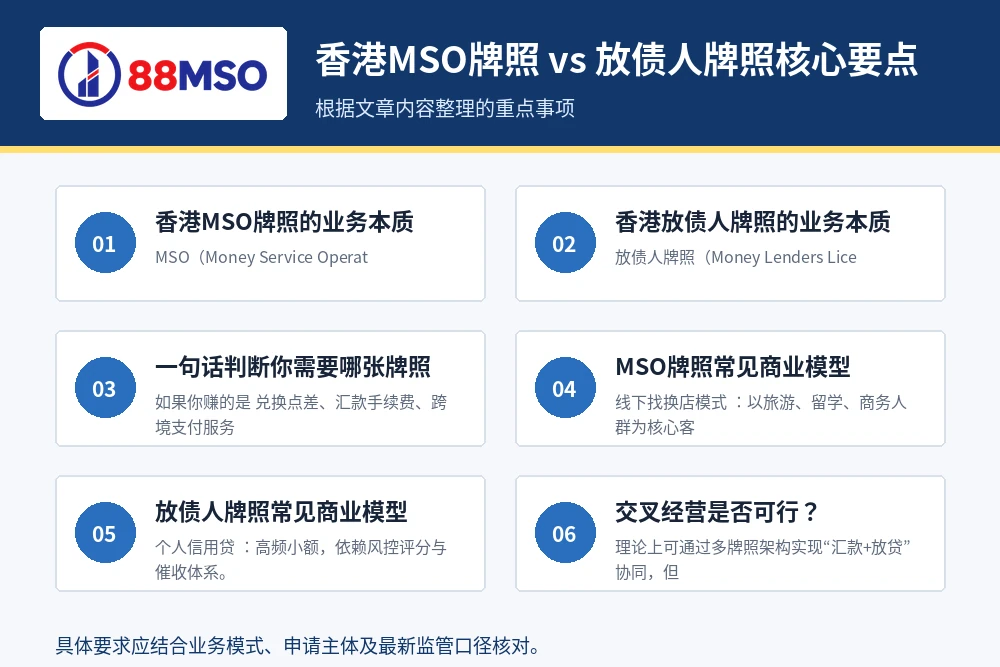
This article will start frombusiness model、Capital and cost requirements、Application difficulty、Regulatory focus、Common reasons for failure、Adapt to corporate portraitsix dimensions,Make a practical comparison that can be implemented,Help you make more prudent decisions on Hong Kong’s financial compliance path。
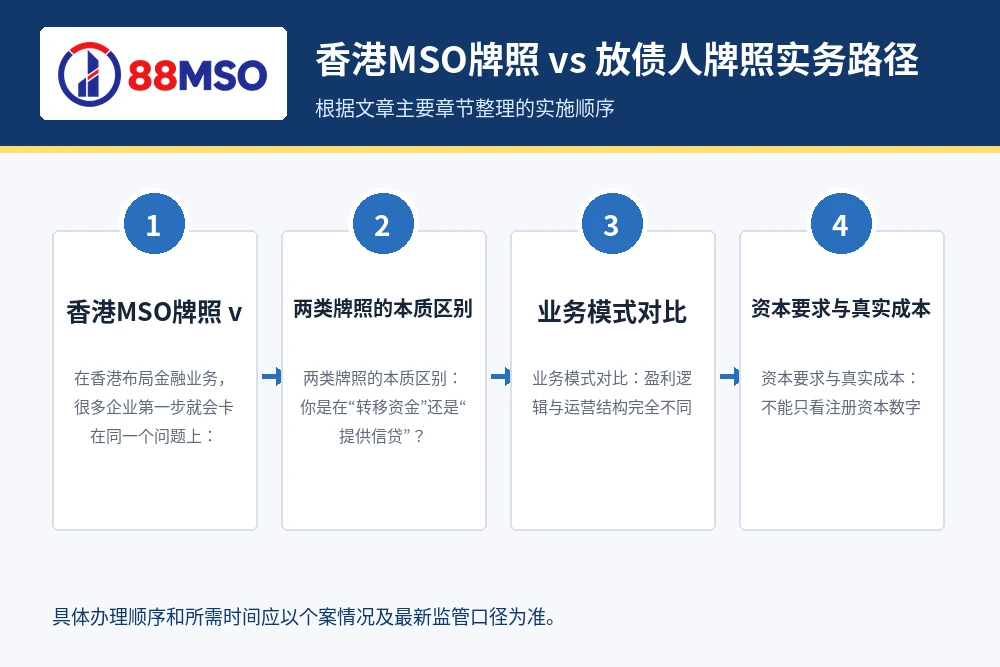
one、The essential difference between the two types of license plates:Are you "transferring funds" or "providing credit"?
1. The business nature of Hong Kong MSO license
MSO (Money Service Operator) is mainly composed ofHong Kong Customs and Excise Departmentsupervision,The core corresponds to two types of businesses:
- Money Changing:For example, exchange between Hong Kong dollars and foreign currencies。
- Remittance Service:Includes local and cross-border fund transfer arrangements。
so,The MSO license solves the problem of "how to legally transfer and settle funds",rather than “who the funds are lent to”、"How to calculate interest" question。MSO business is naturally related toKYC due diligence、Transaction monitoring、Suspicious Transaction Report、Anti-money laundering (AML) systemstrong binding。
2. Business Nature of Money Lender License in Hong Kong
Money Lenders License corresponds to the act of “lending”,That is, providing loans to individuals or businesses on a commercial basis,And charge interest and fees as agreed。Its core lies in:
- Loan contract compliance
- Interest rate and charge boundaries
- Legality of Collection Practices
- Borrower Protection and Information Disclosure
Simply put,The money lender's license solves the problem of "how to recycle the money in compliance with regulations and make a profit after lending it out",Rather than "how to transfer money across borders"。
3. Determine which license plate you need in one sentence
- If you earnexchange spread、Remittance fee、Cross-border payment service fee:Prioritize MSOs。
- If you earnloan interest、Guarantee fee、Installment service fee:Priority will be given to money lender licenses。
two、Business model comparison:Profit logic is completely different from operating structure
1. Common business models for MSO licenses
- Offline exchange store model:to travel、Study abroad、Business people are the core customer group,Earn the exchange spread。
- Cross-border remittance channel model:for foreign trade、E-commerce、Overseas labor services and other customer groups provide collection and payment transfer services。
- B2B settlement service model:Serving the international settlement needs of small and medium-sized enterprises,Emphasis on speed and compliance。
The key competencies of MSO organizations are usually inChannel stability、Exchange rate quotation capability、Compliance system maturity,rather than "capital leverage"。
2. Common business models for money lender licenses
- personal credit loan:High frequency small amount,Reliance on risk control scoring and collection system。
- Corporate revolving loan:bill、accounts receivable、Trade background screening requirements are higher。
- Mortgage/Pledge Loan:around real estate、Equity、Loan structure design for assets such as insurance policies。
The core of a moneylender institution isCustomer acquisition ability、Asset quality control、Overdue management、Capital cost control。Once the defective rate gets out of control,No matter how high the interest rate spread is, it will be swallowed up。
3. Is cross-operation feasible?
In theory, "remittance + lending" synergy can be achieved through a multi-license structure,But it must be noted:
- Different businesses are undertaken by different licensed entities,Avoid confusion of business boundaries。
- Internal financial transactions、Client funds segregation、The pricing mechanism must be auditable and penetrable。
- Marketing rhetoric cannot mislead customers: "One service, one license covers all"。
in practice,Many companies will first obtain a license to quickly verify the market,Then expand the second license according to the needs of the customer group,This is a safer path。
three、Capital Requirements and True Costs:Don’t just look at the registered capital figure
1. “Explicit costs” before applying
Whether it is an MSO or a moneylender license,There are government fees、Company structure establishment costs、Legal and advisory fees。Many applicants only look at the “minimum threshold”,Ignoring what really affects survival,It is subsequent continuous investment。
2. "Hidden costs" during the operation period
MSO organizationCommon ongoing costs include:
- AML/KYC system construction and maintenance
- Transaction monitoring and suspicious transaction reporting process
- Employee Compliance Training and Internal Auditing
- Cooperation channel bank account maintenance cost
moneylender agencyCommon ongoing costs include:
- Credit risk control model and approval system
- Post-loan management and collection team
- Legal document standardization and litigation preparation
- Bad debt provisions and capital occupation costs
3. Adequate capital does not mean adequate compliance
Many projects fail,It’s not because “I don’t have enough money to apply”,But because “I have enough money to apply for、Not enough to operate”。For example, if an MSO does not have an ongoing compliance budget,Vulnerabilities will soon be exposed in reviews and annual reviews;If a moneylender underestimates the bad debt rate,Cash flow can deteriorate rapidly within 6-12 months。Therefore, the license budget must be calculated based on "at least a 12-month operating cycle",Rather than just counting the cost of obtaining the certificate。
Four、Application difficulty comparison:Who is more difficult? The answer depends on your team’s DNA
1. Difficulties in applying for MSO
- Funding sources and business rationality explanation:Supervision wants to see the truth、sustainable、Traceable business model。
- Anti-money laundering system integrity:Includes customer risk rating、Transaction monitoring、record keeping、Suspicious transaction reporting mechanism。
- Background review of actual controllers and key personnel:Integrity record、Industry experience、Related risks will be paid attention to。
If the team has paid、money transfer、Compliance experience,MSO application and follow-up management will be smoother。
2. Difficulties in applying for a money lender
- Legality of Loan Product Design:interest rate structure、Charge items、Contract terms must be compliant。
- Borrower Protection and Information Disclosure Mechanism:You cannot "disburse money first and then make up for the process"。
- Collection and post-loan process control:Any aggressive or irregular behavior will amplify law enforcement risks。
If the team is good at credit、Risk control、legal affairs,Moneylender licenses make it easier to scale;on the contrary,It’s easy to fall into the trap of “let it go fast”、It gets worse faster”。
3. Difficulty conclusion:There is no absolute simplicity,Only if it matches
From file preparation,Both MSOs and moneylenders have ongoing compliance requirements;From a long-term perspective,MSO is heavy onAnti-Money Laundering and Transaction Monitoring,Moneylenders favorCredit risk control and post-loan management。Enterprises should choose a track based on organizational capabilities,Instead of just looking at “who gets the certificate faster?”。
five、Comparison of regulatory key points:Getting the certificate is just the beginning,Continued compliance is key
1. Regulatory concerns for MSOs
- Is customer identification in place?
- Whether high-risk transactions are promptly identified and escalated for review
- Is there a "trustee"、Borrow the way、Anonymous transaction risk
- Whether record keeping meets audit traceability
MSO organizations are most afraid of "business growth faster than compliance capabilities",After the trading volume increases,Manual review can easily fail。
2. Regulatory concerns for money lenders
- Are there charging arrangements that exceed licensing boundaries?
- Whether the total cost of borrowing and liability for breach of contract are fully disclosed
- Is the collection process civilized?、legitimate、Traceable
- Whether there is misleading marketing and improper sales
Money lenders are most afraid of “aggressive front-end customer acquisition”,Once complaints accumulate,It will have a chain impact on license renewal and business cooperation.。
six、How companies choose:Make your licensing decision in four steps
first step:Define your income sources first
Write down clearly the next 18 months,Revenue mainly comes from handling fees、Spread,Or interest and loan-related fees?。Income sources determine license direction。
Step 2:Assess team capability structure
If your team’s strength lies in AML、payment settlement、Cross-border process,MSO is more suitable;If your strength lies in credit granting、Risk control、Collection、Legal litigation management,moneylenders better match。
Step 3:Calculate compliance and operating cash flow
Put "system、personnel、audit、training、legal affairs、“Bad debt provisions” are all included in the budget,Coverage for at least 12 months。Can survive the first year,Only then are we qualified to talk about scale。
Step 4:Create a licensing roadmap rather than a single point of application
The correct path for many institutions is:Get the main license plate first and run through the model,Then extend the second license according to the business,Form a closed loop of compliance。A team of professional consultants is of greatest value at this step,Because it can avoid "architectural conflicts" and "logical faults in application materials" in advance。
seven、Common misunderstandings and correction suggestions
- Myth 1:Get the certificate first and then talk about it,Business will be paid for later
Correction:Supervision pays more and more attention to "substantial operating capabilities",Empty shell ideas are extremely risky。 - Myth 2:Compliance is a cost center,Save if you can
Correction:in financial industry,Compliance is a prerequisite for revenue sustainability,Not optional。 - Myth 3:You can pass by copying other people's materials
Correction:The background of each company’s shareholders、Customer group structure、Funding paths are different,Must be customized。 - Myth 4:Once you get the license, everything will be fine
Correction:annual review、Internal control update、Personnel training、Regulatory communication is a long-term project。
Conclusion:Choose the right license plate,The essence is to choose the right growth method
Hong Kong MSO LicenseThere is no “who is more senior” with moneylender licenses?,There is only “who is a better fit for your business flywheel”。The former emphasizes capital flow compliance and anti-money laundering capabilities.,The latter emphasizes credit pricing and asset quality management。What the business really needs,Not a license plate that “looks like it can do a lot”,It’s a path that can go through the regulatory cycle.、Compliance operation path to support long-term profitability。
at a practical level,More and more companies going overseas will rely on professional teams like 88MSO that have long been involved in financial compliance in Hong Kong.,Do business boundary diagnosis first,Develop an integrated application and operation plan。The value of doing this is not in “accelerating the issuance of certificates” itself,It’s about reducing rework costs from day one、Reduce regulatory friction,Let licenses truly serve business growth,rather than becoming a barrier to growth。
FAQ:Quick answers to frequently asked questions
Q1:I do cross-border e-commerce payment,Do I need an MSO or moneylender license?
Usually first check whether you are involved in "valet remittance/fund transfer"。If the core is receipt, payment and currency exchange,Generally prioritize the MSO path for evaluation;If you also provide credit financing,Re-evaluation of moneylender arrangements。
Q2:Can the same company apply for two types of licenses at the same time?
Feasibility depends on specific business design and regulatory requirements。In practice, sub-entity licensing is often used,Facilitates risk isolation and audit tracking。
Q3:Which license plate is faster?
no absolute answer。Data completeness、Team background、Internal control maturity affects time more than “license type”。
Q4:SMEs have limited budgets,How to reduce trial and error costs?
First clarify the main income model,Concentrate resources to obtain “the first and most critical license”,and simultaneously build a scalable compliance framework,Avoid having to reinvent the wheel later。
First determine whether the business falls within the scope of MSO based on capital flow.
When evaluating Hong Kong MSO license vs money lender license,What should be handed over from the customer to the company?、How the company exchanges or remits、Which accounts do the funds go through?、What assets are finally delivered to start drawing the capital flow?。Just looking at the product name is not enough to determine the scope of regulation;Involving legal currency exchange、Cross-border remittance、When collecting and paying virtual assets or third parties,It is also necessary to check separately whether other regulatory systems are applicable at the same time.。
Application and going concern information should cover actual business location、Equity and ultimate owners、fit and proper person、business plan、risk assessment、Customer due diligence、Sanctions Screening、Transaction monitoring、Report suspicious transactions、Record keeping and staff training。During on-site inspection,Institutional documents、Sampled customer files and bank statements must be mutually corroborative。
Read more:Latest changes in Hong Kong Customs’ anti-money laundering review of MSO licensees in 2026。