 简体中文
简体中文 繁體中文
繁體中文 English
Latest changes in Hong Kong Customs’ anti-money laundering review of MSO licensees in 2026
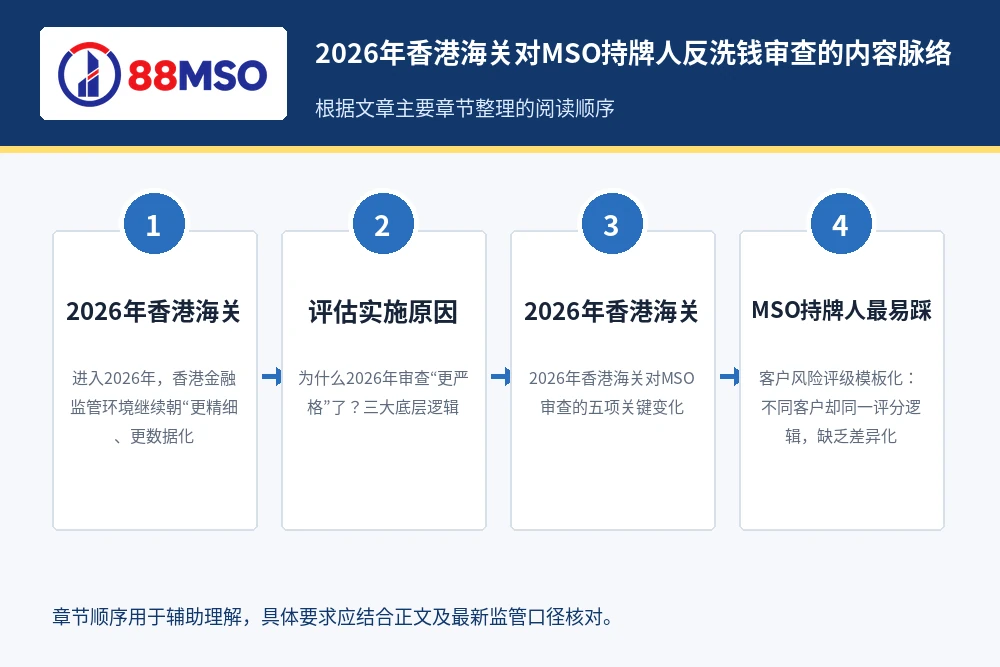
Entering 2026,Hong Kong’s financial regulatory environment continues to move toward “more sophisticated、More digital、Evolution in the direction of “more accountability”。forHong Kong MSO (Money Service Operator),Money Service Operator) LicenseeIn terms of,Anti-money laundering (AML) and counter-terrorism financing (CFT) are no longer just “systems will do”,Instead, enter the "system enforceable、The process is penetrable、A new stage of “evidence traceability”。especially inHong Kong Customs and Excise DepartmentOn-site review and off-site supervision,The focus of supervision has obviously shifted from “insufficient documentation” to “whether risk management is real and effective”。
this means:Historical reliance on templated compliance documents、Passively respond to annual review、How to supplement information afterwards,Fading fast。If companies want to steadily carry out cross-border remittances in 2026 and beyond、Exchange and other services,AML capabilities must be built into underlying business capabilities,Rather than a one-time action when applying for a license。
one、Why will censorship be “tighter” in 2026? Three underlying logics
1) International regulatory coordination continues to strengthen
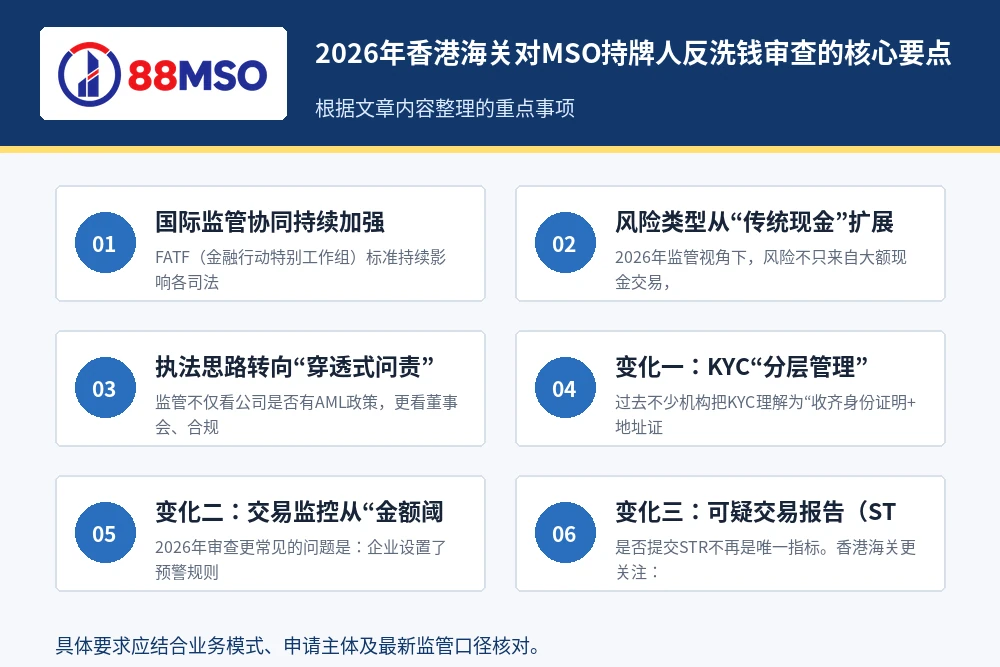
FATF (Financial Action Task Force) standards continue to influence the implementation standards of various jurisdictions,Hong Kong as an international financial center,Maintain high consistency and transparency in AML/CFT execution。Hong Kong Customs’ review of MSO licensees,There is also more emphasis on aligning with international standards,Includes customer due diligence、suspicious transaction report、Sanctioned list screening, etc.。
2) Risk types expand from “traditional cash” to “digital links”
From a regulatory perspective in 2026,Risks don’t just come from large cash transactions,Also from multi-tier proxies、Cross-border small-amount high-frequency splitting、Third party payment、Abnormal IP login、Complex scenarios such as virtual asset-related capital flows。If MSO still uses extensive risk control thresholds,It is easy to appear "seemingly compliant"、In fact, it was missed”。
3) Law enforcement thinking shifts to “penetrating accountability”
Supervision not only depends on whether the company has an AML policy,Read more about the board of directors、Compliance Officer (MLRO)、Do frontline employees truly fulfill their responsibilities?。If there is a systemic flaw,Punishment targets may extend from the organization to key responsible persons,Brings higher legal and reputational risks。
two、Five key changes in Hong Kong Customs’ review of MSOs in 2026
Change one:KYC “layered management” requirements are more detailed,Static data is no longer enough
In the past, many institutions understood KYC as “collecting proof of identity + proof of address”。Under review in 2026,Supervision pays more attention to:
- Whether the customer risk rating method is reasonable (whether there is a clear basis for low/medium/high risk stratification)
- Whether high-risk customers perform enhanced due diligence (EDD)
- Whether customer information is dynamically updated according to risk level,rather than a one-time collection that remains unchanged for a long time
- Whether the corporate customer’s beneficial owner (UBO) identification is complete and verifiable
regulatory signals:"Complete information" is just the bottom line,"Risk can be explained" is the core。
Change 2:Transaction monitoring is upgraded from "amount threshold" to "behavior pattern recognition"
The more common questions for the 2026 review are:The enterprise has set up early warning rules,But the rules are too simple,leading to a large number of false positives or false negatives。Supervision pays more attention to:
- Whether to identify "short-term high-frequency split trading"
- Whether to identify “the transaction purpose is inconsistent with the customer profile”
- Whether to identify "abnormal payee concentration/country and region risk"
- Is there a closed loop of investigation and handling records after the warning?
In short,Transaction monitoring should shift from “looking at the amount” to “looking at the behavioral logic”。
Change three:The review of suspicious transaction reports (STR) pays more attention to "timeliness + quality"
Whether to submit STR is no longer the only indicator。Hong Kong Customs is more concerned about:
- Is the internal upgrade path clear (frontline → supervisor → MLRO)
- Whether to report in a timely manner after triggering suspicion、timely decision making
- Is the STR narrative specific?、Is the chain of evidence complete?
- Is there a situation of "not reporting orders for fear of affecting business?"
For MSOs,STR capabilities reflect more than just compliance levels,It is also the maturity of governance culture。
Change four:MLRO and senior management accountability become more substantive
Law enforcement practice in 2026,MLRO should not be just a “front role”。Supervision will examine whether it is actually implemented:
- Regular risk assessment and system updates
- Suspicious transaction review and reporting decisions
- Training organization and assessment supervision
- Submit compliance reports to management and promote rectification
If corporate AML governance remains on paper,Management and key responsible persons will bear more direct risks。
Change five:The proportion of "sampling and digging" in on-site inspections has increased,Evidence traces become the focus
Many organizations mistakenly believe that "complete system documentation" can handle inspections。A more common practice in 2026 is to back-check the entire process through sampling transactions.:Open an account、Rating、monitor、Review、Report、File saving。No records at any stage、Records are inconsistent、Approval missing,are considered control deficiencies。
three、Seven high-frequency problems that MSO licensees are most likely to encounter
- Customer risk rating templates:Different customers but the same scoring logic,Lack of differentiated standards。
- EDD trigger condition is too narrow:Just look at the country,Regardless of transaction behavior and complexity of funding sources。
- Sanction screening "only once for account opening":Lack of continuous screening mechanism。
- Transaction Alert Backlog:There are many alarms but the processing is slow,Forming "compliance debt" under review。
- STR judgment criteria are not uniform:Inconsistency in understanding between departments,leading to missed or late reporting。
- Training becomes a mere formality:Just sign in,No scenario-based assessment,Employee’s identification ability is weak。
- Document management fragmentation:Evidence scattered in the mail、Chat tools and paper files,Unable to retrieve quickly。
Four、Executable compliance upgrade roadmap in 2026 (90-day practical version)
Phase 1 (1-30 days):Risk inventory and gap assessment
It is recommended to do an AML health check from a "regulatory perspective" first.:
- Check whether the system is consistent with the actual process
- Sample recent transactions,Test alarm and disposal closed loop
- Review the integrity of high-risk customers’ EDD files
- Evaluate evidence of performance of MLRO duties (meeting minutes、Report、Approval records)
Phase 2 (31-60 days):Institutional Reconstruction and System Calibration
- Update customer risk rating model,Supplementary behavioral trait dimensions
- Optimize transaction monitoring rules,Balancing false positive and false negative rates
- Establish STR graded response mechanism (normal、major、urgent)
- Improve the continuous screening and hit review process of the sanctions list
Phase 3 (61-90 days):drill、Training and review preparation
- Organize cross-department tabletop exercises (front desk、operations、Compliance、management)
- Carry out on-the-job training:counter staff、reviewer、MLRO separate assessments
- Create an "inspection package":policy、Record、sample、Retrieve the rectification report with one click
- Conduct a mock site inspection,Expose weak points in advance
in practice,Many companies will introduce external professional teams to assist in building the above routes.。Consultants who have long served Hong Kong licensed institutions like 88MSO/88MSO,The value often lies in "translating rules into processes",And make practical rectifications based on the review standards,Instead of just providing template text。
five、How to turn "regulatory pressure" into "business advantage"?
For MSO licensees,The key in 2026 is not “how to avoid detection”,but “how to build sustainable compliance capabilities”。When the AML system is solid,Businesses usually get three rewards::
- Cooperation between banks and payment channels is more stable:Counterparties are more willing to cooperate with institutions that are compliant and transparent。
- Improved efficiency of license plate maintenance:Annual review and routine communication preparation costs have been significantly reduced。
- Cross-border business expansion is smoother:When expanding into new markets,Compliance system can be quickly reused。
This is why more and more institutions regard AML construction as a strategic project,Not just legal tasks。
six、Conclusion:After 2026,MSO compliance enters the "operational era"
Hong Kong Customs’ anti-money laundering review of MSO licensees is being comprehensively upgraded:From document review to behavioral verification,From formal compliance to substantive effectiveness,From institutional responsibility to key person accountability。For businesses,The safest path is to establish a four-in-one compliance mechanism of "system-system-personnel-evidence" as soon as possible。
If you are preparing a license application、License plate maintenance、Internal rectification or regulatory communication,It is recommended to conduct a gap assessment as early as possible and formulate a phased implementation plan。The sooner compliance becomes a daily operational capability,The more proactive we can be in future regulatory cycles。
FAQ:4 issues that MSO licensees are most concerned about
Q1:Does the 2026 review mean that all customers must undergo enhanced due diligence?
no。The core is Risk-Based Approach。Low-risk customers can perform due diligence according to standards,Only high-risk clients need EDD,But the premise is that your rating logic must be clear and provable。
Q2:Small MSOs have limited resources,How to prioritize investment?
Priority recommendations:KYC layered rules >; Transaction monitoring closed loop >; STR aging mechanism >; Training and marking system。Solve high-risk and high-frequency links first,Then gradually expand。
Q3:Only update the AML manual,Is it possible without changing the system process?
The risk is high。Supervision increasingly focuses on “implementation evidence”。If the system rules、Approval path、The leaving behind mechanism remains unchanged,Manual update hard to hold up in review。
Q4:What is the optimal role of external consultants in remediation?
The best role is not "ghostwriting documents",Rather, it helps companies complete diagnosis、process reshaping、Personnel training and mock inspections,Make sure the system really works。This is also the core value of the professional team in MSO compliance practice。
First determine whether the business falls within the scope of MSO based on capital flow.
When assessing the latest changes to Hong Kong Customs’ anti-money laundering review of MSO licensees in 2026,What should be handed over from the customer to the company?、How the company exchanges or remits、Which accounts do the funds go through?、What assets are finally delivered to start drawing the capital flow?。Just looking at the product name is not enough to determine the scope of regulation;Involving legal currency exchange、Cross-border remittance、When collecting and paying virtual assets or third parties,It is also necessary to check separately whether other regulatory systems are applicable at the same time.。
Application and going concern information should cover actual business location、Equity and ultimate owners、fit and proper person、business plan、risk assessment、Customer due diligence、Sanctions Screening、Transaction monitoring、Report suspicious transactions、Record keeping and staff training。During on-site inspection,Institutional documents、Sampled customer files and bank statements must be mutually corroborative。
Read more:Hong Kong MSO license transfer and acquisition:Key points of due diligence and customs approval、Transformation of traditional money change shops:How can I legally access the virtual asset exchange business with an MSO license?。