 简体中文
简体中文 繁體中文
繁體中文 English
What is Enhanced Due Diligence (EDD)? Why is it so critical in the account opening process?
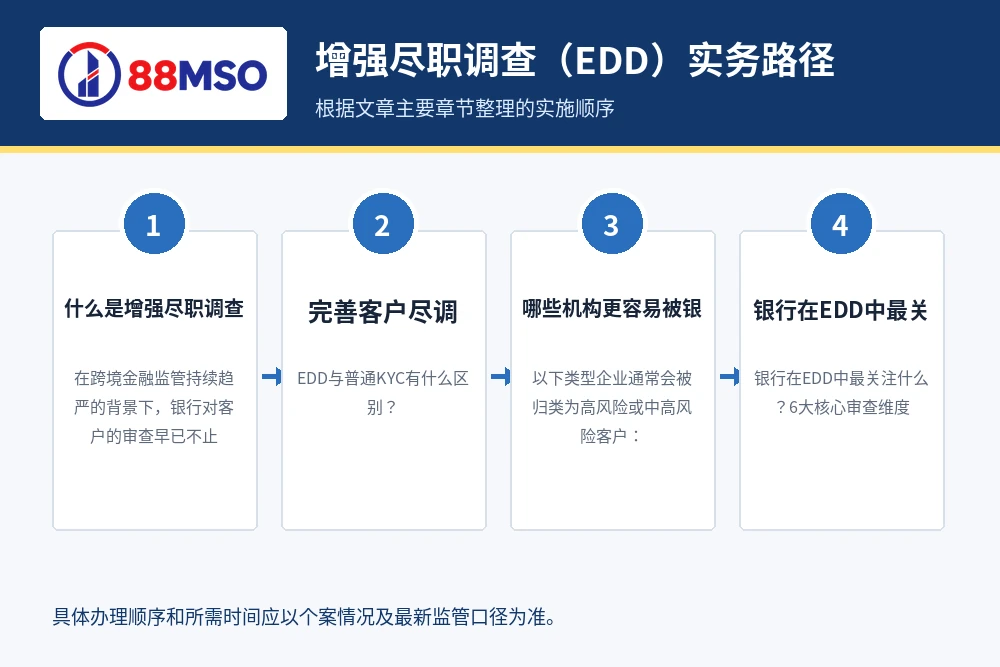
In the context of continued tightening of cross-border financial regulation,Banks’ review of customers has long gone beyond the basic level of “know your customer (KYC)”。For cross-border flows of funds、The transaction structure is complex、Enterprises with sensitive business areas or high regulatory license attributes,The bank will startEnhanced Due Diligence, EDD)。In simple terms,EDD is based on ordinary due diligence,Further verify customer identity、Source of funds、business model、Transaction purpose、An in-depth review mechanism for beneficial ownership and compliance governance capabilities。
For Hong Kong MSO、SFC licensed、insurance broker、For financial institutions such as money lenders,EDD is almost a "standard action" in the account opening process.。Many companies clearly hold legal licenses,However, I was repeatedly asked to provide additional information when opening an account.,We even encountered problems such as "approval first and then approval", "transaction restrictions" and "delayed activation".,The root cause is not "the license plate is invalid",But the bank’s risk identification is not fully satisfied。
therefore,Understand that EDD is not “passive cooperation”,Instead, high-risk licensed institutions conduct compliance operations、Key capabilities in capital security management and long-term bank relationship building。
What is the difference between EDD and ordinary KYC?
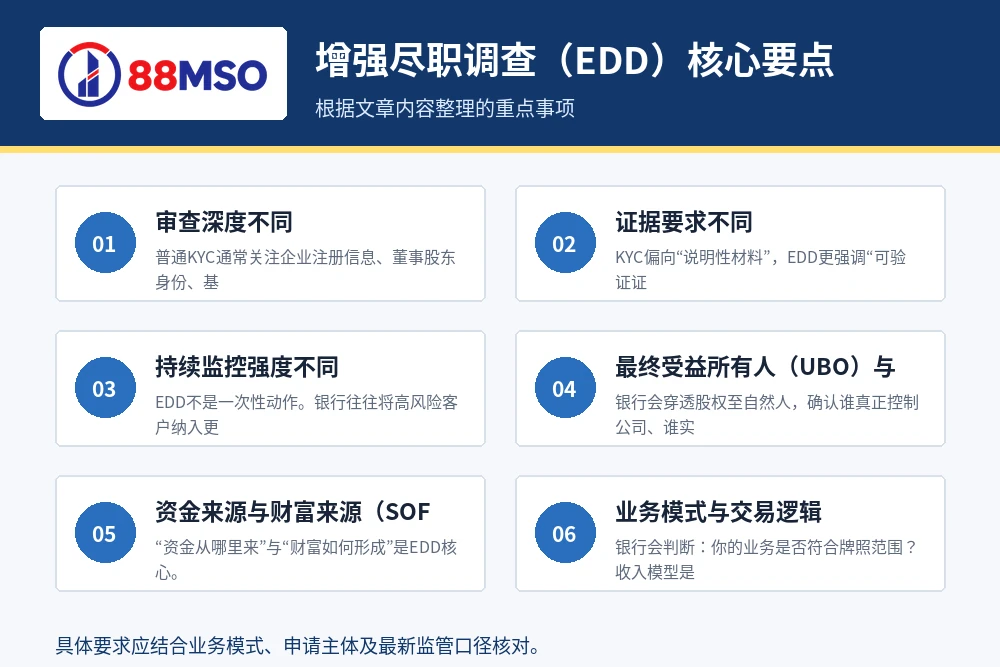
1. Depth of review varies
Ordinary KYC usually focuses on company registration information、Director shareholder status、Basic business description and account usage;EDD will drill down into the counterparty profile、Funding path、business substance、geographical risk、Whether it involves high-risk industries and politically exposed figures (PEPs), etc.。
2. Evidence requirements are different
KYC favors “illustrative materials”,EDD places more emphasis on “verifiable evidence chain”。For example,Not only must the source of funds be stated,Contract still needs to be submitted、bill、Audit report、Flow closed loop proof、tax records etc.。
3. Continuous monitoring varies in intensity
EDD is not a one-time action。Banks often include high-risk customers in more frequent continuous monitoring mechanisms,Includes trading pattern monitoring、periodic review、Abnormal transaction explanation mechanism, etc.。In other words,Opening an account is just the beginning,Subsequent operations are also subject to review。
Which institutions are more likely to be included in EDD by banks?
The following types of businesses are typically classified as high-risk or medium- to high-risk customers::
- Licensed financial institution:Such as Hong Kong MSO、Securities related licensed entities、moneylender、Insurance intermediaries, etc.;
- Enterprises with frequent cross-border capital flows:There are many countries for payment and payment、The currency is complex、Upstream and downstream across judicial districts;
- Involving virtual assets、pay、exchange currency、Collection and paymentHighly sensitive business;
- Complex shareholding structure:Multi-layer offshore architecture、Trust holdings、Nominal shareholder arrangement;
- Trading volume and account behavior fluctuate greatly in the short term:New account means high frequency and large amount;
- Sensitive management background:PEP、sanctions link、More negative public opinions。
This also explains why many companies have misunderstandings:"I have a license,Why is it so difficult to open an account? " Banks are concerned about more than just “whether you are regulated”,It’s more about “Do you have the ability to sustainably、penetrable、Verifiable compliance operations capabilities”。
What do banks pay most attention to in EDD? 6 core review dimensions
1. Ultimate Beneficial Owner (UBO) and Control Transparency
The bank will penetrate the equity to the natural person,Confirm who really controls the company、who actually benefits。If the equity chain is too long、Spanning multiple offshore jurisdictions and unclear explanation,Usually considered a high-risk signal。
2. Source of funds and source of wealth (SOF/SOW)
“Where do funds come from” and “how wealth is formed” are the core of EDD。banks expect to seeReasonable source、amount match、Evidence closed loop。For example, capital injection、historical profit accumulation、Legal income of shareholders、Proceeds from asset disposal, etc.,There should be corresponding supporting evidence。
3. Business model and transaction logic
The bank will judge:Does your business meet the scope of the license? Is the revenue model clear? Does the counterparty actually exist? Is the funding path necessary and reasonable? If there is a "multi-layer transit、"Unclear explanation" situation,Risk scores will increase significantly。
4. Geographic and Counterparty Risk
Involving sanctioned areas、High money laundering risk countries、Shell counterparties or partners that lack substantial operations,will trigger stricter scrutiny。Banks may require counterparty KYC information or further proof of business substance。
5. Compliance governance structure
Is there an AML policy? Is there an MLRO/Compliance Officer? Whether to carry out employee training、Transaction monitoring、Suspicious transaction reporting mechanism? For licensed institutions,These "system construction evidence" directly affect the bank's judgment on its risk level.。
6. Account usage and expected transaction profile
Monthly trading volume filled in when opening an account、Single range、Main payment areas、Main customer categories,Will become the baseline for subsequent monitoring。If the difference between the actual transaction and the declaration is too large,Easy to trigger alarms,Resulting in account restrictions or even termination of the relationship。
When opening an account with a high-risk licensed institution,How to cooperate effectively with EDD?
first step:Do a pre-compliance review from a “bank perspective” first
Don’t wait for the bank to ask questions before improvising。It is recommended that before submitting the account opening,First conduct a "pre-EDD diagnosis" by the internal compliance team or an external professional agency,Identify the following issues:
- Whether the equity penetration materials are complete and consistent;
- Whether the license business description matches the actual operation;
- Does the source of funds prove that there is evidence of continuity?;
- Is the transaction scenario quantifiable?、Interpretable data support;
- Are there any rectification instructions for historical negative records?。
Step 2:Establish a "standardized account opening information package"
EDD is inefficient,A common reason is data fragmentation。It is recommended to create a reusable data package (Data Room),contains at least:
- Company registration documents、Charter、Register of Directors and Shareholders、UBO Statement;
- license document、Regulatory transaction records、Annual review/license renewal status;
- AML/KYC Policy、Customer due diligence process、risk rating mechanism;
- Compliance team structure、MLRO appointment documents、training records;
- Management accounts for the past 6-12 months、Audit report、Sample main contract and invoice;
- Proof of source of funds and wealth、tax related documents;
- Description of expected transaction model (including country、Currency、Amount range、frequency)。
Step 3:unified caliber,Avoid "inconsistencies"
What banks are most sensitive about is not "many problems",But "the answers are inconsistent"。Account opening form、Interview、Email reply、The instructions for supplementary parts must be consistent in caliber.。It is recommended that a responsible person coordinate the response,avoid directors、finance、The business people all say their own things。
Step 4:Proactively explain “high risk points” rather than avoid them
If the enterprise naturally has high-risk attributes (such as cross-border multi-currency clearing)、Complex channel payment、specific customer groups),Risk mitigation statements should be proactively submitted,like:
- Counterparty screening mechanism;
- Sanctions List and Negative News Screening Process;
- Upgraded approval mechanism for high-risk transactions;
- Suspicious transaction identification and internal reporting process。
Proactive disclosure often builds bank trust better than passive questioning。
Step 5:Prepare for “continuous compliance” rather than “one and done”
After the account opening is approved,Information still needs to be updated regularly as required by the bank。It is recommended to establish a quarterly compliance review mechanism,Track trading deviations、Data expires、Structural changes and new high-risk exposures,Avoid being passive during bank review。
Common misunderstandings:Why do many companies get "stuck" in the EDD stage?
- Misunderstanding 1:Only template files are provided,No practical evidence provided
Having an AML policy does not mean it is fully implemented.。Banks pay more attention to system implementation records。 - Misunderstanding 2:The business description is too macro
“Doing cross-border financial services” is too general,Need to be broken down into specific products、Fund flow and charging logic。 - Misunderstanding 3:Underestimating the penetrating power of banks
Conceal affiliated companies、historical risk events,Subsequent discovery will seriously affect trust。 - Misunderstanding 4:Feel free to change your trading behavior after opening an account
The deviation between the actual transaction and the declared image is too large,Very easy to trigger risk control。 - Misunderstanding 5:Treat EDD as a "materials problem" rather than a "governance problem"
The essence of EDD is to evaluate an enterprise's long-term compliance capabilities,Not just filling out forms。
Practical suggestions:"Three-tier approach" to improve EDD pass rate
Ground floor:Compliance framework first
Create coverage for customer access、Transaction monitoring、suspicious transaction report、record retention、AML system for employee training,and form documented evidence。
middle level:Data and process traceability
Every key transaction should be traceable back to the contract、bill、Logistics/service certificate、Receipt and payment flow,form a closed loop。
high-rise:Strategic bank relationship management
Choose the matching bank and account structure according to the business stage,Make arrangements for primary and backup accounts、Regional diversion and compliance communication mechanism,Avoid "single account risk"。
Conclusion:EDD is not resistance,It is a threshold test for licensed institutions to move towards robust globalization.
Strengthening due diligence does not mean "making things difficult for banks",It reflects the global financial system’s commitment to transparency、Common requirements for traceability and anti-money laundering liability。For high-risk licensed institutions,Who can prepare EDD in advance?,Who can more easily obtain stable banking access?、Reduce the risk of operational disruption,and remain competitive in a cycle of tightening regulations.。
In Hong Kong and cross-border financial licensing practice,More and more companies are beginning to adopt the integrated promotion path of “license + compliance + account opening”。Like 88MSO and the professional team behind it (88MSO), they have long-term focus on Hong Kong MSOs、SFC related licenses and compliance implementation,Ability to assist companies in optimizing EDD material structures based on regulatory logic、Unified review standards and bank communication strategies,Help businesses implement more efficiently under the legal and compliance framework。
FAQ:High frequency issues in EDD coordination
Q1:Already have a Hong Kong license,Will I still be diagnosed with EDD?
Most likely。Licensed status reduces “unlicensed risk”,But it does not automatically reduce “money laundering and sanctions risks”。Banks will still conduct risk stratification based on business and transaction characteristics。
Q2:How long does EDD usually take?
depending on bank、Depends on business complexity and data integrity。Complete information and consistent caliber,Often significantly shortens cycle time;Repeated repairs may take weeks to months。
Q3:The bank requires a customer list or counterparty information,Is it normal?
normal。Especially in cross-border payments、Fund pooling、Scenarios such as collection and payment,Banks need to verify the authenticity and commercial reasonableness of counterparties。
Q4:Will I do EDD again after opening an account?
meeting。The bank will conduct continuous due diligence and regular reviews,Significant shareholding changes、business expansion、Abnormal transactions may trigger re-examination。
Account opening materials must form a complete chain of financial evidence
What to Expect When Preparing for Enhanced Due Diligence (EDD),Banks usually structure their companies、actual controller、business contract、Customers and Suppliers、Expected trading country、Single and monthly amounts and funding sources are judged together.。website、bill、contract、If the written and verbal instructions conflict with each other,Easily trigger patchwork or enhanced due diligence。
High-risk industries should prepare separate licenses or registration certificates、Anti-Money Laundering System、Customer access criteria、Sanctions Screening and Transaction Monitoring Instructions,and evidence of source of funds and source of wealth for major transactions。Remote account opening does not mean less review;Unexplained collection and payment、Short-term large-amount postings and transactions inconsistent with reported business,You should adjust the process before opening an account。
Industry references:Hong Kong Monetary Authority:Anti-money laundering and customer due diligence information。
Read more:Open a bank account for virtual assets over-the-counter (OTC) trading:Proof of source of funds and compliance requirements、What are NRA and FTN accounts? Compliance Operation Guide for Mainland Enterprises to Open Foreign Currency Offshore Accounts。
Read more:Anti-Money Laundering (AML) Audit and Consulting Services。