 简体中文
简体中文 繁體中文
繁體中文 English
Hong Kong vs Singapore:Why is this comparison important for fintech companies?
For fintech companies planning to expand in Asia,HongkongandSingaporeTwo options that are almost unavoidable。Both places have international capital、Mature financial infrastructure、Good legal environment and global talent pool。But it really enters the practical stage,Businesses will soon discover:Although they are both international financial centers,The two are in the regulatory thinking、license plate path、There are significant differences in tax costs and talent mechanisms。
If you only decide based on "where the tax is low" and "where the approval is fast",It is often easy to pay higher hidden costs in subsequent compliance operations。especially when it comes to payments、virtual assets、Securities products、In cross-border liquidation and other scenarios,regulatory fitMore critical than short-term registration speed。This article will start from the license、tax rate、Three dimensions of talent,Combined with practical implementation,Systematic comparison between Hong Kong and Singapore,Help enterprises make more executable regional strategic choices。
one、Comparison of regulatory frameworks:equally strict,But the regulatory philosophy is different
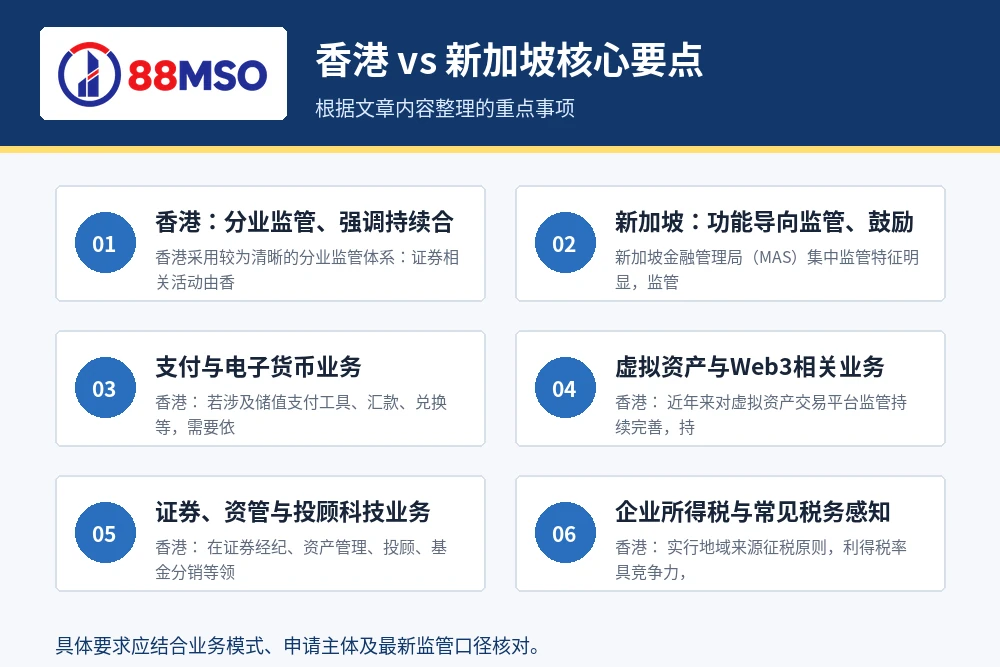
1. Hongkong:Separate supervision、Emphasis on continuous compliance and business boundaries
Hong Kong adopts a relatively clear separate supervision system:Securities related activities are regulated by the Securities and Futures Commission of Hong Kong (SFC),The banking system is subject toHong Kong Monetary Authority(HKMA) Regulation,Insurance、lending、Money services, etc. are managed separately by different laws and organizations。For financial technology companies,this means:
- Business attributes must be accurately identified first,Then match the corresponding license plate;
- There is very little room for “trial operation first and then license renewal”,High cost of non-compliance;
- Ongoing obligations after licensing (auditing、Report、AML、Qualification of personnel) is the focus of supervision。
Hong Kong’s advantage lies in open and transparent rules、Judiciary can be expected、Connect with international capital markets。Especially when it comes to security tokens、Asset management technology、Cross-border wealth management and other fields,The Hong Kong system is highly aligned with the compliance standards of international institutional investors.。
2. Singapore:function-oriented regulation、Innovation is encouraged but front-end risk control requirements are high
The Monetary Authority of Singapore (MAS) has obvious centralized regulatory features,The regulatory framework places more emphasis on the “nature of activities” and the “principle of risk proportionality”。Singapore is often considered more “innovation-friendly”,But that doesn't mean it's lenient。Its core features are:
- to pay、New business formats such as digital token services have early institutional arrangements;
- The application process attaches great importance to business model clarity、Technical risk control and governance structure;
- Segregation of client funds、Technology risk management、Anti-money laundering procedures require detailed。
Fast product iteration、Enterprises with heavy technology stack,Singapore has certain attractions in terms of regulatory communication mechanisms and regulatory sandboxes;However, its approval increasingly emphasizes “substantive operations” and “high-quality governance”,Not a "shortcut to getting cards"。
two、Comparison of license plate dimensions:From “can it be done” to “how big can it be done”
1. Payment and electronic money business
Hongkong:If stored value payment facilities are involved、money transfer、Exchange, etc.,Need to fall into different regulatory frameworks based on specific businesses。Companies usually need to figure out the "fund flow path" in the early stages of product design.、Nature of client funds、Sort out the counterparty types clearly,To avoid triggering the need for multiple licenses。
Singapore:The tiering of licenses under the Payment Services Act (PSA) is clearer,Common paths are standard payment institutions and large payment institutions.。For cross-border remittances、Merchant Acquirer、Scenarios such as electronic currency issuance,Enterprises can configure application strategies based on transaction size and risk level。
Practical conclusion:Singapore is more intuitive in classifying payment licenses,Hong Kong has more strategic value in cross-market financial connections and RMB-related ecology。If an enterprise takes the Greater China payment network as its core,Hong Kong is often a key node;If priority is given to payment coverage in Southeast Asia,Singapore has natural location advantages。
2. Virtual assets and Web3 related businesses
Hongkong:In recent years, the supervision of virtual asset trading platforms has continued to improve.,The licensing system emphasizes investor protection、Escrow arrangements、market conduct、AML/KYC etc.。Hong Kong’s policy signal is to “promote industry development under controllable supervision”,Suitable for those who wish to enter institutionalization、Project parties and platforms on the compliance track。
Singapore:There is a clear regulatory basis for digital payment token services,But in consumer risk warning、marketing restrictions、Tightening of transaction risk management。Singapore places greater emphasis on business sustainability and risk isolation,Pay special attention to cross-border capital flows and technical security incident response。
Practical conclusion:Both places are looking for a balance between "supporting innovation + strengthening supervision"。If companies want to connect traditional financial institutions and global funds,Compliance design needs to be moved forward,Instead of treating the license as a "post-administrative process"。
3. securities、Asset management and investment advisory technology business
Hongkong:in securities brokerage、asset Management、investment advisory、Fund distribution and other fields,SFC licenseThe system is mature,The market has high awareness of licensed institutions。Plans to serve high net worth clients、Home office、Institutional investors、Enterprises with cross-border asset management structures,Hong Kong has obvious advantages in branding and market acceptance。
Singapore:The Capital Market Services (CMS) framework is also mature,Suitable for regional asset management and home office layout,And closely connected with the ASEAN market。For B2B fintech serving corporate customers in Southeast Asia,The landing collaboration efficiency is high。
Practical conclusion:If the business is highly dependent on capital linkage between mainland China and Hong Kong,Hong Kong has more strategic depth;If the focus is on the wealth management ecosystem in Southeast Asia,Singapore can create more natural regional radiation。
three、Tax rates and tax structures:Beyond nominal tax rate,More importantly, we need to look at the “effective tax burden”
1. Corporate income tax and common tax perceptions
Hongkong:Implement the principle of geographical source taxation,Profits tax rate is competitive,And the tax system is relatively simple。For cross-border business enterprises,Determination of source of profits、transfer pricing、Service contract structure can directly impact tax consequences。
Singapore:Corporate tax rates are also attractive internationally,And there is certain incentive policy space。Different types of enterprises are actually operating、Staffing and local economic contribution,May affect available policy benefits。
therefore,Companies should not just compare “announced tax rates”,Instead, evaluate:
- Revenue recognition and profit attribution;
- Internal service fees and intellectual property arrangements within the group;
- Double tax treaty network adaptability;
- Whether there are sufficient substantive operations to support tax claims。
2. "Low tax" does not mean "low risk"
Many companies tend to aim at “minimizing tax burden” in the early stages of establishment.,However, the financial industry is highly regulated、Leaving heavy marks、High penetrability。If structure and substance do not match,Open an account later、audit、Risks can easily be magnified during the financing due diligence stage。A more robust path is:Tax planning based on compliance and interpretability,Let tax structures and licensing activities、capital flow、Consistent staffing。
Four、Talent dimension:Who is easier to build a “sustainable compliance team”?
1. Hong Kong’s talent characteristics:Financial license with intensive practical experience
Hong Kong has accumulated rich experience in traditional finance and licensed management,Have extensive familiarity with SFC、AML、Audit and risk control process professionals。For enterprises that need to quickly establish a "licensed governance + risk control and internal control + compliance reporting" system,Hong Kong’s talent market has strong immediate capabilities。
2. Singapore’s talent characteristics:High degree of integration between regionalization and technology
Singapore attracts a large number of international technology and financial talents,Mature English business environment,Suitable for building products targeting multiple ASEAN markets、Compliance and Operations Team。For the emphasis on technical risk control、Data governance and regional expansion for enterprises,Talent synergy has obvious advantages。
3. real challenge:Key jobs are scarce and expensive
Whether Hong Kong or Singapore,Fintech companies all face the same reality:Compliance Officer、Anti-money laundering manager、Risk Management Executive、licensed responsible personis a scarce resource,Long recruitment cycle、high salary、Strong stability requirements。Businesses need to plan ahead:
- Timetable for appointment of key positions (synchronized with license application);
- The boundary between local teams and outsourced support;
- Compliance training、System implementation and audit coordination mechanism。
five、How should companies choose:Make decisions based on business models rather than “city aura”
Suitable for corporate portraits that prioritize Hong Kong
- Target customers are highly correlated with funding sources in Greater China;
- involving securities、Asset management、Financial activities with strong licenses such as wealth management;
- Hope to strengthen international investor trust and capital market connections;
- Plan for the long term and build an auditable、Penetrable compliance system。
Suitable for corporate portraits that prioritize Singapore
- The business focuses on payment and digital finance scenarios in Southeast Asia;
- Product iteration is fast、Need for stronger regulatory communication and technical governance framework;
- The team is highly internationalized,English-speaking regional operations center required;
- Hope to rely on Singapore to radiate into multinational markets。
dual center strategy:A realistic choice for more and more companies
For medium and large fintech groups,"Hong Kong + Singapore" dual center layout is becoming common:Hong Kong undertakes the capital market and Greater China compliance portal,Singapore undertakes market expansion and regional operations in Southeast Asia。The key is not to “have both”,But lies in:
- There is a clear functional division of labor between the two places;
- capital flow、information flow、Consistent contract flow;
- Unification of AML/KYC standards at the group level;
- Avoid duplication of compliance investments and regulatory conflicts。
six、Implementation suggestions:Upgrading from "licensing thinking" to "full-cycle compliance management"
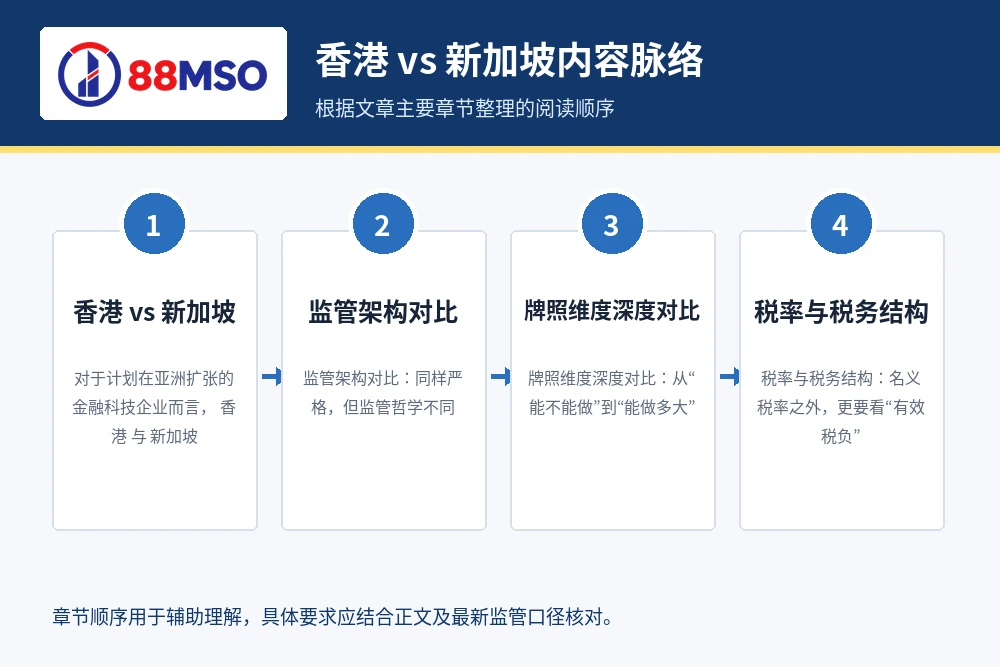
Whether you choose Hong Kong or Singapore,What really determines success or failure is not "the day you get the certificate",It’s about the ability to continue operating after being licensed.。It is recommended that enterprises proceed at the following pace:
- Early diagnosis:Clarify business boundaries、Customer type、Trading scenario、Funding closed loop;
- License plate path design:Combined assessment of main license + possible additional licenses;
- Governance structure establishment:Board of Directors、Compliance、Risk control、Clear internal audit responsibility matrix;
- Institutions and Systems:AML/KYC、Suspicious transaction monitoring、Data retention、Outsourcing management;
- Ongoing maintenance:annual review、Regulatory filing、Qualified personnel、Training and stress testing。
in this process,Have cross-licenses、The value of professional service teams with cross-jurisdictional practical experience is particularly outstanding.。Judging from the long-term practice of 88MSO and its 88MSO team,If an enterprise can obtain a license in the early stages of establishment、Compliance、tax、Linkage design of bank account and organizational structure,Often significantly reduces subsequent rectification costs,and improve regulatory communication efficiency。
Conclusion:There is no “definitely better” market,Only a “more matching” regulatory ecology
Neither Hong Kong nor Singapore are “low-barrier shortcuts”,but high-standard financial markets。The difference is:Hong Kong places greater emphasis on in-depth connections with international capital markets and financial activities in Greater China.;Singapore further highlights its attributes as a regional technology and financial hub。For financial technology companies,The optimal solution is not to pursue short-term policy dividends,but to build a sustainable、auditable、Scalable compliance management system。
When you upgrade your decision-making framework from "Where to get cards faster" to "Where is more suitable for long-term growth?",The path will naturally be clearer。Do business model and regulatory mapping first,Make license and tax configuration again,Finally, the implementation of talent and organization - this is the methodology for going global with financial technology that transcends cycles.。
Comparing regulatory environments requires using the same business model
When comparing Hong Kong vs Singapore,The product should be fixed first、client、Funding flow and team arrangements,Then check the license boundaries of the two places separately.、Capital and personnel、client funds、Anti-money laundering、Data and outsourcing requirements。If you click on the payment service、On the other side, compare by virtual assets or securities business,No matter how accurate the data on tax rates and application cycles are, they are incomparable.。
The choice of landing should also consider banking and payment channels.、Recruitment of key staff、Regional customer acceptance、Ongoing filing and exit costs。It is recommended to prepare a regulatory difference table first,Then use real business scenarios to test each item,Rather than choosing a location first and then adjusting the product to accommodate the license。
Read more:Difficulties in Singapore Large Payment Institution (MPI) License Audit:MAS security requirements for system penetration testing、What is the difference between Hong Kong SFC No. 1 and No. 4 plates? Guidance on Capital Requirements and Business Boundaries。