简体中文
 繁體中文
 English

illustrate: This article is a preparation guide for a Hong Kong SFC Type 9 licence application, it is not a client approval case, and does not include client identities, Approval time, success rates or outcome guarantees.
introduction: What verifiable evidence should be prepared for Hong Kong SFC No. 9 license application?
Official verification update (August 2026): The Hong Kong Securities Regulatory Commission does not guarantee the approval commitment of "9 months to obtain a license". Application time depends on business complexity, Responsible Officer and Shareholder Review, Material integrity and inquiry round trip; This article only explains the key points of application preparation, Not a customer approval record, Does not represent the approval period for any project. For specific rules, seeHong Kong Securities and Futures Commission Licensing Manual.
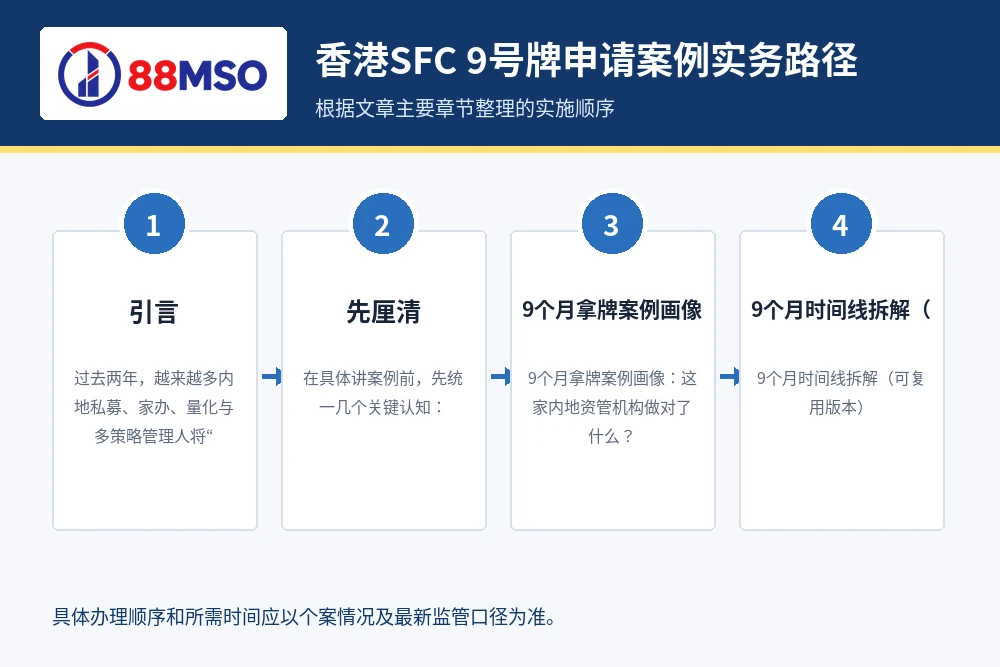
past two years, More and more mainland private equity, Home office, Quantitative and multi-strategy managers regard the "Hong Kong licensed platform" as the core entrance to global layout. in, Hong Kong Securities and Futures Commission (SFC) License No. 9 (Asset Management)It is one of the most popular licenses: It is not only related to whether institutions can legally carry out regulated asset management business in Hong Kong, It also directly affects the institution’s bank account opening., Fundraising Credibility, Overseas cooperation negotiation efficiency and long-term valuation.
The focus of the application includes the capabilities of management and responsible personnel, Policies, Verifiable evidence of governance and financial resources. Approval time will vary depending on business complexity, Material Integrity and Regulatory Inquiry Changes, Specific projects should not be extrapolated based on unfounded intervals..
This article focuses on institutions planning to launch asset management business in Hong Kong, Describe the architecture, RO arrangement, business plan, Compliance system, Preparation steps for financial forecasts and inquiry responses. The following scenarios are only used to explain how the materials correspond, Does not claim to correspond to actual customers, Approved projects or replicable approval cycles.
one, First clarify: What exactly does SFC No. 9 deal with?
Before organizing application materials, Let’s check a few key concepts first:
- Type 9 covers asset management, Common scenarios include managing funds, Discretionary Account, etc..
- If it involves fund marketing, Distribution, investment advisory behavior, May trigger simultaneouslyNo. 1 (Securities Trading)orNo. 4 (advising on securities), Need to judge licence combination.
- SFC will focus on reviewing: Management competencies, RO qualifications, internal control, risk management, Conflict of interest handling, AML/KYC system, Outsourcing Governance and IT Security.
two, Application preparation scenario: Institutions planning to carry out asset management business in Hong Kong
1. Planned business and data gaps
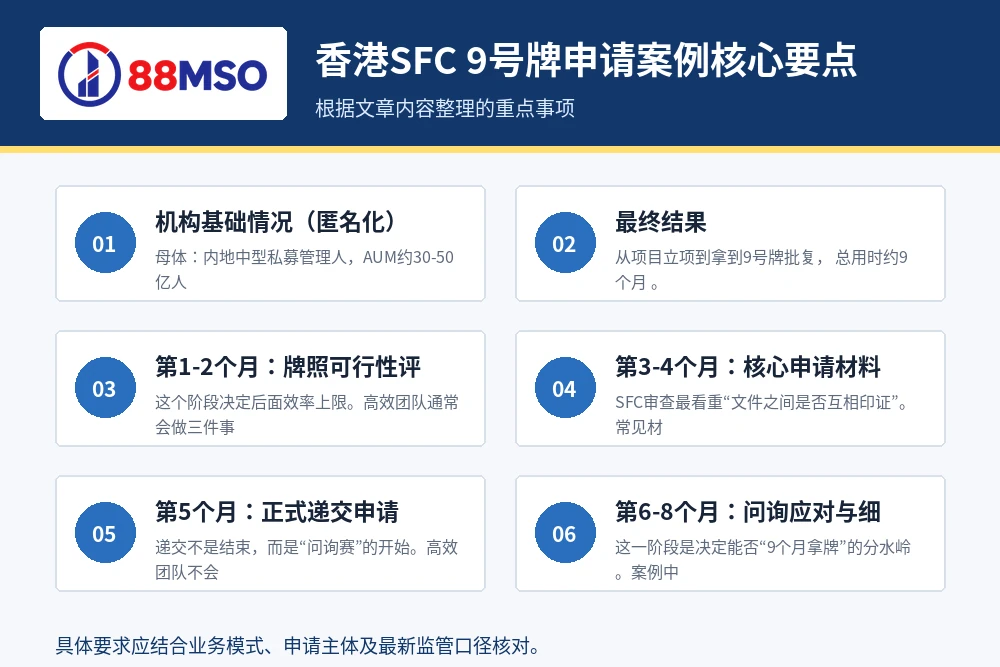
- mother body: Mainland mid-sized private equity manager, AUM is approximately RMB 3-5 billion, Multi-strategy (fixed income +, quantitative neutrality, Hong Kong and US stocks strengthened).
- Target: Establishing a licensed platform in Hong Kong, Undertake offshore funds and professional investor entrustment, Subsequent expansion of US dollar funds.
- initial challenge: Hong Kong’s local team is weak, Insufficient RO reserves, Compliance system is more localized, The cross-border information isolation mechanism is unclear.
2. The preparation results that should be formed
Preparatory output may include business scope table, Personnel responsibilities and resume evidence, Financial resource measurement, Institutional Documentation and Consistency Checklist. These are application preparation materials, Not a certificate of approval, Nor can we infer the approval time or pass rate based on this..
three, Application work divided by preparation stage
Stage one: License feasibility assessment + architecture construction
This stage determines the upper limit of efficiency later.. Highly effective teams typically do three things::
- License scope boundary confirmation: Clarify whether to apply for No. 9 license only, Or lay out the 1/4 number plate simultaneously?, Avoid "unbranded operations" in subsequent business.
- Legal entity and equity structure design: Including Hong Kong licensed companies, Holding platform, Ultimate beneficiary disclosure path, ensure transparency, explainable, penetrable.
- First draft of personnel plan: Assessment of resume compatibility of at least two RO candidates, Responsible for functional division of labor, Physical office arrangements in Hong Kong.
You can prepare the inquiry preparation list first, Check the verifiability of RO experience, Investment decision-making authorization chain and responsibilities of parent and subsidiary companies. 88MSO can coordinate materials and communication within the scope agreed by both parties., It does not replace the review judgment of the China Securities Regulatory Commission..
Stage 2: Polishing and consistency checking of core application materials
The most important thing in SFC review is "whether documents corroborate each other". Common materials include:
- Detailed business plan (Business Plan)
- Internal Controls and Compliance Manual (Including Transaction Monitoring, Valuation, hosting, conflict of interest, Complaint mechanism)
- AML/KYC policy and customer classification mechanism
- Financial Budget and Capital Adequacy Statement
- RO and senior management resumes, Responsibilities, authorization matrix
Compare business plan with consistency checklist, financial forecasts, RO Responsibilities, Operational procedures and outsourcing arrangements. Documents should be consistent with each other, and provide evidence of actual execution or implementation of the plan.
Stage three: Formal submission of application
Submission is not the end, It’s the beginning of the “Inquiry Competition”. Effective teams don’t wait passively after submission, But prepare in advance:
- Consult the FAQ library (for RO qualifications, Investment research process, High-frequency issues such as parent-subsidiary boundaries)
- Interview drills with key personnel (especially RO and compliance officer)
- Supplementary Document Template (Organizational Chart, Responsibilities, IT Control Supplement)
Stage four: Inquiry response and detail correction
The content of the inquiry will vary depending on the case.. When preparing materials, you can check whether additional explanations are needed from the following aspects::
- Proof of RO competency and time investment: Requires a clearer demonstration of their relevant asset management experience and actual level of participation.
- Firewall between Mainland parent entity and Hong Kong licensed entity: Research sharing boundaries need to be explained, Customer data isolation, Trading instruction link.
- Risk control practicality: Not only is there a system, There must also be evidence of implementation (such as risk control report template, regular meeting mechanism, Exception handling process).
Regulatory issues can be divided into factual supplements, System revision and supporting documents, and designate responsible persons respectively, Reviewers and Internal Time Limits. The response period shall be subject to the actual regulatory notice, Internal processing goals cannot be written into official approval commitments.
Stage five: Approval in principle and preparation before licensing
After entering the end, Organizations often need to complete several conditions (such as personnel arrival confirmation, System online, insurance arrangements or other operational preparations), Then obtain a formal license. Don’t “relax after celebrating” at this time, Instead, we should immediately switch to a licensed operating mode..
Four, 5 key points that should be checked in application materials
1. RO configuration must be "real and executable", Not pieced together on paper
Type 9 licence generally require at least two ROs. Many applications are delayed, The root cause is that the RO resume does not match the proposed development strategy., Or the actual arrangements for stationing in Hong Kong are insufficient. It is recommended to complete the RO interview during the project approval period, Job responsibilities, Signing rhythm and alternatives.
2. Business plans must be "conservative and credible"
Some organizations like to write very aggressive AUM goals, But the team and system support are insufficient, Can easily raise regulatory concerns. The prudent approach is: Phased goals + personnel expansion plan + synchronized construction path of risk control capabilities.
3. Compliance documents should be customized around “your business scenario”
Templated manuals are the biggest minefield. For example, if you do quantification, It is necessary to reflect model change control, Data vendor management, Algorithmic Trading Risk Monitoring; You are subjectively long, It is necessary to reflect the traces left by investment research decisions, Valuation independence and isolation of conflicts of interest.
4. Communication mechanism is more important than "material thickness"
The inquiry stage focuses on project collaboration: legal affairs, Compliance, business, HR, Can finance be unified?, Quick decision making. A team of professional consultants can significantly improve efficiency here, Especially teams that are familiar with SFC inquiry style and review focus.
5. Maintenance after obtaining the license requires pre-planning
The regulatory perspective is continuous. If you ignore the annual review just to "get the card", Report, Continuous monitoring mechanism, Higher follow-up costs. It is recommended to set up the continuous compliance model during the application stage..
five, Common causes of delay and avoidance list
- Reason for delay A: RO temporary changes → avoid: Double candidate pool + resume pre-review.
- Reason for delay B: Unclear boundaries between parent and subsidiary companies → avoid: Clarify the authorization matrix and information isolation system.
- Reason for delay C: Financial forecasts are unreasonable → avoid: Click "People, system, office, Professional Services” Split your budget and match the pace of your business.
- Reason for delay D: File conflicts → avoid: Establish a unified version control and cross-review mechanism.
- Reason for delay E: Slow patch response → avoid: Establish project manager and time limit management, Form a library of standard reply templates.
six, Ongoing obligations after formal permission is obtained
Getting the No. 9 card is just the first stage, The real competition lies in the quality of operations after being licensed. It is recommended to focus on:
- Continuous Compliance Governance: Regularly review transaction monitoring, Employee Transaction Report, Conflict of Interest Ledger.
- Investor communication mechanism: Information disclosure, Risk disclosure, Transparency in net worth and valuation processes.
- Collaboration between banks and service providers: hosting, audit, legal affairs, Administrative management forms a stable ecology.
- Cross-border business boundary management: Especially marketing, Delivery of investment advice, Cross-border data compliance.
When external support is needed, Documentation should be clearly organized, Service scope for process communication and ongoing maintenance. 88MSO can provide relevant support within the agreed scope, Personnel appointment, Legal obligations and formal application decisions must still be processed in accordance with applicable rules.
Conclusion: make business, People aligned with institutional evidence
Hong Kong SFC No. 9 license application requires business scope, Management team, Policies, Financial resources and risk control arrangements correspond to each other. Project management helps organize preparation, However, it does not constitute a guarantee of the approval cycle or results..
Before starting the application, You can sort out the license scope first, Staffing and business evidence gaps, Then make a preparation plan accordingly. Whether it is approved and the specific time will be determined by the China Securities Regulatory Commission on a case-by-case basis..
FAQ: The 4 issues that mainland asset management institutions are most concerned about
Q1: Can I do fund sales only if I apply for No. 9 license?
Usually cannot directly cover all sales activities. Whether plate No. 1 or No. 4 is involved, Depends on the specific promotion method, Customer contact paths and business arrangements.
Q2: Does RO require Hong Kong permanent residents?
Not necessarily, But it needs to meet the qualification requirements of SFC, experience, Requirements on time investment and feasibility of performing duties in Hong Kong, Case-by-case differences are large.
Q3: Can I apply first without a local team in Hong Kong?
It is theoretically possible to plan, However, in practice, if there is a lack of substantial operational arrangements,, Inquiry pressure will increase significantly, It is recommended that at least the core position placement design be completed.
Q4: Can I commit to a fixed time for approval?
Not applicable to all. If complex equity structures are involved, RO is unstable or the business model is too cross-licensed, The cycle may be lengthened. The key lies in early diagnosis and execution quality.
Application documents should explain how the business actually operates
When preparing for Hong Kong SFC No. 9 license application, The business plan should not only list the license name. The source of customers should be explained item by item, Products and transaction processes, Whether to hold client assets, Order placement and valuation arrangements, Outsourcing services, Conflict of interest handling and abnormal incident reporting path, and let the organizational structure, Personnel biographies and financial forecasts match each other.
The responsibilities of responsible personnel and core functional managers need to be implemented in daily decision-making and supervision records. Financial resources must continue to be monitored after being licensed, personnel changes, Business scope, Client Assets and Regulatory Reporting; Acquiring a licensed company does not mean that the license is automatically and unconditionally transferred with the transaction., Changes in control and key personnel should be checked against notification or approval requirements.
Industry references: Hong Kong Securities and Futures Commission: Licensing Manual.
Read more: Establishing a Family Office in Hong Kong: Which SFC financial licenses do I need to apply for?, Apply for Hong Kong SFC license: Responsible Personnel (RO) affiliation minefields and real management red lines.
Read more: Hong Kong SFC No. 9 Asset Management License Application Guide.