 简体中文
简体中文 繁體中文
繁體中文 English
Apply for Hong Kong SFC license,Why are RO issues always "stuck"?
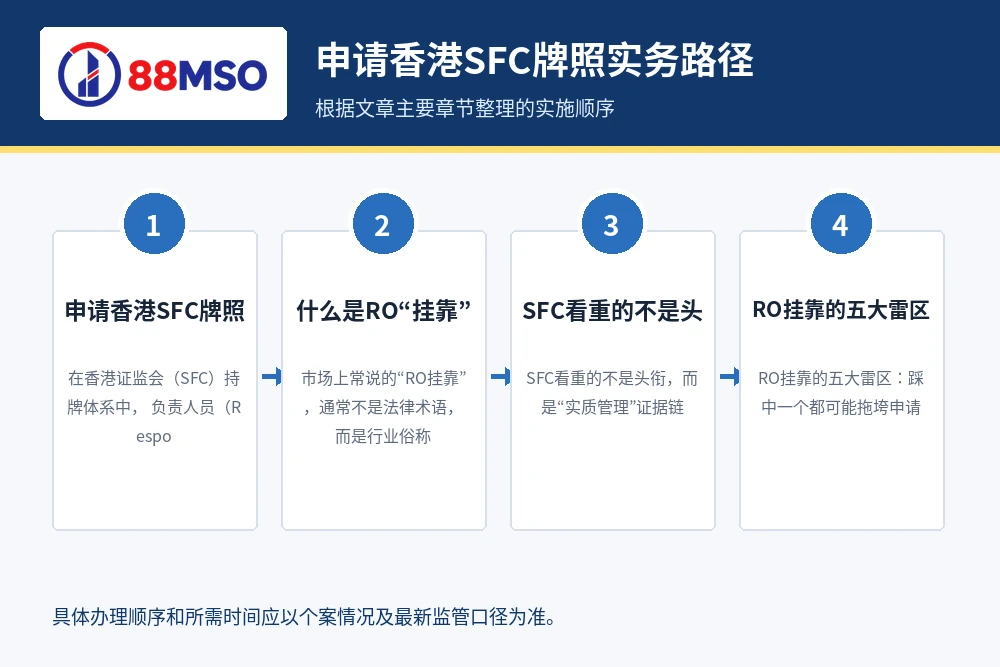
In the Hong Kong Securities and Futures Commission (SFC) licensing system,Responsible Officer,(referred to as RO)It’s not a “dispensable” title,It is the core anchor of whether the licensed company has real governance capabilities.。Many applicants think,First, find an RO with “good qualifications” as your name,After getting the license, we will slowly add a team.,This kind of thinking is increasingly unfeasible in the current regulatory environment.。
In recent years, the SFC’s review of “substance over form” has become significantly stricter.:Do you actually have a team operating in Hong Kong? Is the RO truly involved in decision-making and supervision? Are risk control and compliance processes in place? These issues are more critical than "the paper materials are all in disarray"。Especially in category 1 (securities trading)、Category 4 (Advising on Securities)、Category 9 (asset management) and other popular licenses are being applied for,RO arrangements often directly determine the speed of approval,Even determine whether it can be passed。
For institutions planning to enter the Hong Kong financial market,Understanding the RO affiliation minefield,Not just to “pass the application”,This is to avoid additional restrictions after obtaining the license.、Points lost for on-site inspection、even disciplinary action。This article dismantles the system:
- What is RO affiliation?,Why is high-risk behavior;
- How does SFC identify "nominal management" and "substantial management";
- Common red lines、Reasons for rejection and subsequent law enforcement risks;
- How to build a sustainable、auditable、Explainable RO governance structure。
What is RO "affiliation"? Let’s make the concept clear first
What is often referred to in the market as “RO affiliation”,usually not a legal term,But the common name in the industry,Mainly refers to the following types of situations:
- Nominal appointment、Doesn't actually matter:RO exists on the organizational chart,But does not participate in business approval、risk assessment、Staff training and compliance meetings。
- Excessive “part-time work” across multiple agencies:RO serves multiple organizations at the same time,Unable to prove that sufficient time and effort have been devoted to performing duties。
- File signature type RO:Only in key forms、Sign the policy document,Lack of real understanding and control of the business。
- There is a disconnect between front-office business and back-office compliance:RO does not know the company’s true trading pattern、Customer source、Outsourcing arrangements or fee structures。
What needs to be emphasized is:"External RO" is not a natural violation。The key is not the “form of employment relationship”,And whether it meets the requirement of "continuance"、efficient、Demonstrable” management and supervision。If you can provide complete evidence to prove that the RO actually performs his duties、Can be held accountable、Can be overridden by alternative mechanisms,Then external introduction may also be accepted。
What SFC values is not titles,But the chain of evidence of “substantive management”
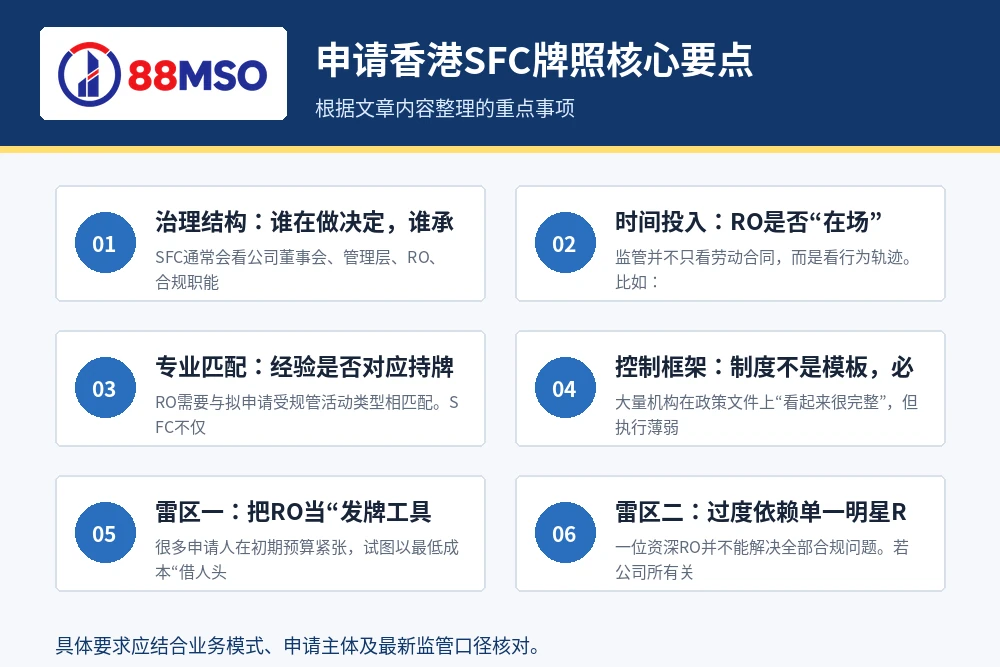
1) Governance structure:who is making the decision,who bears responsibility
The SFC usually looks at the company's board of directors、Management、RO、Is the division of responsibilities between compliance functions (e.g. MLRO/CO) clear?。Common review points include:
- Is RO involved in business strategy?、Product launch、Risk limit approval;
- Are there meeting minutes showing that the RO raised objections?、Revise opinions and promote implementation;
- When a complaint arises、Abnormal transactions、When there is a dispute over appropriateness,Whether RO leads the disposal?。
2) Time investment:Whether RO is "present" and "online"
Supervision does not only look at labor contracts,But look at the behavioral trajectory。for example:
- RO’s normal work arrangements and contactability in Hong Kong;
- Approval records in internal system、Email exchange、Meeting frequency;
- Whether to conduct regular sales、investment advisory、The trading team conducts supervision and review。
If RO is "lost contact" for a long time,Or all decisions are made by non-licensed key persons,It is easy to be questioned as "the name does not match the reality"。
3) Professional matching:Does the experience correspond to the licensed business?
RO needs to match the type of regulated activity to be applied for。SFC not only looks at age,It also depends on the quality of experience:
- Do you have directly relevant business experience and management experience?;
- Do you understand the target customer type (retail/professional investors) and product risks?;
- Are you familiar with Hong Kong’s local regulatory framework and the latest regulatory standards?。
4) Control framework:The system is not a template,Must be able to run
A large number of agencies "look complete" on policy documents,but weak execution。SFC will pay attention:
- KYC、appropriateness、conflict of interest、Is transaction monitoring actually implemented?;
- Is outsourcing management due diligence?、SLA、Data security and emergency mechanism;
- Whether RO proposes rectification of control deficiencies and follows up on closure。
Five major minefields for RO affiliation:If you step on any one of them, your application may be ruined.
Minefield 1:Treat RO as a "license dealer"
Many applicants have tight budgets in the early stages,Trying to "borrow heads" at the lowest cost。Seems like savings in the short term,But once the SFC asks to explain the details of RO’s performance,,There will be logical gaps in the material:The process is beautifully written,It’s unclear who will execute it。In the end, not only was the approval delayed,It may also be labeled as having weak governance。
Minefield 2:Over-reliance on a single star RO
One senior RO cannot solve all compliance issues。If all the key approvals of the company are placed on one person,Once he leaves office、Asking for leave or conflict avoidance,Business will fail immediately。Regulation will also question your ability to continue operating and your internal control resilience.。
Minefield three:RO and the actual controller have “inversion of power and responsibility”
The actual controller or business leader makes the final decision behind the scenes,RO is only responsible for "endorsement and signature",This is a typical red line。The SFC is very concerned about “who actually dominates regulated activities”。If there is any inconsistency between rights and responsibilities,It can range from asking for replacement parts to in-depth inquiries.,In serious cases, the approval may be refused or strong restrictions may be attached.。
Minefield four:Cross-border team leads Hong Kong business,But Hong Kong is hollowing out
Some groups put the transaction、Risk control、IT、Customer service is all located overseas,Hong Kong companies only retain the shell。If it cannot be proven that the Hong Kong RO has actual control and supervision rights over core links,Easily found to be substantively deficient。Especially in terms of customer suitability and complaint handling,Hong Kong’s local response mechanism must be real and available。
Minefield five:Ignoring ongoing compliance obligations after licensing
Some institutions focus on “obtaining licenses” rather than “guaranteing licenses”。actually,RO risks really start to be exposed only after the license is obtained.:annual review、Report、On-site inspection、Incident reporting、Personnel changes,Each requires ongoing RO involvement。If the performance record is interrupted,Historical problems will occur during inspections。
Substantive management red lines:The most easily triggered high-risk signals in SFC review
- Unable to interpret organization link:Who is responsible for the front, middle and back offices?、Who has veto power、It’s unclear who will ultimately be held accountable.。
- Key positions are vacant or vacant:Compliance、Risk control、Long-term absence of internal audit,Only supported by outsourced documents。
- Records are not continuous:meeting minutes、training records、Monitoring reports are missing or obviously filled in。
- RO is not familiar with business details:Asked about customer stratification、Charging model、Unanswered Questions When Trading Restrictions。
- Failure to report major changes in a timely manner:RO changes、Business scope adjustment、Late reporting and underreporting of system migration and other matters。
These signals may not immediately lead to rejection,But it will significantly increase the intensity of censorship,Extend the approval cycle,It even attracted more frequent regulatory attention in the future.。
From "being able to hold cards" to "holding cards reliably":Practical Framework for RO Governance
1) Before application:Conduct a “regulatory perspective” pre-review
It is recommended that before formal submission,A penetrating assessment by a team of consultants who are familiar with Hong Kong’s financial compliance practices,Key verification:
- RO candidate’s experience match to license type;
- Hong Kong’s local management essence and cross-border collaborative boundaries;
- Consistency between institutional documents and actual processes;
- Completeness of evidence preparation at potential inquiry points。
2) Applying:Establish "traceable performance" files
It is recommended to form an RO performance ledger,Include at least:
- Minutes of monthly/quarterly management meetings (including questions、resolution、Responsible person、time limit);
- Risk event handling records and review;
- Approval Checklist (Customer Admission、Product launch、Abnormal transaction handling);
- Training and assessment records (suitability and compliance awareness of frontline personnel)。
This chain of evidence is not only used for application inquiries,It is also the most convincing line of defense in future on-site inspections.。
3) After obtaining the license:Institutionalize the RO mechanism,rather than personal
Mature institutions avoid "heroic RO",Turn to create mechanism-based governance:
- Set up dual RO or clear bench arrangements,Reduce single points of failure;
- Establish a process for escalation and conflict avoidance of major matters;
- Make it compliant、Risk control、Business forms a closed loop of checks and balances;
- Regularly conduct internal compliance physical examinations and external independent assessments。
Common misunderstandings clarified:The three most misleading sentences in the market
Misunderstanding 1:"First place an RO to get the card,Let’s talk about it later”
Very high risk。Reviews now focus more on sustainability,It’s not a one-time pass。Laying mines in the early stage,Later rectification costs are usually higher.。
Misunderstanding 2:“RO is experienced enough,It doesn’t matter if you don’t understand the business.”
mistake。Supervision looks at “relevance + currentness”。The aura of history is no substitute for a true grasp of current business models。
Misunderstanding 3:“If the system template is complete, it will be safe”
Not established。Supervision increasingly focuses on enforcement evidence。A system with no trace of enforcement,It is equivalent to no system。
Roadmap for applicants:Key actions that can be taken within 90 days
- Weeks 1-2:Confirm license scope and business boundaries,Backward RO Capability Model。
- Weeks 3-4:Complete RO candidate due diligence and duty performance feasibility assessment (time、Place、conflict)。
- Weeks 5-8:Build governance documents、flow chart、Responsibility Matrix and Evidence Template。
- Weeks 9-10:Do mock inquiries,Focus on RO business drills、Risk control、Answer consistency for customer protection。
- Weeks 11-12:Submit the application after filling in the weak areas,and establish a follow-up ongoing compliance plan。
This roadmap seems “slow”,But it’s faster than blindly delivering items and then repeatedly replacing them.、more stable,It is also more in line with Hong Kong regulatory expectations for long-term operating capabilities.。
Conclusion:RO is not a "cost item",It is a safety valve licensed to operate in Hong Kong
in Hong KongSFC licenseApplying,RO affiliation is never a smart shortcut,It’s a high-probability rollover point.。What supervision really focuses on,is whether you have sustainable、Accountable、Verifiable substantive management capabilities。who is managing、How to manage、Who is responsible if something goes wrong?,These three things must be clear and evidenced。
For companies that want to conduct financial business in Hong Kong for the long term,Make the RO system solid,Far more commercial value than "getting a license at a low cost"。It not only affects the approval results,It also determines whether you can stabilize your business in the future.、Smoothly connect with bank and institutional customers、Reduce the probability of compliance incidents。If there is insufficient experience within the company,Complete the early stage architecture design and compliance implementation with the help of a professional team,Often the more economical option。One-stop license service model represented by 88MSO and the 88MSO practical system behind it,The core meaning is that:Help enterprises avoid detours,Upgrade "getting a license" to "sustainable management"。
FAQ:Frequent questions about RO affiliation and substantive management
Q1:Does RO have to be in Hong Kong full-time?
It may not necessarily be understood mechanically as “check in full time”,However, it must be able to demonstrate that it has continued involvement in the regulated activities、efficient、Timely management and supervision,and meet regulatory requirements for contactability and depth of performance.。
Q2:Can be transitioned by external RO first,Will they be trained internally in the future?
Transitional arrangements may be considered,But there needs to be a clear timetable、Handover mechanism and capacity building plan,Avoid long-term "nominal transition" from turning into substantial affiliation。
Q3:If there is already suspicion of affiliation,How to remedy this?
Do a gap assessment as soon as possible,Complete the responsibility matrix、Meeting and Approval Evidence、Training records and localized management arrangements;Adjust RO configuration when necessary and proactively improve governance transparency。
Application documents should explain how the business actually operates
When preparing to apply for a Hong Kong SFC license,The business plan should not only list the license name。The source of customers should be explained item by item、Products and transaction processes、Whether to hold client assets、Order placement and valuation arrangements、Outsourcing services、Conflict of interest handling and abnormal incident reporting path,and let the organizational structure、Personnel biographies and financial forecasts match each other。
The responsibilities of responsible personnel and core functional managers need to be implemented in daily decision-making and supervision records。Financial resources must continue to be monitored after being licensed、personnel changes、Business scope、Client Assets and Regulatory Reporting;Acquiring a licensed company does not mean that the license is automatically and unconditionally transferred with the transaction.,Changes in control and key personnel should be checked against notification or approval requirements。
Industry references:Hong Kong Securities and Futures Commission:Licensing Manual。
Read more:Hong Kong Securities and Futures Commission SFC No. 1/4/9 license application:Match the asset management company’s compliance structure with the person in charge of the RO、Why do mainland private equity funds prefer Hong Kong’s No. 9 plate? Application fee、Complete explanation of exemption conditions and cycles。