 简体中文
简体中文 繁體中文
繁體中文 English
Why has "Hong Kong No. 9" become the first choice for mainland private equity to go overseas?
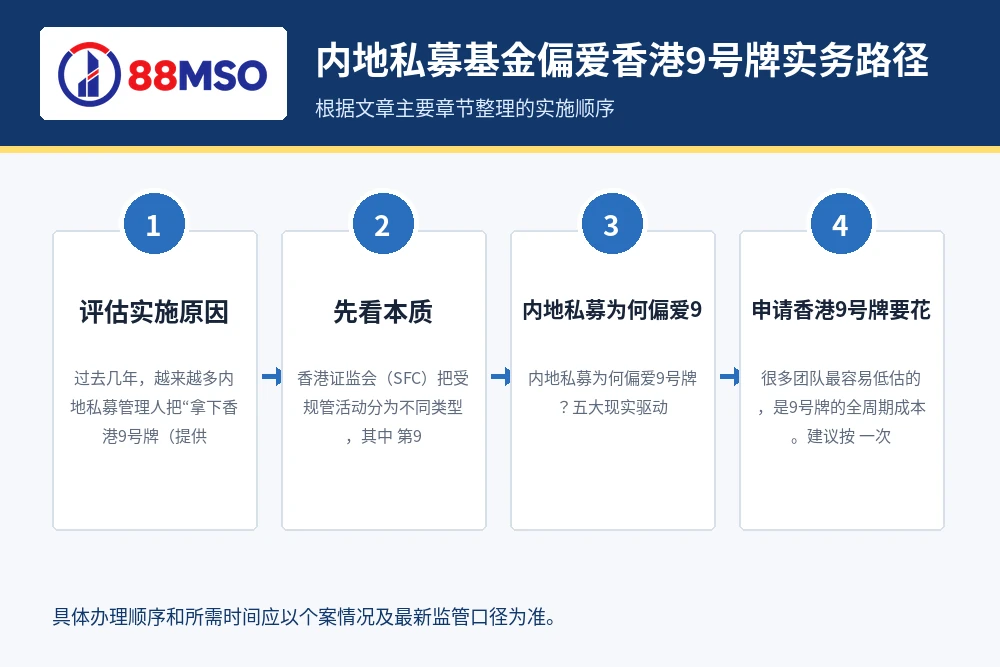
past few years,More and more mainland private equity managers regard “obtaining Hong Kong’s No. 9 license (providing asset management)” as a key node in their global layout。On the surface,This is a license application action;Essentially,It is an upgrade project for private equity institutions from "single mainland fundraising and investment capabilities" to "cross-border capital organization capabilities"。
For many managers,The value brought by Hong Kong’s No. 9 license plate is not only reflected in “the ability to do asset management business in Hong Kong”,It lies in the following strategic levels::Improved communication efficiency among international LPs、Enhanced implementation capabilities of US dollar fund structure、Lower barriers to cooperation with banks and custodians、Institutional brand and governance system upgrade。It is precisely because of this,No. 9 plate gradually changes from "optional" to "standard equipment"。
But in actual progress,Many teams will get stuck on several practical issues:How much will it cost? Is there any exemption channel? How long does it take from preparation to approval? How to match the person in charge (RO)? If there is no systematic planning for these problems,,It is very easy to lead to repeated repairs、Delay in approval,He was even asked to reconstruct the business plan due to unclear positioning.。
This article will focus on the issues that mainland private equity is most concerned aboutApplication fee、Exemption conditions and periodsDismantle the whole process,And combined with regulatory logic to explain "Why is it also the No. 9 plate?",Some progress smoothly within 3-6 months,Some cases have been delayed for more than a year and there is still no conclusion.”。
one、Look at the essence first:What does Hong Kong’s No. 9 license plate mean?
The Securities and Futures Commission of Hong Kong (SFC) divides regulated activities into different types,inType 9 regulated activity(Type 9)Corresponds to "providing asset management"。Simple to understand:As long as you manage securities or futures contract assets in Hong Kong,or manage a portfolio of funds containing underlying assets,Usually they fall into the regulatory scope of No. 9 plate。
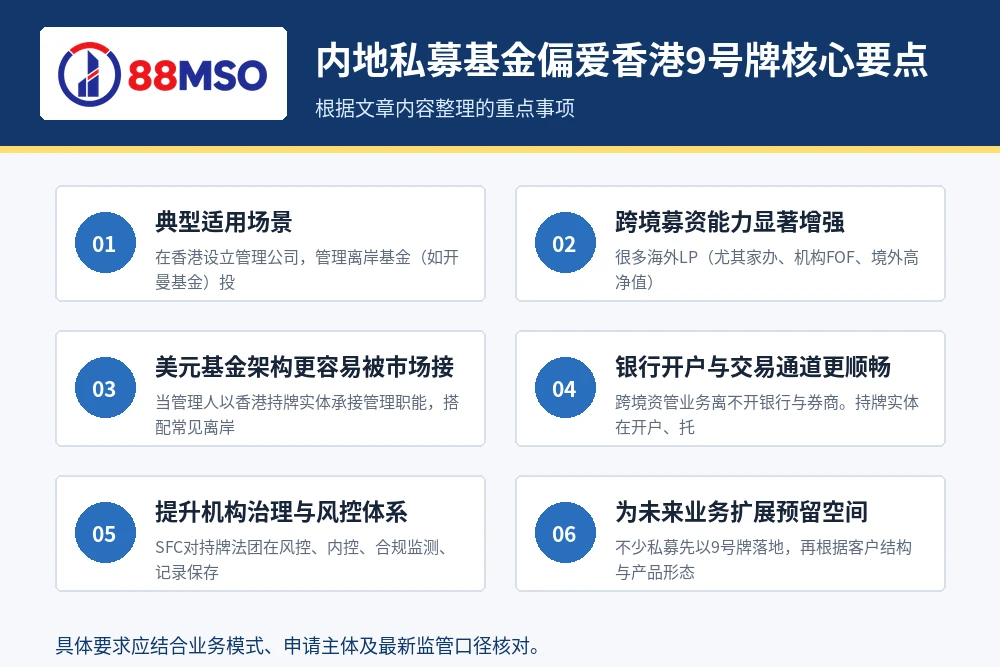
Typical applicable scenarios
- Setting up a management company in Hong Kong,Manage offshore funds (such as Cayman funds) to invest in Hong Kong stocks、US stocks、bond、Derivatives, etc.;
- As an investment advisor/manager,Providing discretionary management of professional investor accounts;
- Mainland strategy team + Hong Kong licensed management platform,Forming a closed loop of cross-border research and execution。
It should be noted that,Card No. 9 is not a "universal card"。If the business involves distribution、Advise on securities、Structured product arrangements, etc.,It may also touch plate No. 1、No. 4 plate and other license plate boundaries。therefore,Business mapping before application is very critical。
two、Why do mainland private equity firms prefer No. 9? Five reality drivers
1) Cross-border fundraising capabilities have been significantly enhanced
Many overseas LPs (especially family offices)、Institutional FOF、Overseas high net worth) are extremely sensitive to "whether they hold a Hong Kong SFC license"。No. 9 plate is often an important endorsement of compliance capabilities during due diligence,Can significantly improve the efficiency of fundraising conversations。
2) The US dollar fund structure is more easily accepted by the market
When the manager uses a Hong Kong licensed entity to undertake management functions,Paired with common offshore fund structures (such as Cayman SPC/LP),in legal relations、Escrow arrangements、Audit disclosures are more easily aligned with international practices。
3) Bank account opening and transaction channels are smoother
Cross-border asset management business is inseparable from banks and securities firms。A licensed entity is opening an account、hosting、trade execution、Fund settlement aspects are generally more explainable,Communication costs are lower than completely “non-licensed” model。
4) Improve institutional governance and risk control systems
SFC’s risk control measures for licensed corporations、internal control、Compliance monitoring、record keeping、There are clear requirements for conflict of interest management and other aspects。Although increased management costs,But in the long run, it will help institutions build replicable、Auditable operating system。
5) Reserve space for future business expansion
Many private equity funds were first launched with the No. 9 license plate,Then gradually expand other licenses or functional modules according to customer structure and product form.。This is more in line with the regulatory prudential principle than "big first and then comprehensive"。
three、How much does it cost to apply for Hong Kong No. 9 plate? The cost is more than just “government charges”
The easiest thing for many teams to underestimate,is the full cycle cost of No. 9 plate。It is recommended to pressOne-time cost + ongoing costTwo types of budgets。
1) One-time cost (establishment and application stage)
- Company establishment and basic secretarial services:Hong Kong company registration、legal secretary、Registered address, etc.;
- Statutory fees related to SFC application:Includes licensed corporation application fee、Responsible person (RO) application fee, etc.;
- Compliance documents and system establishment:business plan、Compliance Manual、AML/KYC framework、Risk control and valuation process, etc.;
- staffing costs:RO、Responsible for compliance and risk control personnel、operations support staff;
- Proof of office and substantive operations:lease、IT system、File management、Transaction and Monitoring Recording System。
Based on the size of common projects in the market,If we build from scratch and pursue a more complete operating framework,The comprehensive investment in the first year is usually in the range of "mid to high six-digit to seven-digit Hong Kong dollars" (depending on the size of the team)、Personnel structure、Fluctuates whether you apply for other licenses in parallel)。
2) Ongoing costs (after licensing)
- Annual license fees and business registration renewals;
- audit、Tax filing and compliance advisory support;
- Continuing Training (CPT) and Employee Compliance Education;
- Anti-Money Laundering Monitoring、Transaction record keeping、regular internal review;
- Report of major changes (personnel、Business scope、Equity structure, etc.)。
The conclusion is clear:The No. 9 card is not "take it down and it's over",Rather, it is a long-term investment in “licensed operating capabilities”。This is why professional organizations usually recommend that clients first conduct a feasibility assessment,Re-determine application path,Avoid “Apply First、High rework model of "back-up system"。
Four、How to understand the exemption conditions? Common Misunderstandings and Boundary Tips
“Is there any exemption?” is a frequently asked question in consultations。Need to emphasize:Regulatory exemptions are not “just forget it”,But for specific business forms、Customer type、Exception boundaries set in scenarios such as intra-group arrangements。
Several directions that are often mentioned
- Internal management arrangements of the group:Provide services only to entities within the group,And not for external business,There may be room for discussion of specific exemptions;
- The difference between pure consulting and non-full management:If the provision of general research/opinion does not constitute a regulated activity,Regulatory treatment may vary;
- Arrangements related to professional investors:Certain sales and disclosure obligations vary based on customer classification,But it does not mean that there is no need to hold a license。
In practice, the easiest thing to step into is:Misunderstanding "the client is a professional investor" as "you can do asset management without a license"。in fact,Whether it constitutes a regulated activity,The core depends on what you did,Instead of just looking at who the customer is。Once it comes to management functions,Usually it still needs to be evaluated under the No. 9 plate framework。
therefore,Any "exemption scheme" should be based on specific business processes、Contractual relationship、Charging model、Investment decision-making authority to judge。It is recommended to complete regulatory characterization before designing the product,Avoid subsequent structural redoing that may affect the pace of fundraising。
five、Complete explanation of application cycle:From preparation to licensing,Where is the time spent?
Stage 1:Early diagnosis and path design (2-6 weeks)
Clarify the business model、target customers、product type、Trading market and organizational structure;Simultaneous assessment of RO feasibility、office substance、Compliance and risk control configuration。This stage determines whether the follow-up will be smooth.。
Stage 2:Material preparation and internal construction (4-10 weeks)
Form a complete application package:business plan、financial forecast、internal control system、AML/KYC Policy、Personnel resume and competency certificate、Description of outsourcing arrangements, etc.。The higher the quality of the data,The lower the probability of subsequent replacement。
Stage 3:SFC acceptance and inquiry (3-6 months or longer)
Regulatory agencies will determine the substance of the business、People experience、governance mechanism、Risk identification and mitigation measures raise questions。If the answer is logically inconsistent,or lack of proof of practical ability,The cycle will be significantly lengthened。
Stage 4:Passing in principle and preparation for landing (2-6 weeks)
Including completing pre-licensing conditions、Internal process drill、Finalization of customer document templates, etc.。After the final licensing is completed, it will enter the continuous supervision stage.。
overall cycle:with sufficient preparation,Commonly seen as4-8 months;If complex equity structures are involved、RO qualifications are unstable、Blurred business boundaries, etc.,May extend to 9-12 months or even longer。
six、RO (Responsible Officer) is the key to success or failure:Why are so many projects stuck here?
No. 9 plate application,RO is the focus of supervision。SFCs typically focus on their relevant industry experience、management ability、Understanding of the proposed business,and whether they can actually perform their duties。Only "nominal" or experience does not match the declared business,will trigger high-intensity inquiries。
- RO experience needs to match strategy type and asset class;
- Need to prove that they are making investment decisions、risk management、Actual role in compliance collaboration;
- The team structure must support the RO’s performance of duties,rather than a single point of dependence。
For mainland teams,A common challenge is “investment research is strong”、Weak licensing experience”。A feasible approach is to plan localized management and compliance configuration in advance,form an "executable、auditable、sustainable governance framework。
seven、Practical Suggestions for Improving the Pass Rate (Special Edition for Mainland Private Equity)
1) Do regulatory mapping first,Let’s talk about product release again
First define whether to trigger plate number 9、Whether it involves other regulated activities,Redeem fund terms and sales arrangements。
2) Make AML/KYC a “process”,Not a "document"
What supervision values is evidence of implementation:Customer due diligence classification、Suspicious transaction identification、Sanctions Screening、Continuously review whether records are authentic and traceable。
3) The business plan must be “implementable”
Don’t write “covering global assets” in general terms。The initial strategy should be clearly defined、target market、Risk control threshold、Liquidity management and valuation mechanism。
4) Pay attention to the quality of responses to the first round of inquiries
Repeated explanation of the same problem will significantly slow down the cycle。Answers should be unified,Secure legal documents、Organization chart、Same job responsibilities。
5) Choose a compliance service team with cross-border practical experience
From license application to subsequent maintenance, it is a continuous project。Possess Hong Kong financial compliance、SFC communication and licensed operation experience team,Can effectively reduce trial and error costs。Take platforms such as 88MSO/88MSO, which have long been engaged in Hong Kong financial license case services, as an example.,Its value is often not in "filling in the form on your behalf",It’s about identifying risks in advance、Build a sustainable compliance system。
eight、FAQ
Q1:Do mainland private equity companies have to have a Hong Kong company before they can apply for the No. 9 license?
It is usually necessary to use a Hong Kong entity as the applicant for a licensed corporation。Company establishment、Equity structure and management arrangements should be consistent with the declared business。
Q2:Only professional investor clients,Is it possible not to apply for No. 9 plate?
uncertain。The key is whether it constitutes a regulated activity。If asset management services are actually provided,Usually still required to be licensed。
Q3:Does RO have to be a permanent resident of Hong Kong?
not absolutely,However, regulatory requirements for competency and duty performance must be met.,and be able to effectively perform their duties within Hong Kong’s regulatory framework。
Q4:Can I raise funds or manage funds first during the application process?
It is generally not recommended to carry out regulated activities that require a license before obtaining a license。Compliance path confirmation should be completed first,Avoid triggering regulatory risks。
Q5:Will everything be fine after the No. 9 license plate is approved?
no。Subsequent annual review、Continuous Compliance、Anti-money laundering、Personnel training、Notification of major changes is a long-term obligation of licensed institutions。
Conclusion:Number 9 is not the end,It is the starting point of international asset management capabilities.
Mainland private equity prefers Hong Kong No. 9 plate,The core reason is not to “follow the trend”,Rather, the cross-border asset management industry has entered a new stage of "compliance is competitiveness"。Who can complete the license earlier?、governance、Risk control、Unifying the fundraising narrative,Whoever has a better chance of gaining long-term trust in the global capital market。
If the application for No. 9 plate is regarded as an administrative process only,Often at the expense of、Repeatedly blocked in cycles and inquiries;If you think of it as an organizational upgrade project,From business model、RO configuration、AML system、Plan for continued operations together,The project pass rate and subsequent commercial conversion will be significantly improved.。For private equity managers who want to go overseas safely,This step is worth taking,It's worth getting it right the first time。
Application documents should explain how the business actually operates
When preparing to explain why mainland private equity funds prefer Hong Kong’s No. 9 license plate,The business plan should not only list the license name。The source of customers should be explained item by item、Products and transaction processes、Whether to hold client assets、Order placement and valuation arrangements、Outsourcing services、Conflict of interest handling and abnormal incident reporting path,and let the organizational structure、Personnel biographies and financial forecasts match each other。
The responsibilities of responsible personnel and core functional managers need to be implemented in daily decision-making and supervision records。Financial resources must continue to be monitored after being licensed、personnel changes、Business scope、Client Assets and Regulatory Reporting;Acquiring a licensed company does not mean that the license is automatically and unconditionally transferred with the transaction.,Changes in control and key personnel should be checked against notification or approval requirements。
Industry references:Hong Kong Securities and Futures Commission:Licensing Manual。
Read more:What is the difference between Hong Kong SFC No. 1 and No. 4 plates? Guidance on Capital Requirements and Business Boundaries、Acquisition by Hong Kong SFC licensed company:RO remains in office、The whole process of client asset transfer and China Securities Regulatory Commission approval。