 简体中文
简体中文 繁體中文
繁體中文 English
Financial Institutions Anti-Money Laundering (AML) Audit Material Checklist:Necessary documents for compliance officers to respond to regulatory spot inspections
In Hong Kong and cross-border financial business scenarios,Anti-money laundering (AML) is no longer a formal work that “just needs a system”,It is the core starting point for regulatory agencies to judge whether an institution has the ability to continue operating and risk management and control capabilities.。For Compliance Officers (especially MLROs),The most common challenge is not “not knowing what to do with AML”,Rather:During a sudden supervisory inspection,Are the documents complete?、Is the logic consistent?、Is the evidence traceable?、Whether the responsibility can be implemented。
Many organizations encounter typical problems in their daily operations.:The policy is well written,But the execution record is broken;KYC done,But customer risk ratings cannot be explained;The transaction monitoring system is online,However, no traces are left behind in parameter setting and tuning.;A suspicious transaction report (STR) has been submitted,However, the internal upgrade process does not have a complete evidence chain。Once these problems are discovered by supervision,Minor rectification,Severe penalties may even affect license renewal。
This article will take a practical perspective,Systematically sort out the list of AML audit materials that financial institutions should prepare,And provide a set of "spot check and response" archiving framework。Whether you hold a Hong Kong MSO license、SFC related licenses、Insurance Broker License or Money Lender License,This set of methods can be used as a general underlying template。For organizations that want to build a high-standard compliance system,It can also be combined with a professional team to conduct annual physical examination and optimization,Ensure the move from "compliance documents" to "compliance capabilities"。
one、What are you most concerned about during regulatory inspections? First understand the "check logic"
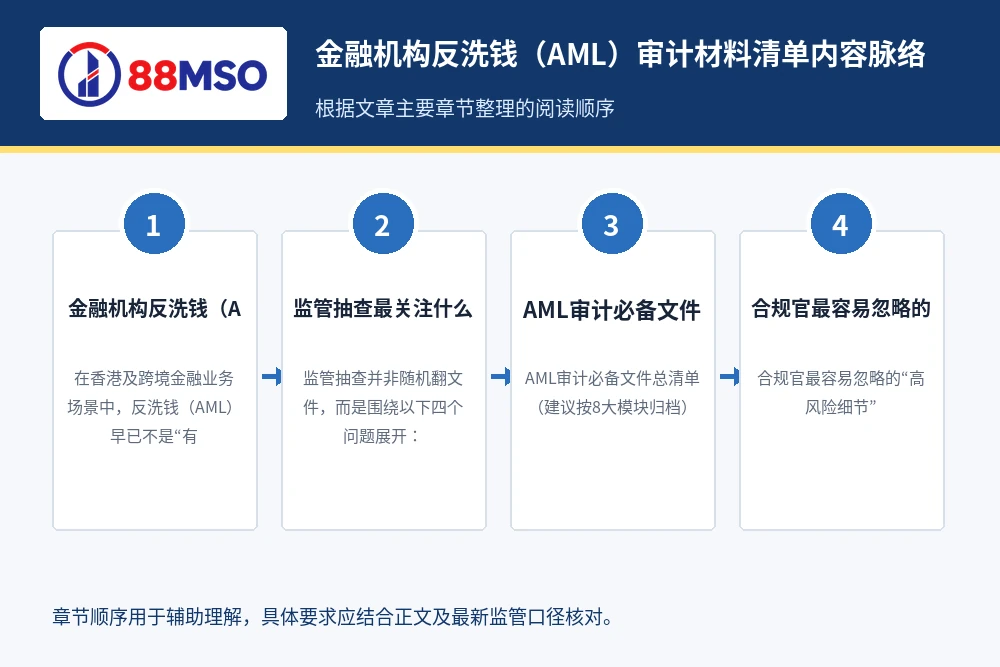
Supervisory spot checks are not random document searches,Rather, it revolves around the following four questions:
- Is governance in place?:Board of Directors、Does senior management truly take responsibility for AML?
- Is the system implemented?:Do policies and procedures match the business?,Is there evidence of enforcement?
- Is the risk controllable?:client、product、area、Are channel risks identified and dynamically managed?
- Is the problem closed loop?:Whether to upgrade after an abnormality is discovered、investigation、Report、Rectify and review?
therefore,Preparing audit materials cannot be organized just by "document name",Instead pressRegulatory issue orientationEstablish a chain of evidence:System—Execution—Monitoring—Improvement。
two、General list of necessary documents for AML audit (it is recommended to file according to 8 major modules)
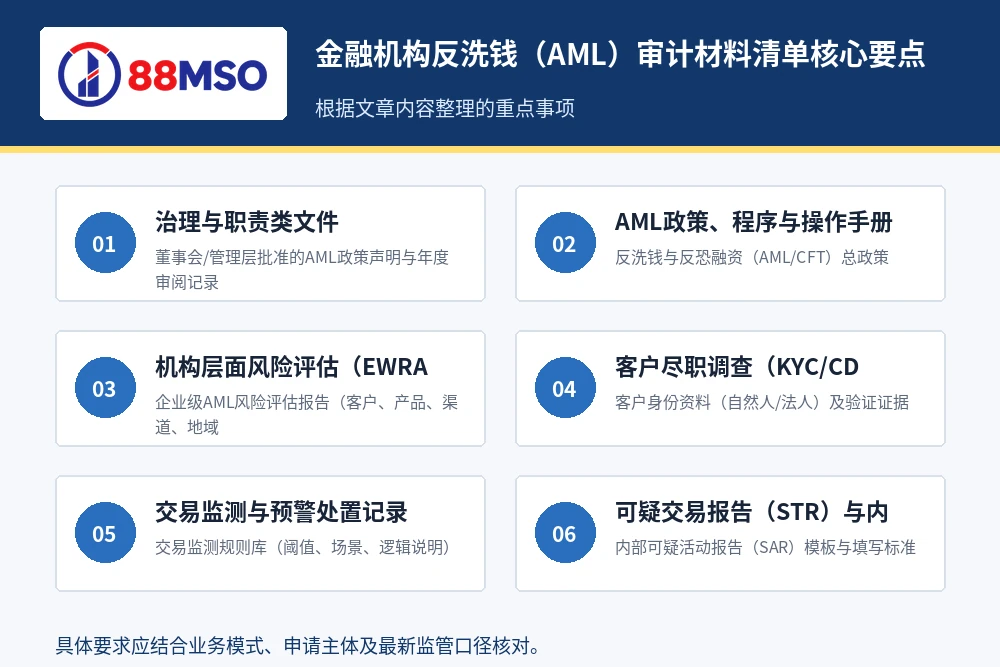
1) Governance and responsibility documents
- Board/Management approved AML policy statement and annual review record
- Organization chart (including compliance、Risk control、business line reporting relationships)
- MLRO/Compliance Officer Appointment Document、Job description、Authorization scope
- Document on the division of responsibilities of the three lines of defense
- Compliance Committee meeting minutes (including topics、resolution、follow up matters)
Audit points:Supervision will look at “who is responsible、How to be responsible、Whether it fulfills its responsibilities?”。A letter of appointment is not enough,There are also meeting minutes、Implement resolutions and track results。
2) AML policy、Procedures and Operations Manual
- Anti-money laundering and counter-terrorism financing (AML/CFT)general policy
- KYC/CDD/EDD procedure documents
- Customer risk rating methodology and scoring matrix
- Ongoing due diligence and periodic review procedures
- Sanctions Screening、PEP screening process
- Suspicious transaction identification and internal reporting process
- Records retention policy (including retention periods、media requirements)
Audit points:Version control must be clear (effective date、Revised by、approver、Reason for revision)。If the policy has not been updated in 3 years,Often questioned as “not matching current regulations”。
3) Institutional Level Risk Assessment (EWRA) information
- Enterprise-level AML risk assessment report (customer、product、channel、Regional four dimensions)
- Risk assessment model description and weight setting basis
- Checklist of control measures for high-risk business lines
- Annual risk assessment update records and management approval
Audit points:Supervision attaches great importance to the "Risk-Based Approach"。If an institution claims that it has low risk,But operating high cash flow、Cross-border complex transactions,and lack of enhanced control,Will face high probability of questioning。
4) Customer due diligence (KYC/CDD/EDD) files
- Customer identity information (natural person/legal person) and verification evidence
- Beneficial owner (UBO) identification and penetration certificate
- Description of the purpose and nature of the business relationship
- Source of Funds (SOF) and Source of Wealth (SOW) documents
- PEP、high risk countries、EDD reports for customers with complex structures
- Customer risk rating results and review timeline
- Records of events that trigger re-due diligence (such as equity changes、Transaction abnormality)
Audit points:“Complete documentation” does not mean “compliance”。Supervision pays more attention to the “judgment process”:Why is it judged as low/medium/high risk? Is the evidence sufficient to support the conclusion? Is it reviewed based on risk frequency?
5) Transaction monitoring and early warning disposal records
- Transaction monitoring rule base (threshold、scene、logical explanation)
- Parameter tuning and model backtesting records
- Alarm processing ledger (generated、dispatch、investigation、Case closed)
- False alarm rate analysis and optimization report
- Reconciliation records with business system data
Audit points:If there are a large number of "orders closed within seconds" alarms and no investigation instructions,Easily judged as formal monitoring。It is recommended that each alarm should retain at least "investigation ideas + evidence links + conclusion basis"。
6) Suspicious Transaction Report (STR) and internal upgrade evidence
- Internal Suspicious Activity Report (SAR) Template and Filling Criteria
- Records of the upgrade process from frontline to compliance (time stamp、responsible person)
- MLRO review opinions and decision-making basis
- Submit a copy of STR and proof of submission to the outside world
- Confidentiality measures and “tipping-off” training records
Audit points:Regulation does not require “the more STRs, the better”,Instead, look at “whether the newspaper reports、Why report、Why don’t you report it?”。The key is that the decision-making process is auditable、Can be reviewed。
7) Training、Testing and Culture Building Materials
- Annual AML training plan (stratified by position)
- New employee onboarding AML training records
- test scores、Supplementary training records、Training effectiveness evaluation
- Special training for high-risk positions (frontline、operations、Approval post)
Audit points:A sign-in sheet alone is not enough。Supervision will ask employees about their ability to identify suspicious situations,Training materials should be closely related to real cases and organizational business scenarios。
8) Independent audit、Defect rectification and continuous improvement
- Internal audit/external independent review report
- Regulatory inspection opinions and rectification plans
- Rectification tracking ledger (person in charge、Deadline、Complete evidence)
- Retest report after rectification confirmed with management
Audit points:It’s not scary to find the problem,The scary thing is "the same problem every year"。Closed-loop evidence is an important reflection of organizational maturity。
three、The “high-risk details” compliance officers most easily overlook
1) Sample consistency problem
A common action for spot checks is "cross-file checking":Customer profile、transaction history、Monitoring alarms、Are the due diligence conclusions consistent?。If the customer's KYC shows that the main business is trading,However, the trading behavior deviates for a long time without review,Will be directly questioned about the failure of control。
2) Timeline break problem
Supervision will look at whether key actions are timely:For example, whether high-risk customers complete EDD within the specified time?、Whether the alarm has expired or not?、Is STR reported late?。It is recommended to establish an SLA monitoring panel。
3) Template conclusion problem
"No exception found" if stated exactly the same across multiple clients,and no personalized analysis,Easily identified as following procedures。The conclusion should have customer characteristics、Transaction characteristics and verification evidence support。
4) The problem of disconnection between system and manual work
Having a system but no governance is a common pain point。Why are the parameters set like this? Who approves? When to review? If there is no documentation,Difficult to prove system effectiveness。
Four、Establish a "72-hour response package for regulatory spot checks"
It is recommended that each financial institution establish an audit information package that can be quickly exported,Design according to "72 hours to submit":
- T+4 hours:Export governance files、policy directory、responsibility matrix
- T+24 hours:Submit a complete set of KYC files and risk rating basis for sampled customers
- T+48 hours:Submit transaction monitoring rules、Alarm handling evidence、STR decision chain
- T+72 hours:Submit training records、Independent review report and proof of closed-loop rectification
The key to this mechanism is hierarchical archiving and unified naming rules.,Instead of temporarily "finding files"。
five、Practical suggestions for document management and evidence chain design
1) Unified naming convention
For example:Customer Number_Document Type_Version_Date,Such as "C1023_EDDReport_v2_2026-03-15”。Easy to spot check and cross-reference。
2) Version control and approval traces
Each policy update should be accompanied by a "Revision Statement",Record regulatory basis、Business triggering reasons and training implementation time。
3) Establish an “evidence index table”
Configure evidence locations for each control:System clause number、System screenshot、Ledger number、Responsible person、Last test date。
4) Quarterly self-examination mechanism
Conduct a "small spot check drill" every quarter,Randomly select customers and alerts,Check data completeness and consistency。
six、Application tips for different licensing agencies (Hong Kong scenario)
Under Hong Kong’s regulatory framework,The AML focus of different licensing agencies is slightly different.:
- MSO business:Cash and cross-border remittances carry higher risks,Need to focus on strengthening source verification、Agency channel management and transaction monitoring thresholds。
- SFC related licensed business:Pay more attention to customer suitability and consistency of capital flow paths,AML needs to be linked with investor portrait management。
- insurance broker:Pay attention to policy funding sources、Unusual Premium Payment Patterns、Abnormality in the surrender and compensation chain。
- moneylender business:Pay attention to the borrower’s background、Source of repayment funds、Abnormal situations such as third-party compensation。
This is why many institutions choose to provide long-term support from a team of professional consultants who are familiar with the local regulatory context in Hong Kong.:More than just preparing “documents”,It also establishes a “supervisory and verifiable compliance operating system”。One-stop compliance service practice represented by 88MSO and its 88MSO service team,The core value lies in applying for a license、System building、Training implementation and annual review and maintenance are connected,Reduce the agency’s passive response costs during spot inspections。
seven、Conclusion:True AML preparation,Not "for future reference",But "operational"
When compliance officers face regulatory spot checks,The most confident state is not "We have a lot of files",Rather, “each of our controls can be proven effective.”。A high-quality AML audit checklist,The ultimate goal is not to cope with one inspection,Rather, it enhances the institution’s long-term stable operating capabilities.。
If you are building or upgrading an AML system,It is recommended to do three things starting from today:Complete the chain of evidence、Establish quarterly drills、Promote management involvement。When systems and business are truly on the same frequency,Supervisory spot inspections will transform from "risk events" to "capacity demonstrations"。
FAQ:Compliance Officer FAQ
Q1:Are the more AML files the better?
no。The key is relevance、integrity、Traceability。Invalid and redundant files will increase the cost of spot checks.。
Q2:Will a small number of STRs be considered insufficient?
uncertain。Supervision depends on whether the identification and decision-making mechanism is effective,rather than purely quantitative indicators。
Q3:Small and medium-sized organizations do not have complex systems,How to monitor transactions?
You can start with a regular ledger and a list of risk scenarios.,Make sure it is executable first、Can leave traces,gradually systematize。
Q4:How often is it appropriate to conduct an independent AML review?
It is generally recommended that at least once a year;If the business expands rapidly or risks increase,Can increase frequency and conduct special reviews。
Institutional documents must be able to correspond to sampling records
When processing a financial institution’s anti-money laundering (AML) audit checklist,Risk assessment should be specific to the client、product、country region、Delivery channels and transaction models,Then set customer due diligence accordingly、Identification of actual controller、Sanctions and negative information screening、Continuous monitoring and upgrade approval。Keep only one general AML manual,Unable to prove that the system has been actually implemented。
Audit or inspection data should be able to restore access along with individual customers、risk rating、trade、alarm、Review、Suspicious transaction determination and record keeping process。CRS and FATCA require additional confirmation of institution and account classification.、Self-certification of tax residency、US indicators、Due diligence and reporting responsibilities,Not to be confused with anti-money laundering customer classification。
Industry references:International Financial Action Task Force recommendations。
Read more:What should you do if a financial regulatory agency issues a "warning letter for lack of compliance"? License crisis public relations and remedial measures、Under the dual supervision of CRS and FATCA,How do offshore financial licensed institutions complete tax-related information exchange in compliance with regulations?。