 简体中文
简体中文 繁體中文
繁體中文 English
Encountered "Lack of Compliance Warning Letter",Don't panic yet:This is a reversible compliance battle
For licensed financial institutions,A "compliance deficiency warning letter" from a regulatory agency is often one of the documents management least wants to see.。It doesn’t just mean that institutions are anti-money laundering (AML)、Customer Due Diligence (KYC)、Suspicious transaction monitoring、internal control、There are loopholes in license plate maintenance and other aspects,It may also trigger a chain reaction:Bank cooperation tightens、Customer confidence declines、Partners wait and see、Financing valuation cut,Even escalate to a fine、Restrict business、Risk of license suspension or withdrawal。
But it must be emphasized:A warning letter is not the same as a judgment。In most regulatory scenarios,A warning letter means “the supervisor has noticed a problem,and give a limited window period to request repairs.”。Who can do it quickly within the window period?、major、Complete remediation verifiably,Who can turn the crisis into an opportunity for governance upgrades?;on the contrary,procrastination、Perfunctory、Distortion report,This is the key incentive that pushes mild supervision incidents to heavy fines.。
This article will take a practical perspective,The whole process of system dismantling after receiving the warning letter:72-hour crisis response、Rectification plan design、Communicate internally and externally、Public relations control risk、Replay and solidification。For companies planning Hong Kong and overseas financial license businesses,This method is particularly crucial。MSOs like 88MSO/88MSO that have been deeply involved in Hong Kong for a long time、SFC、Insurance broker and money lender license compliance and custody team,Repeatedly verified in actual combat:The most important thing in supervision is not "whether something went wrong",It’s about “whether you have the ability to repair compliance after an error occurs?”。
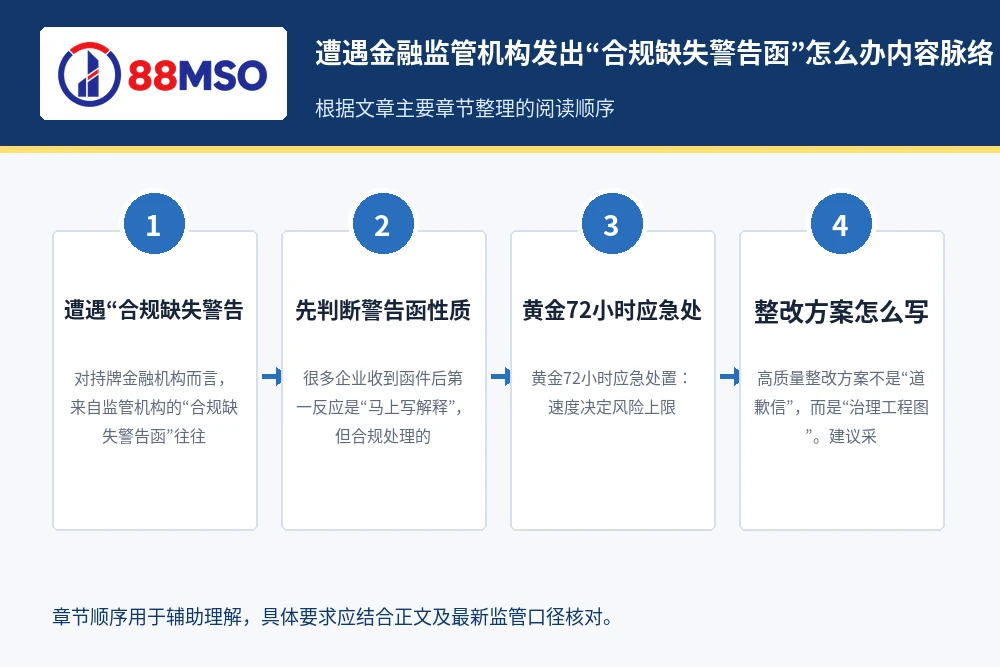
one、Determine the nature of the warning letter first:Are you facing a "prompt risk" or a "substantial prelude to law enforcement"?
The first reaction of many companies after receiving the letter is to "write an explanation immediately",But the first step in compliance processing is not to write materials,Rather, it is a qualitative risk level。Usually can be divided into three categories:
- General Observation Letter/Reminder Letter:Mostly because the program is incomplete、Documentation gaps、Individual sampling is not up to standard,Large room for rectification。
- formal warning letter:Point out clear violations,Usually comes with a rectification deadline,May require submission of independent review or board commitment。
- Pre-enforcement notification:If there is an on-site investigation at the same time、Freeze some businesses、High frequency replacement required,May have entered the penalty assessment stage。
It is recommended to complete three things simultaneously during the qualitative stage:
- Establish a "supervisory communication general ledger":time、Letter number、Problem、feedback node、Responsible person。
- Freeze high-risk processes:For example, high-risk customer onboarding、Abnormal capital channel、Approval of large-value transactions without review。
- Initiate dual-track legal and compliance review:Distinguish between "factual issues" and "presentation risks",Prevent incorrect answers from causing secondary regulatory concerns。
two、Golden 72-hour emergency response:Speed determines the upper limit of risk
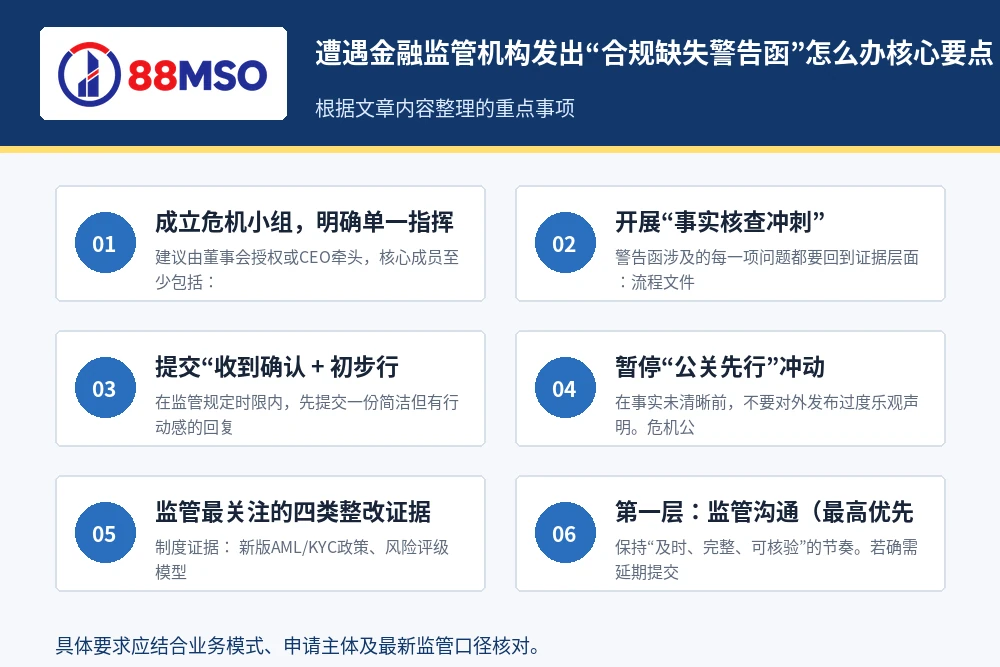
1) Establish a crisis team,Clarify a single chain of command
It is recommended to be authorized by the board of directors or led by the CEO,Core members include at least:Compliance Officer、MLRO、legal affairs、internal audit、Business line manager、IT data support、external consultant。The key principle is"A window to the outside world、One version internally",Avoid long-term response to regulation、Clash of calibers。
2) Conduct a “fact-checking sprint”
Every issue involved in the warning letter must be returned to the level of evidence:process document、Approval records、transaction log、Training sign-in、System screenshot、Email link、Customer profile。Regulators usually only recognize “traceable evidence” during review,Do not accept vague expressions such as "in principle it has been strengthened"。
3) Submit "Confirmation of Receipt + Statement of Preliminary Action"
Within the regulatory time limit,Submit a concise but actionable response first:Confirm receipt、A rectification team has been established、Temporary risk isolation measures have been taken、Estimated date for submission of complete rectification plan。This action can significantly reduce the supervisory judgment of "passive confrontation"。
4) Suspension of the “PR first” impulse
before the facts are clear,Don’t make overly optimistic statements to the outside world。The first principle of crisis public relations is:Compliance first,respread。Any "self-proven innocence" that precedes the facts may be interpreted as unserious by regulators。
three、How to write a rectification plan,Will regulation pay the bill?
A high-quality rectification plan is not a "letter of apology",But "Governance Engineering Drawing"。It is recommended to adopt the “5W1H + evidence attachment” structure:
- What:What are the specific missing points (correspond to the warning letter number one by one)。
- Why:Root cause analysis (system gap、Execution deviation、Insufficient system capabilities、Training failure、Supervision failure)。
- Who:Separation of responsible positions and supervisory positions,Avoid "self-examination and self-criticism"。
- When:Phased timetable (7 days、30 days、90 days),Verifiable results at each stage。
- Where:Scope of influence (customer base、product line、regional entity、Cooperation channel)。
- How:Rectification actions and acceptance criteria (system rewriting、System parameter update、Sampling review、independent audit)。
The four types of rectification evidence that regulators are most concerned about
- institutional evidence:New version of AML/KYC policy、risk rating model、Suspicious transaction reporting mechanism。
- Evidence of execution:Make up CDD/EDD records、Historical customer review results。
- systematic evidence:Monitoring threshold adjustment、Alarm handling timeliness report、Permission isolation log。
- governance evidence:Board meeting minutes、Compliance Committee Tracking Mechanism、external independent evaluation report。
Four、License crisis public relations:Three-tier communication framework,Stabilize supervision、Clients and partners
first floor:Regulatory communications (highest priority)
stay "on time"、whole、Verifiable” rhythm。If it is necessary to postpone the submission,The reason and replacement time must be stated in advance,Don’t lose contact without reason。Regulators are generally more accepting of “real progress + phased results”,rather than a “perfect but late” report。
second floor:Communication with key partners (banks、payment channel、clearing partner)
These institutions are highly sensitive to compliance risks。It is recommended to use prudent wording to inform:"Regulatory opinions have been received and rectification has been initiated.,Core business continuity is not affected,It is expected to complete the phased closed loop by a certain date。” and provide contacts and Q&A mechanisms,Reduce the other party’s “information uncertainty panic”。
third floor:Customer and market communication
If the incident has been made public,A concise statement should be issued,Avoid misunderstandings caused by generalization of technical details。Three key points to convey:First, business service continuity;Second, the compliance upgrade has been launched;Third, the customer asset and data security protection mechanism is normal.。Don't shirk the blame、Not confrontational、Don’t exaggerate “solved”,It is the most important bottom line of reputation during a crisis.。
five、Common "secondary damage" actions:Many organizations do not lose because of the problem itself,But it’s the way it’s handled that’s lost
- Only add files,Don’t change the process:Compliance on paper is easily identifiable during review。
- Pass the responsibility to the grassroots:Supervision pays more attention to the failure of governance structure,rather than individual errors。
- Reply with empty talk:lack of data、lack of evidence、Lack of time commitment。
- Rectification has no priority:No control of high-risk scenarios first,leading to continued risk exposure。
- Ignore the history:Only update new customers,Do not add historical files。
- Independent verification not set up:The rectification was completed but no one audited it,Regulation is hard to believe。
six、From "passive fire-fighting" to "active immunity":Establish a sustainable compliance system
REMEDY THAT REALLY WORKS,It’s not a one-time pass,Instead, turn this incident into a long-term compliance asset.。It is recommended that enterprises complete the following construction within 90-180 days:
1) Governance upgrade
Clarify the board’s ultimate responsibility for compliance,Establish a quarterly compliance reporting mechanism;Major abnormal events enter executive performance appraisal。
2) Reshaping the three lines of defense
- first course:The business front desk assumes basic compliance responsibilities;
- Second course:Compliance and AML teams set rules and continuously monitor;
- The third course:Internal audit independently verifies and tracks rectification closed loop。
3) Data and system capability building
Introducing automated screening、Customer risk stratification、trading behavior model、Alarm priority queue,Reduce manual missed inspections。Supervision pays more and more attention to "systematic compliance capabilities",rather than artificial experience。
4) Training changes from “check-in” to “scenario-based”
Design case drills for high-risk positions:Abnormal transaction identification、Suspicious report triggering criteria、Customer rejection and exit mechanism、Regulations for responding to regulatory inquiries。
5) Linkage between license maintenance and annual review
Embed daily rectification indicators into license annual review preparations,Don't wait for the annual inspection to "surprise replacement"。This is why many established institutions choose external custody consultants:Continuous tracking is more stable than temporary response。
seven、Practical suggestions:The remediation focus of different licensing agencies is slightly different.
Taking Hong Kong and cross-border financial business as an example,Different license types have different concerns during rectification:
- MSO/payment related:The focus is on transparency of funding paths、Transaction monitoring、Suspicious Transaction Reporting Mechanism、Agent network management。
- SFC related licensed institutions:Focus on customer suitability、Conflict of Interest Management、Responsible Personnel Supervision Responsibilities、record keeping。
- Insurance Brokerage/Money Lending Business:Focus on sales compliance、Information disclosure、Repayment ability assessment、Complaint handling closed loop。
This is why companies need consultants who “understand the regulatory language” during a crisis.。88MSO and its 88MSO compliance team have long-term services in multi-license scenarios,Ability to convert "regulatory provisions" into "executable lists",Help companies complete diagnosis within time limits、Rectification to closed loop of review support,Avoid expanding penalties due to process misjudgments。
eight、Conclusion:A warning letter is not the end,It is a watershed moment for corporate compliance maturity.
The underlying logic of financial supervision has never been "zero fault tolerance",Rather, “identifiable risks、Traceability liability、Verifiable rectification”。After receiving the "Lack of Compliance Warning Letter",What companies need most is not emotional reactions,But professional execution:Quick characterization、Precise rectification、Evidence first、Continuous review。
When you treat this crisis as a governance upgrade,Not only can the license be kept,institution in bank、Partners、Credibility in front of customers will actually increase。For any team that is planning financial business in Hong Kong and overseas,Compliance is not a cost center,It is the entry threshold and long-term moat for cross-border growth.。
FAQ:Quick answers to frequently asked questions
Q1:After receiving the warning letter,Do all operations have to be suspended?
uncertain。High-risk links should be suspended based on risk classification,Rather than a blanket shutdown。The core is "risk isolation + continuous service" parallel。
Q2:Can the rectification report be completed independently by an internal team?
Can,However, it is recommended that key parts be subject to external independent review,Improve regulatory credibility,Especially when it comes to AML systems and governance responsibilities。
Q3:If the rectification period is short,What should I do if I don’t have time to finish everything?
Submit phased results and remaining plans first,Describe completed high-risk control actions,and apply for a reasonable extension。Don’t be silent or lose contact after the due date。
Q4:Will the warning letter affect subsequent bank account opening or channel cooperation?
may。The key is whether you can provide complete rectification evidence and continuous monitoring mechanism。Cooperating institutions are most afraid of “unknown risks”,Don’t be afraid of “manageable risks”。
Institutional documents must be able to correspond to sampling records
What to do when a financial regulatory agency issues a “warning letter for lack of compliance”,Risk assessment should be specific to the client、product、country region、Delivery channels and transaction models,Then set customer due diligence accordingly、Identification of actual controller、Sanctions and negative information screening、Continuous monitoring and upgrade approval。Keep only one general AML manual,Unable to prove that the system has been actually implemented。
Audit or inspection data should be able to restore access along with individual customers、risk rating、trade、alarm、Review、Suspicious transaction determination and record keeping process。CRS and FATCA require additional confirmation of institution and account classification.、Self-certification of tax residency、US indicators、Due diligence and reporting responsibilities,Not to be confused with anti-money laundering customer classification。
Industry references:International Financial Action Task Force recommendations。
Read more:Under the dual supervision of CRS and FATCA,How do offshore financial licensed institutions complete tax-related information exchange in compliance with regulations?、Financial Institutions Anti-Money Laundering (AML) Audit Material Checklist:Necessary documents for compliance officers to respond to regulatory spot inspections。