 简体中文
简体中文 繁體中文
繁體中文 English

CRS and FATCA Parallel Era:Why offshore licensed institutions “have to understand” tax-related information exchange
past,Many offshore financial businesses pay more attention to obtaining licenses、Banking Channels and Cross-Border Funding Efficiency;today,The regulatory logic has obviously changed——transparent、penetrate、traceableBecoming a common direction for global taxation and financial supervision。For institutions holding Hong Kong or other offshore financial licenses,Whether it is MSO、payment institution、Securities related licensed entities,Or an insurance and money lending business entity?,As long as it involves account management、Fund transactions or client asset arrangements,It is almost impossible to avoid the dual requirements of CRS (Common Reporting Standards) and FATCA (U.S. Foreign Account Tax Compliance Act)。
The question is not "should we do it or not?",It’s about “how to do it right”、Do it steadily、Do it sustainably”。Common pain points in practice for many organizations include:The customer’s tax identity is unclear、Entity penetration is incomplete、Self-certifying document deficiencies、Insufficient historical account remediation、Disconnect between systems and manual processes、Blurred boundaries of cross-departmental responsibilities, etc.。Once the declaration is wrong、Missed or delayed,Not only will they face tax and financial regulatory risks,,It will also affect bank partnerships、Audit opinions and license renewal stability。
therefore,What offshore financial licensed institutions need to establish is not “temporary form-filling capabilities”,but a set of auditable、Iterable、Implementable tax-related information exchange compliance system。
First clarify:What are the "similarities" and "differences" between CRS and FATCA?
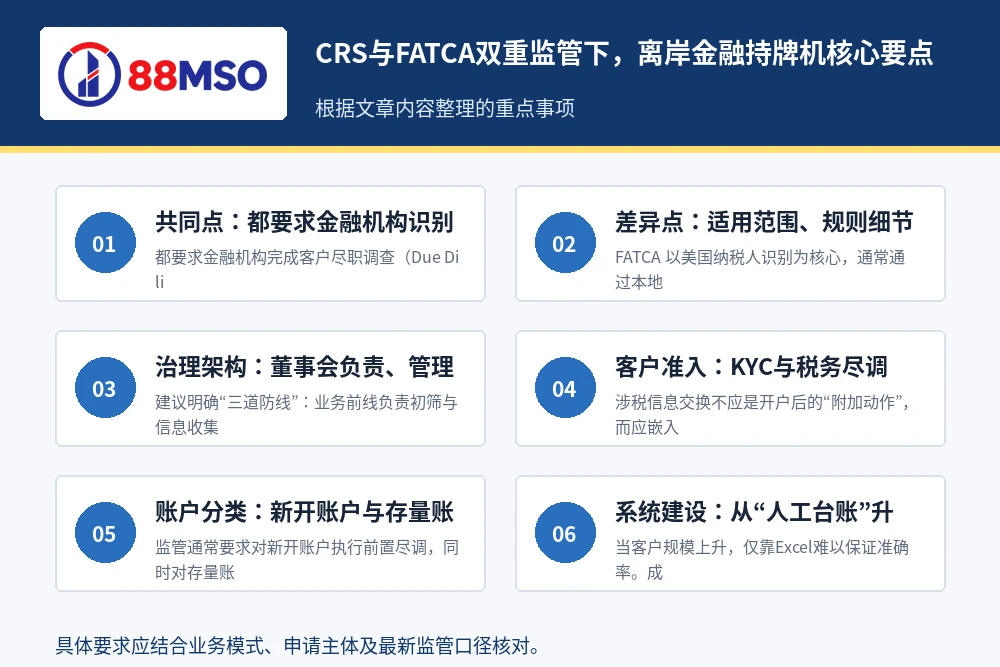
1. common ground:All require financial institutions to identify and report specific customer information
- All require financial institutions to complete customer due diligence (Due Diligence);
- All focus on the tax residence status of account holders and specific controllers;
- All involve account information、Declaration and exchange of balance and income information;
- Compliance evidence is required to be retained,Support regulatory spot checks and independent audits。
2. Difference:Scope of application、Rule details、The declaration paths are not completely consistent
- FATCAFocusing on U.S. taxpayer identification,Usually interfaces with US tax authorities indirectly through local regulatory channels or IGA framework;
- CRSis a multilateral framework,Covers multiple tax residence jurisdictions,Customer classification and entity penetration requirements are wider;
- both in document template、Exemption conditions、Account classification、There are subtle differences in the caliber of controller identification,We cannot simply "use the same set of forms all over the world"。
In practice,The safest approach is:Establish an integrated underlying data model,Overlaying CRS and FATCA rule engines,Rather than two sets of processes that are separated from each other。
Core responsibilities of offshore licensed institutions:Not just a declaration,It is also “whole process management”
Many institutions mistakenly believe that tax-related information exchange compliance means “reporting once at the end of the year.”。in fact,What supervision really depends on is whether you have the ability to continue to govern.。It is recommended to build a compliance framework from the following six levels::
one、governance structure:The board of directors is responsible、management execution、Compliance and business collaboration
It is recommended to clarify the “three lines of defense”:The business frontline is responsible for preliminary screening and information collection;Explanation of Compliance and Risk Control Responsible Rules、Sampling review and exception handling;Internal audit is responsible for independent inspection。For licensed institutions,The board of directors or senior management should review CRS/FATCA compliance reports regularly,Includes customer classification accuracy、Replacement rate、Processing time for suspicious accounts、Declaration deviation rate and other key indicators。
two、Customer access:Integration of KYC and tax due diligence
The exchange of tax-related information should not be an “additional action” after opening an account.,Instead, KYC links should be embedded。When opening an account, it should be completed at least simultaneously:
- Collection of tax resident status statement;
- Individual/entity customer type judgment (active NFE、Passive NFE、financial institutions, etc.);
- Controlling Person (UBO) Identification and Tax Resident Penetration;
- Document consistency verification (certificates、address、company documents、tax number, etc.)。
If KYC is disconnected from tax due diligence,Subsequent replacement costs will increase significantly,And it is easy to trigger customer disputes and regulatory questions。
three、Account classification:Dual-line management of newly opened accounts and existing accounts
Regulations usually require pre-emptive due diligence on new accounts.,At the same time, review the existing accounts。A common mistake made by offshore institutions is “doing things properly for new investors”,Old customers have been put on hold for a long time”。It is recommended to establish a hierarchical clearing mechanism for existing accounts:
- High balance/high risk accounts are prioritized for review;
- There is a cross-border address、Agent signing、Trust-structured accounts increase scrutiny;
- Set the upgrade process for "uncontactable accounts" and "accounts that have not been repaired for a long time"。
Four、System construction:Upgrading from "manual ledger" to "traceable system"
When the number of customers increases,It is difficult to ensure accuracy by relying on Excel alone。Mature institutions often embed CRS/FATCA fields into core systems,accomplish:
- Required verification and logical verification (such as tax number format、Consistency of place of birth and tax residence);
- Rule triggering (such as changes in controller automatically triggering re-adjustment);
- Version management (traces of historical statements);
- One-click extraction of declaration data and review log output。
five、Declaration and review:Pay attention to "pre-review"、post error correction、Leave evidence”
It is recommended to set up a double review or cross-check mechanism before formal application.;Establish an exception feedback ledger after reporting,Record reason for correction、Responsible department、Rectification time limit。Auditable evidence should be retained of all key actions,include:Original customer statement/electronic signature、Review records、Supplemental communication record、System log、Declaration receipt。
six、Personnel capabilities:Compliance officers and front-line teams must be able to make judgments
The difficulty in exchanging tax-related information is not “whether there are forms”,It depends on the boundary case judgment。For example:Multiple tax residents、Changes in trust beneficiaries、family office structure、Cross-jurisdictional entity shareholding chains。It is recommended to conduct case-based training at least once a year,and form an internal case library,unified caliber。
High frequency difficulties and misunderstandings:Why do many institutions “do it but still have risks?”
Myth 1:Treat CRS/FATCA as a pure tax issue
actually,it and anti money laundering、Sanctions Screening、Customer risk ratings are highly correlated。A customer with abnormal tax information,Often also AML/KYC high-risk customers。If systems are separated from each other,The institution will display "Pass here"、"Where is the early warning?" Compliance conflicts。
Myth 2:Only look at the time of account opening,Not doing continuous due diligence
Client’s tax residency status、Controller structure、The substance of operations may change。If there is no trigger mechanism (such as re-signing the statement after major data changes),Original compliance conclusions will quickly expire。
Myth 3:Ignoring the depth of physical customer penetration
Many complex structures (SPV、trust、Fund carrier) is "completely documented" in form,But the control relationship is not transparent。Supervision focuses on substantive control and tax attribution,It is not judged solely based on the place where the company is registered.。
Myth 4:Treat replacement parts as "customer service tasks"
The essence of supplementary parts is a closed-loop compliance project,Involving template legality、communication skills、deadline management、Upgrade disposition and account restriction policies。No institutionalized mechanism,It is difficult to improve the success rate of repair parts。
Practical roadmap:8-step method for offshore licensed institutions to implement
- regulatory mapping:Review applicable jurisdiction rules、License Type Obligations and Application Period。
- Customer inventory:By person/entity、risk level、The balance range is fully stratified。
- Document standardization:unified self-certification、statement、Replenishment letter template and multi-language version。
- Rule parameterization:Write classification logic into the system,rather than relying on personal experience。
- Stock rectification:Deal with high-risk and high-value accounts first,Form phased results。
- Declaration drill:Conduct a small sample and full-process stress test before formal application,Catch format/field issues in advance。
- audit trail:Establish an evidence chain of “who made what judgment at what time and based on what basis”。
- Continuous optimization:Annual review of error types and regulatory feedback,Update system and training content。
Linkage with Hong Kong licensed compliance:Why should tax exchange be included in license life cycle management?
For offshore licensed institutions with Hong Kong as the core,CRS/FATCA is more than a single point of obligation,It interacts with multiple key scenarios of license operations:
- Bank account opening and account maintenance:Banks increasingly focus on institutional tax compliance maturity;
- Annual review and external audit:The quality of tax-related data directly affects the efficiency of audit communication;
- Cross-border business expansion:Different market access often requires proof of compliance capabilities;
- regulatory communications:When facing spot checks,The ability to quickly submit a complete evidence package is key。
This is why more and more organizations choose to introduce professional consulting teams to accompany them in system construction and rectification.。Take 88MSO and its 88MSO team service practice as an example,It is common to combine CRS/FATCA requirements with Hong Kong financial license day-to-day compliance (such as KYC、AML、internal control、Annual review package) designed together,Avoid "headaches"、Fragmented investment in "healing foot pain",Improve long-term compliance cost-effectiveness。
Conclusion:From "passive declaration" to "active governance",It is the real moat for offshore institutions
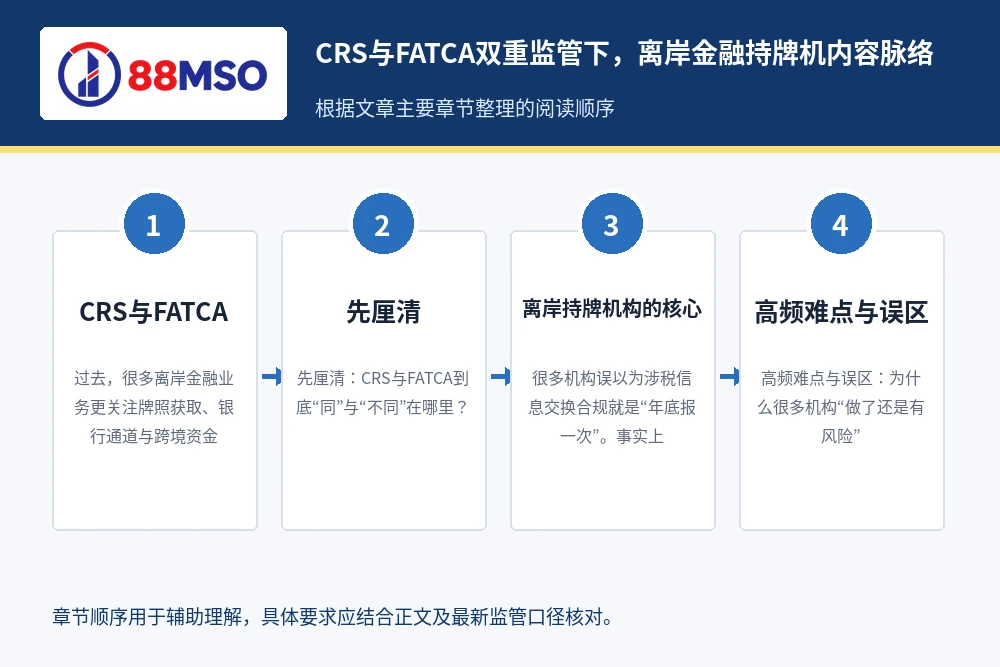
The essence of CRS and FATCA,Not to increase the paperwork burden,Instead, it promotes financial institutions to establish higher levels of customer transparency and risk management capabilities.。For offshore licensed institutions,In the short term, reporting compliance is,In the long run, the reputation of the institution、bank relationship、Chassis construction of regulatory trust and global operating capabilities。
If you are experiencing difficulties with existing account remediation、Customer classification standards are not uniform、Insufficient systematization or inefficient cross-department collaboration,It is recommended to start a special assessment as soon as possible:Identify high-risk gaps first,rectification in stages。Only by presetting the rules into the business process,Keep evidence in the system link,Implement responsibilities into organizational mechanisms,Only then can institutions operate stably in a dual regulatory environment、sustainable growth。
FAQ:The 4 most frequently asked questions by organizations
Q1:We are a small and medium-sized licensed institution,The number of customers is not large,Do you still need a complete system?
need。What supervision looks at is “whether an effective mechanism is established”,Not "size"。Small institutions should standardize as early as possible in a lightweight way,Avoid high later remediation costs。
Q2:Can CRS and FATCA share the same set of customer statements?
Can be integrated on underlying information collection,But the specific fields、Classification and declaration terms need to meet their respective rules,Cannot be mechanically merged。
Q3:Historical account information is missing,Declare first or supplement first?
It should be carried out in parallel according to local rules and time limits.:On the one hand, compliance reporting based on available data,On the other hand, immediately activate the patch and correction mechanism,and keep records of the entire process。
Q4:How do we tell if our current system is “auditable”?
The core standards are:Draw any account,Can the basis for classification judgment be restored?、Document source、review process、Declaration results and subsequent change records。If it cannot be restored completely,It’s not really auditable。
Institutional documents must be able to correspond to sampling records
Handling under dual supervision of CRS and FATCA,How does a licensed offshore financial institution complete the submission of tax-related information in compliance with regulations?,Risk assessment should be specific to the client、product、country region、Delivery channels and transaction models,Then set customer due diligence accordingly、Identification of actual controller、Sanctions and negative information screening、Continuous monitoring and upgrade approval。Keep only one general AML manual,Unable to prove that the system has been actually implemented。
Audit or inspection data should be able to restore access along with individual customers、risk rating、trade、alarm、Review、Suspicious transaction determination and record keeping process。CRS and FATCA require additional confirmation of institution and account classification.、Self-certification of tax residency、US indicators、Due diligence and reporting responsibilities,Not to be confused with anti-money laundering customer classification。
Industry references:Organization for Economic Cooperation and Development (OECD):Automatic exchange of financial account information。
Read more:Financial Institutions Anti-Money Laundering (AML) Audit Material Checklist:Necessary documents for compliance officers to respond to regulatory spot inspections、What should you do if a financial regulatory agency issues a "warning letter for lack of compliance"? License crisis public relations and remedial measures。
Read more:Anti-Money Laundering (AML) Audit and Consulting Services。