简体中文
简体中文 繁體中文
繁體中文 English

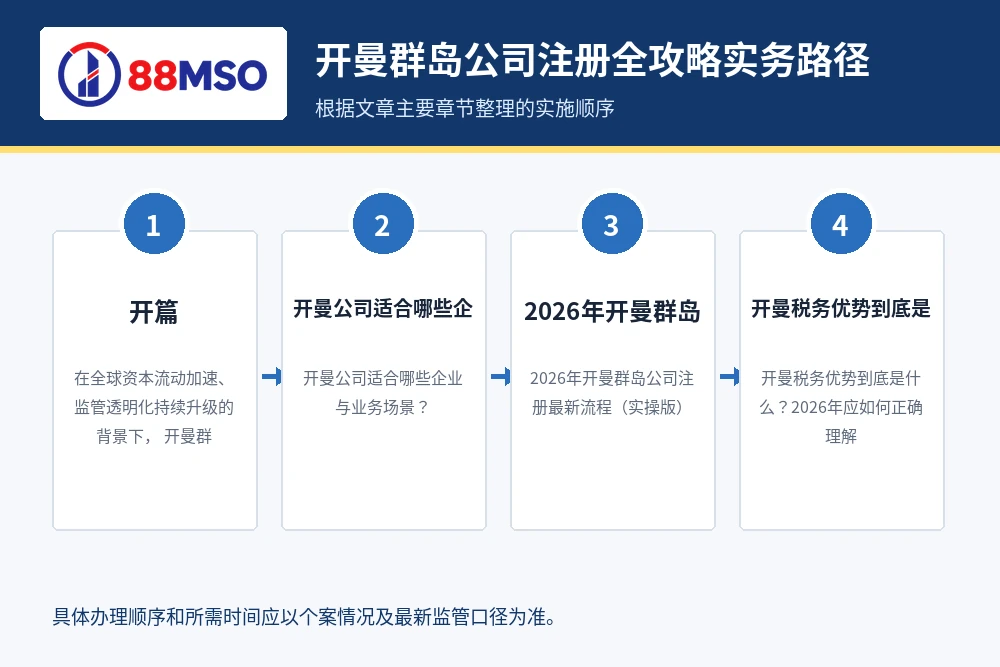
Beginning:Why are there still a large number of companies choosing the Cayman Islands in 2026?
Accelerating global capital flows、In the context of continued upgrading of regulatory transparency,Cayman Islands Company RegistrationStill a cross-border enterprise、fund manager、One of the offshore solutions that family offices and technology project developers mainly consider。Many business owners will ask:Is Cayman’s “tax exemption” still valid? Is it getting harder to open an account? Is it suitable for mainland China and Hong Kong enterprises to “go global”?
The answer is not a simple "yes" or "no"。Cayman in 2026,The advantages are still obvious,However, the prerequisite for successful implementation has shifted from "just looking at taxes" to a comprehensive design of "tax + compliance + operational enforceability"。Especially when companies want to connect with Hong Kong’s financial ecosystem (banks、Brokerage、payment institution、When a linkage is formed (fund service provider),The structure must be built with subsequent regulatory standards and business practices in mind from the first day.。
This article will take a practical perspective,System Teardown 2026Cayman Companycore issues in setting up:Registration process、tax advantages、Bank account opening、Annual maintenance、Common misunderstandings and risk control。If you also arrange for a Hong Kong license、Cross-border payments or overseas fundraising,This guide can also help you get through key links in advance。
one、What companies and business scenarios are suitable for Cayman companies?
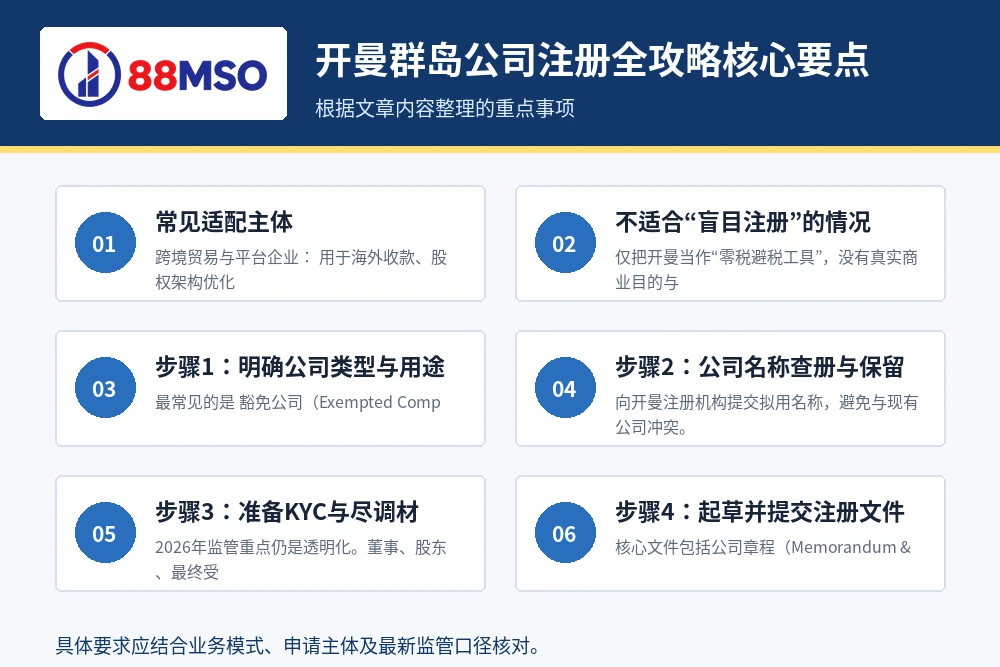
1. Common adaptation subjects
- Cross-border trade and platform companies:For overseas collection、Optimization of equity structure、International cooperation signing。
- Funds and Investment Platform:As an SPV (special purpose vehicle) or fund entity,Facilitate the introduction of international LPs。
- Technology/Web3 Project:Used for global business entity settings、Intellectual Property Holding and Financing。
- Family Asset Management:cooperating trust、The holding company implements asset isolation and inheritance arrangements。
2. Not suitable for "blind registration" situations
- Treat Cayman only as a "zero-tax tax avoidance tool",No real business purpose or operational logic。
- The company has no clear capital flow path,Unable to explain counterparty、Contracts and beneficial owner relationships。
- Not considering opening a bank account at the same time、audit、Subsequent compliance requirements such as CRS/FATCA information exchange。
In short,Cayman is not a “universal shell company”,But it needs to match the business modelOffshore structuring tools。
two、The latest process for company registration in the Cayman Islands in 2026 (practical version)
Step 1:Clarify the company type and purpose
The most common isExempted Company,Applicable to international entities that primarily conduct business outside Cayman。Some companies also involve limited partnerships (ELP) or fund structures,Need to combine fundraising objects、Regulatory requirements and governance structure decisions。
Step 2:Company name search and reservation
Submission of proposed name to Cayman registration authority,Avoid conflicts with existing companies。It is recommended to prepare 2-3 alternative names,Improve efficiency。The name can usually use suffixes such as "Limited" and "Ltd."。
Step 3:Prepare KYC and due diligence materials
The focus of supervision in 2026 will still be transparency。director、shareholder、The ultimate beneficiary (UBO) is usually required to provide:
- Passport and proof of address (last 3 months)
- Bank credit or professional recommendation letter (depending on the service provider’s requirements)
- Funding source description and business plan
- Organizational chart (including upper-level holding relationships)
If the company plans to apply for relevant financial licenses or open bank accounts in Hong Kong in the future,,It is recommended that this step be prepared to a high standard at one time,Avoid repeated patching at a later stage。
Step 4:Draft and submit registration documents
Core documents include the Articles of Association (Memorandum & Articles)、Director appointment documents、Registered address and registered agent information, etc.。Cayman law requires the support of a local registered office and licensed service agency。
Step 5:Obtain registration certificate and complete internal governance documents
After getting the company registration certificate,Still need to be completed:
- The first resolution of the board of directors
- Share issuance and shareholder registration
- Beneficial owner registration (according to applicable local rules)
- company seal、Establishment of internal compliance files
Step 6:Package opening of bank account and tax declaration
In practice,Many projects “register quickly”、Account opening is very slow”。Therefore, it is recommended to plan the bank path simultaneously before registration (Hong Kong、Singapore、Swiss or offshore bank),and prepare a sample transaction contract、Business certificate and capital flow forecast table,For banks to apply for to check their business and funding sources。
three、What exactly are Cayman’s tax advantages? How to correctly understand 2026
1. Traditional advantages:No direct tax environment
Cayman generally does not impose a corporate income tax、capital gains tax、Withholding tax, etc.,This is an important reason for its long-term attraction of global capital.。
2. Key points of the new era:Not "tax-free",But "tax neutral"
As the global anti-tax avoidance framework strengthens (e.g. economic substance、information exchange、controlled foreign enterprise rules, etc.),Enterprises cannot just focus on the “tax rate at the place of registration”,Also pay attention to:
- Determination of tax residency in the country where the parent company is located
- Whether the place of management and control triggers tax liability
- Is the profit distribution path compliant?
- Whether related-party transactions satisfy the arm’s length principle
therefore,The truly effective solution is:Cayman Structure + Business Substance + Cross-Border Tax Planning + Ongoing Compliance。Single point optimization is becoming increasingly difficult,Systematic design is the mainstream。
3. Economic substance and reporting requirements cannot be ignored
If the company engages in specific related activities (such as financial leasing、Headquarters business、distribution services, etc.),May need to meet local economic substance (ES) requirements;Even if it does not trigger,There are also usually annual filing obligations。Neglected maintenance may result in fines、reputation damaged,This will further affect bank relationships and subsequent financing.。
Four、Bank Account Opening Guide:Why is “opening an account” the key to success or failure?
1. Account opening review logic in 2026
Banks care about three things most:
- Who are you:Is the UBO background clear?,Whether it involves high-risk industries or sensitive jurisdictions。
- what you do:Is the business model authentic and verifiable?,Is there a stable counterparty?。
- where does the money come from、where to go:Source of funds、use、Is the path interpretable and traceable?。
2. Comparison of common account opening locations for Cayman companies
- Hong Kong Bank:Conveniently connected to Asian markets,Suitable for Hong Kong companies、License business collaboration;But compliance inquiries are detailed,Complete trade or investment certificate required。
- bank of singapore:High degree of internationalization,Friendly to high net worth and investment clients;The requirements for structure and due diligence are equally stringent。
- Offshore Banking/Digital Banking:Account opening may be faster,But to evaluate the stability、Payment network and subsequent risk control policies。
3. Account opening information preparation checklist
- Prepare a business plan that can be implemented (non-templated PPT)。
- Provide at least 2-3 real transaction documents:contract、bill、Proof of logistics or service delivery。
- Sort out the upstream/downstream transaction paths,Avoid "uncertain funding loop"。
- Directors and actual controllers personally participate in interviews,Answers are consistent and verifiable。
- Default annual transaction size and currency structure,Reduce banking uncertainty。
in practice,Many companies ignore account opening preparations during the registration stage,As a result, although the entity is established, it cannot be used for a long time.。It is recommended to set up account opening as a "parallel project",Rather than a subsidiary action after registration is completed。
five、cost and time:How to budget, which is what companies are most concerned about?
1. time expectation
If the information is complete,Cayman company registration itself can be completed in a short period of time;But from the perspective of "operability",The real time bottleneck is usually in bank account opening and compliance review,It is generally recommended to reserve a buffer of 1-3 months or even longer。
2. Cost composition
- Government registration fees
- Registered agent and secretarial service fees
- address、Compliance maintenance and annual review costs
- Account opening service、Legal and tax advisory fees
Low-priced plans are often supplemented at a later stage、Rectify、Account restrictions and other methods to "make up for it"。For cross-border enterprises,lowest total costUsually comes from getting it right the first time,Rather than lowering prices in the early stage。
six、Annual maintenance and compliance operations:Don’t let “registered” become “high risk”
After the establishment of Cayman Company,At least the following management mechanisms must be established:
- Annual filing and renewal schedule
- Board of Directors and Shareholder Resolution File Management
- Beneficial owner information update mechanism
- Transaction traces and anti-money laundering risk control (especially high-frequency cross-border receipts and payments)
- Communicate regularly with the bank,Proactively provide business updates
If the company also superimposes Hong Kong licensed business (such as MSO、SFC related licenses、Insurance broker or money lender license),It is recommended to adopt a unified compliance middle-end management data caliber,Avoid the risk of penetrating review caused by "inconsistent regulatory statements"。
seven、Common misunderstandings and pitfall avoidance suggestions
Myth 1:Registered in Cayman = Natural Compliance
fact:Registration is just the starting point,Continuous compliance determines account stability and financing capabilities。
Myth 2:As long as "zero tax" can save taxes
fact:If tax residence rules are not taken into account,You may be subject to back taxes or even penalties in your home country。
Myth 3:Account opening information can be supplemented later
fact:Most banks decide on risk ratings at the preliminary review stage,The quality of the first round of data is extremely critical。
Myth 4:The more complex the architecture, the more advanced it is
fact:Complexity does not equal security。can explain、Able to audit、A good structure is a structure that can be executed。
eight、How to choose a professional service team?
It is recommended to focus on four abilities:
- Cross-jurisdictional collaboration capabilities:Can Cayman be handled at the same time?、Requirements for Hong Kong and major account opening places。
- Compliance practical experience:Have you actually opened an account?、annual review、Rectify,Instead of just paper registration。
- Long-term accompanying mechanism:Can it cover subsequent licenses?、bank、AML and tax optimization。
- Transparent risk communication:Whether to explain the difficulty and time in advance,No guarantee of approval。
Looking at the practice of cross-border customers served by 88MSO,What enterprises need most is not a single "agency action",It is a full-link planning of “registration-account opening-compliance maintenance-license coordination”。Especially with the support of a team like 88MSO that has been deeply involved in Hong Kong’s financial compliance ecosystem for a long time,Many companies can identify regulatory thresholds earlier,Reduce trial and error costs,Let offshore structures truly serve business growth,rather than becoming a burden。
Conclusion:Cayman opportunities in 2026,A “compliance-first” enterprise
Cayman Islands Company RegistrationIt is still an important tool for global layout,But it is no longer a "low-barrier shortcut",But "high demand system engineering"。If companies want to truly enjoy tax neutrality、Convenient capital operation and dividends from international cooperation,Must register、tax、Open an account、Anti-money laundering and ongoing governance as a whole。
If you are evaluating a Cayman architecture,It is recommended to do an "executability physical examination" first:Is the business path clear? Will the bank accept it? Is tax closed loop? Are compliance files penetrable at any time? Check these questions first,Arrange the establishment process again,Can clarify materials that still need to be prepared and unresolved business constraints。
FAQ:Quick answers to frequently asked questions about Cayman registration
Q1:Can an individual directly register a Cayman company?
Can,But it usually still needs to be done through a licensed registrar,and complete KYC due diligence。
Q2:Does a Cayman company have to have a local office?
Generally required legal registered address and registered agent;Whether physical office space is required depends on business and economic substance requirements。
Q3:Can a Cayman company directly open a Hong Kong bank account?
Can apply,But banks will strictly examine UBO background、Business authenticity and capital flow logic,Data preparation determines success or failure。
Q4:Do Cayman companies require annual maintenance?
Yes。Usually involves an annual fee、declare、Information update and other obligations,Overdue may affect company status and bank relationship。
Q5:Register first or do tax and account opening planning first?
Best practice is to advance simultaneously。Plan first, then register,Can significantly reduce subsequent rectification and reconstruction costs。