简体中文
简体中文 繁體中文
繁體中文 English
introduction:Why has “low-cost eKYC + AML compliance” become a new imperative for cross-border financial institutions?
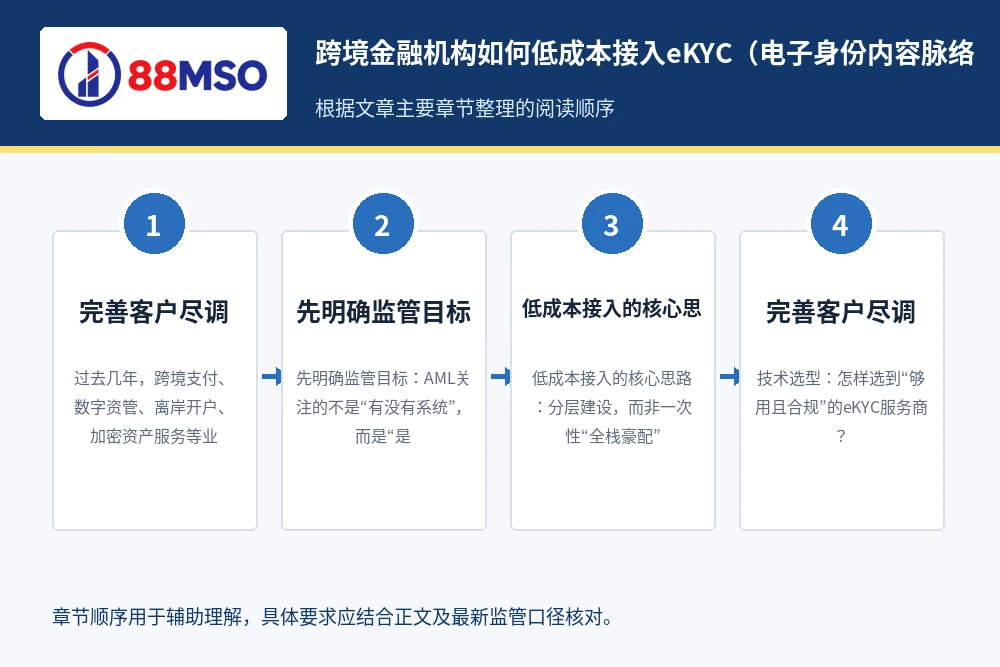
past few years,Cross-border payment、Digital asset management、Offshore account opening、Businesses such as crypto asset services are developing rapidly,Financial institutions welcome customer growth,One side also faces regulatory penetration、based onFATF "Anti-Money Laundering"、International Standards on Counter-Terrorism Financing and Counter-Proliferation Financing"Increased scrutiny and pressure from rising compliance operating costs。Especially Hong Kong and other international financial centers,Regulatory agenciesKYC due diligence、Transaction monitoring、Customer risk stratification、Requirements such as suspicious transaction reporting (STR) are becoming increasingly detailed。For small and medium-sized cross-border institutions,"It needs to be online quickly、Compliance is also required、“We still have to control costs” has almost become a survival proposition.。
In this context,eKYC (Electronic Identity Verification)Digital features are no longer the “icing on the cake”,But to support business expansion、Infrastructure to meet AML requirements。The problem is:Many institutions mistakenly believe that eKYC must mean high system procurement fees、Complex integration cycles and long-term maintenance burden。actually,As long as the strategy is correct,Cross-border financial institutions can fully adopt the method of "modular construction + risk-oriented investment",Achieve compliance goals with a relatively controllable budget。
This article will start from the regulatory logic、Architecture design、cost control、Supplier selection、Process implementation、Common Misunderstandings and Practical Operation Checklist at Seven Levels,The system makes it clear:How cross-border financial institutions can access the eKYC system at low cost,And truly meet AML requirements in actual operations。
one、First, clarify the regulatory objectives:AML is not concerned with “whether there is a system or not”,But "whether it is effective"
1.1 eKYC is not an isolated tool,It is a part of the AML system
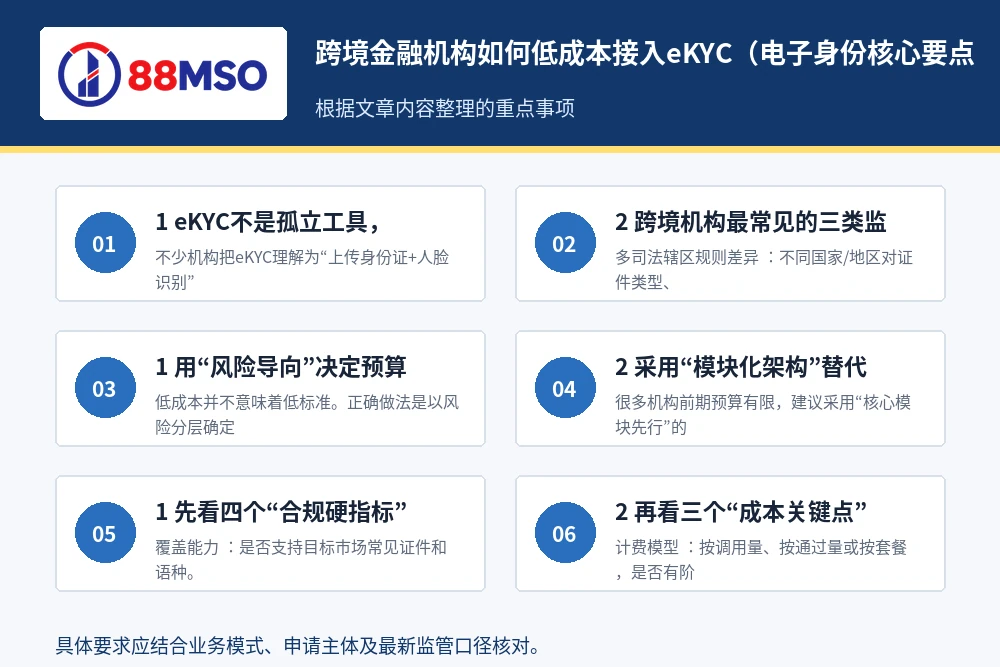
Many institutions understand eKYC as "uploading ID card + face recognition" to complete compliance.,This understanding is too one-sided。What supervision pays more attention to is:Is the organization fully formed?、traceable、Auditable customer due diligence closed loop,include:
- Customer identification and authenticity verification (ID&V)
- Beneficial owner identification (UBO) and control penetration
- Customer risk rating (low/medium/high risk)
- Continuous due diligence (CDD) and regular reviews
- List Screening (Sanctions、PEP、negative public opinion)
- Verification of consistency between transaction behavior and customer profile
That is to say,eKYC is the “gateway”,AML is "Systems Engineering"。The key to low-cost construction,Not a necessary compliance action for compression,Instead, the limited budget should be invested in the core links that can best pass regulatory inspections.。
1.2 The three most common regulatory pain points of cross-border institutions
- Multi-jurisdictional rule differences:Different countries/regions have different requirements for document types、remote verification、Data retention period requirements are different。
- Insufficient identification of high-risk customers:Only basic identity verification is done,Lack of real-time screening and dynamic updates of PEP/sanctions lists。
- Weak audit evidence:The process is dispersed in emails、sheet、In chat tool,Unable to form traceable evidence chain。
This is why more and more organizations tend to build “configurable、Expandable、The eKYC platform that can leave traces,Instead of continuing to rely on purely manual or fragmented processes。
two、The core idea of low-cost access:Stratified construction,Rather than a one-time "full-stack luxury package"
2.1 Use "risk orientation" to determine budget,rather than "feature list oriented"
Low cost does not mean low standards。The correct approach is to determine investment based on risk stratification:
- Low risk products/customers:Basic document verification + liveness detection + blacklist screening
- medium risk business:Add address verification、Device fingerprint、behavioral analysis
- High-risk customer groups:Enhanced EDD (enhanced due diligence)、Fund source verification、Manual review mechanism
by layering,Organizations can avoid the resource waste of “all customers going through the highest cost process”。
2.2 Use “modular architecture” to replace “heavy-duty integrated system”
Many organizations have limited upfront budgets,It is recommended to adopt the "core modules first" route:
- Required module:Identification、Liveness detection、List screening、Audit log
- Advanced modules:UBO penetration、Enterprise due diligence、Transaction monitoring linkage
- Optimization module:OCR optimization、Automated decision engine、Cross-region rules engine
This approach can keep the initial investment low,while retaining room for subsequent expansion.,Suitable for cross-border institutions whose business is still growing。
three、Technology selection:How to choose an “adequate and compliant” eKYC service provider?
3.1 Let’s first look at the four “compliance hard indicators”
- Coverage ability:Whether to support common documents and languages in the target market。
- Accuracy and manslaughter rates:Excessively high false rejections will increase manual review costs。
- List data update frequency:Is the PEP/sanctions database updated daily or in real time?。
- Audit traceability:Whether the complete verification link and decision record can be exported。
3.2 Let’s look at three more “cost key points”
- Billing model:By call volume、By volume or package,Is there any tiered discount?。
- Integration cost:API maturity、Documentation completeness、Whether to support sandbox testing。
- Operation and maintenance costs:Does rule adjustment require secondary development?,Or is it configurable in the background?。
in practice,Many organizations ignore the "operational costs after going online"。A solution that is cheap to purchase but complex to maintain,The total cost often exceeds after 6-12 months。
3.3 “Buying a system” is not as good as “buying capabilities”
For organizations without large technical teams,It is recommended to give priority to partners with the following capabilities::Integrated services of compliance consulting + process design + system access + subsequent annual review support。Take the Hong Kong market as an example,Familiar with MSO、SFC、insurance broker、Teams with different licensed practices such as money lenders,It can significantly reduce the rework risk of "the technology is online but the regulatory standards do not match"。Like 88MSO and the professional service team behind it that focuses on the implementation of financial compliance in Hong Kong (such as the consulting resources in the 88MSO ecosystem),There are usually more practical advantages in such “technology + compliance collaboration” projects。
Four、landing path:A practical blueprint for deploying eKYC at low cost in 90 days
Phase 1 (Weeks 1-2):Compliance Gap Assessment
- Sort out the existing account opening process、Customer type、product risk。
- Identify “must-fill” AML control points (e.g. list screening、Review traces)。
- Develop a Minimum Viable Compliance Checklist (MVC:Minimum Viable Compliance)。
Phase 2 (Weeks 3-6):System selection and process design
- Determine required modules and second-phase modules。
- Design customer hierarchical verification path (personal/enterprise、area、risk level)。
- Establish a manual review SOP and upgrade approval mechanism (especially for high-risk customers)。
Phase Three (Weeks 7-10):API integration and trial operation
- Access OCR、living body、Witness comparison、List Screening API。
- Connect with CRM/account opening system,Make sure data fields are consistent。
- Carry out grayscale testing:pass rate、False rejection rate、Processing time、Manual intervention ratio。
Phase Four (Weeks 11-12):Training and audit material solidification
- Train frontline teams to identify abnormal signals and upgrade paths。
- Solid regulatory inspection package:flow chart、Rules document、Log sample、Review records。
- Set monthly KPIs:Compliance hit rate、Review efficiency、Customer conversion rate balance。
five、Five “instant results” tips for cost control
5.1 Automate high-risk links first
Prioritize budget on high-risk customer identification and list screening,More effective than blindly pursuing full-process automation。
5.2 Establish a dual-track system of "automatic passing + manual review"
Automatically release low-risk customers,Medium and high risks trigger manual review,Can significantly reduce the peak review manpower。
5.3 Reduce repeated collection,Improve first pass rate
Bootstrap via frontend (shot example、Real-time quality prompts) Reduce document retransmission rate,Directly reduce API call and customer service costs。
5.4 Rules configurable,Avoid frequent development
Regulatory standards will change,Configurable rules engine can reduce secondary development investment,Reduce long-term maintenance costs。
5.5 Incorporate “compliance documentation” into daily processes
Many institutions only provide materials before inspection,extremely costly。It is recommended to automatically precipitate logs daily、Approval records and review evidence,Always take one more step,Annual review saves many steps。
six、Common misunderstandings:Seems to save money,In fact, it increases regulatory and operational risks
- Myth 1:Only authentication,Not doing continuous due diligence
Customer risk will change,Lack of continuous monitoring can lead to exposure of subsequent breaches。 - Myth 2:List screening ends with "one manual check"
Sanctions list dynamic update,There must be a regular re-screening mechanism。 - Myth 3:Leave all exceptions to human judgment
Lack of standards leads to inconsistent caliber,Affects audit credibility。 - Myth 4:Ignoring cross-border data compliance
Data storage in different regions、transmission、Authorization requirements are different,Need to be designed in advance。 - Myth 5:Use the lowest price as the only criterion
Cheap but unstable supplier,May result in higher downtime and rectification costs。
seven、eKYC implementation checklist for cross-border financial institutions (can be used directly internally)
7.1 Compliance and Governance
- Are the approval authority of the MLRO/Compliance Officer clearly defined?
- Is there a customer risk rating model and how often is it updated?
- Are high-risk customer EDD trigger conditions defined?
7.2 Technology and Process
- Is it possible to achieve a minimum closed loop of document verification + living body + list screening?
- Is it capable of exporting audit logs and evidence?
- Whether to open an account、Has the transaction monitoring system completed key fields?
7.3 Operations and Costs
- Whether to monitor the pass rate、False rejection rate、Three major indicators of review time?
- Is a monthly rule optimization mechanism established?
- Are supplier SLA and cost reviews conducted?
Conclusion:Low cost is not about “doing less”,But "get it right"
Cross-border financial institutions access eKYC to meet AML requirements,The real difficulty is not the technology itself,but how to regulate effectiveness、Find a balance between customer experience and cost control。Experience shows:As long as we stick to risk orientation、Modular deployment、Processes can be audited、Rule iterable,Organizations can build an “inspection-proof” system within a controllable budget、Compliance system that can run the business。
For organizations planning to enter Hong Kong or use Hong Kong as a hub to expand global business,Introduce professional teams familiar with local regulatory practices as early as possible,Can significantly shorten the cycle from plan to implementation,and reduce subsequent rectification costs。This kind of "license + compliance + system implementation" service capabilities represented by 88MSO,It is an important pivot for many companies to achieve steady growth in complex cross-border scenarios.。
FAQ:4 issues that management is most concerned about
Q1:Limited budget,Which three functions are the most critical to implement first?
A:Prioritize document verification、Liveness detection、Sanctions/PEP list screening。This is the minimum combination required to meet the basic AML requirements。
Q2:Will eKYC reduce the account opening conversion rate?
A:uncertain。Properly designed processes (such as real-time shooting prompts、Automatic verification) can actually improve the first pass rate and customer trust.。
Q3:How long does it take to update KYC information?
A:Depends on customer risk level and regulatory requirements。Common practice is for high-risk clients to be reviewed more frequently,Low-risk customers have longer cycles。
Q4:We already have a manual KYC team,Do you still need a system?
A:need。The system does not replace labor,Rather, it frees humans from repetitive labor,Focus on abnormal judgment and high-risk handling,At the same time, strengthen trace audit capabilities。