 简体中文
简体中文 繁體中文
繁體中文 English
After the Japanese company obtains the registration certificate,It does not mean that you only need to pay a fixed "maintenance fee" every year in the future.。Actual obligations depend on corporate form、Registered address、staff、turnover、GST status、Industry Licensing and Local Government。Statements such as “the consumption tax is unified at 5%”, “corporate tax is determined by the registered capital” and “consumption tax is exempted for the first two years of establishment” in the original text are too simplistic.,Should be re-judged based on the actual situation of the company。
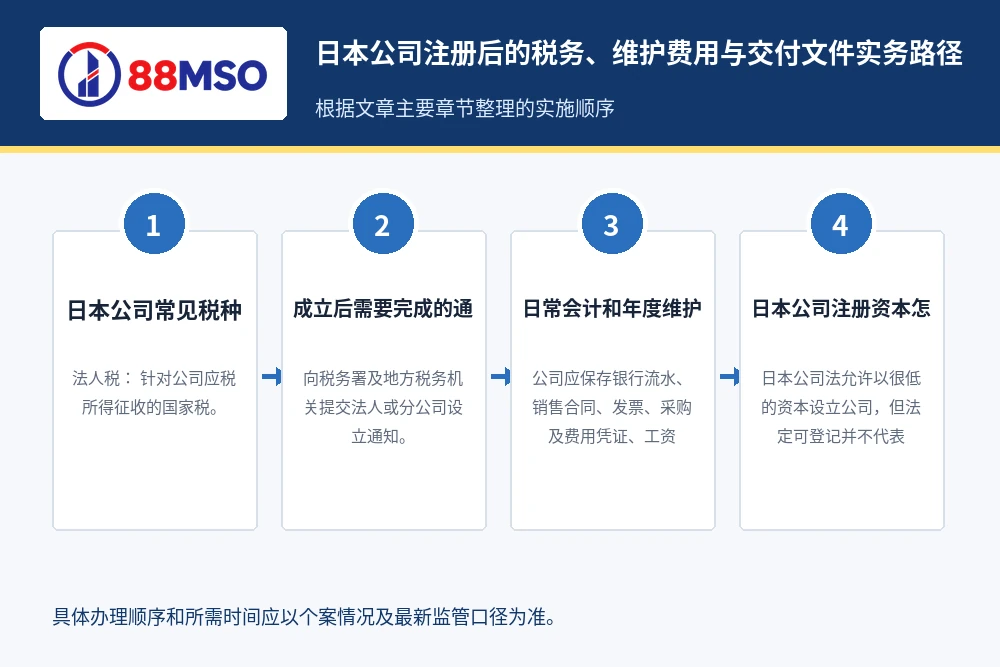
Common taxes for Japanese companies
- Corporate tax:State tax on corporate taxable income。
- Local corporate tax、Corporate resident tax and business tax:According to location、income、Calculation of capital and other applicable factors。
- Special corporate enterprise tax:Usually linked to business tax filing and payment arrangements。
- consumption tax:Applies to qualifying taxable transactions。Whether to become a taxable operator、Whether the tax exemption or simplified taxation system can be applied,Need to be combined with sales during the base period、capital、Group relations、Establishment time and voluntary choice judgment。
- source income tax:Company pays wages、Directors may be required to withhold and pay part of their remuneration or professional fees.。
Notices that need to be completed after establishment
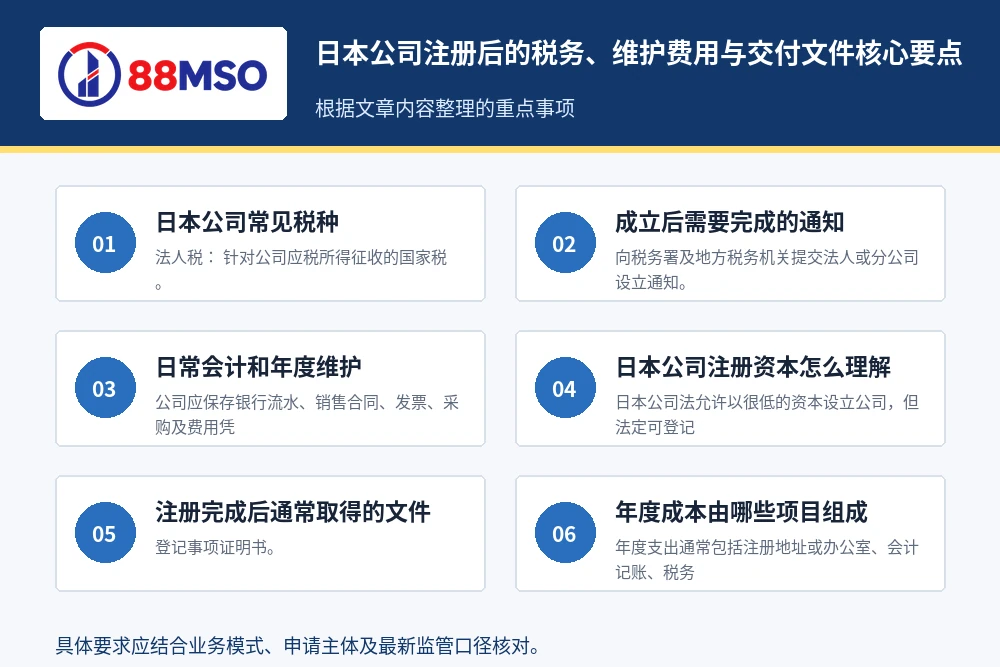
- Submit legal person or branch establishment notice to the tax bureau and local tax authorities。
- Determine fiscal year、Accounting and tax filing manager。
- such as paying wages,Salary payment office、Source tax and year-end adjustment related procedures。
- Such as recruiting employees,Evaluate Social Security、Labor insurance and employment insurance registration。
- Apply for business license according to industry requirements、Foreign exchange law reports or other filings。
Daily accounting and annual maintenance
The company should keep bank statements、sales contract、bill、Procurement and expense vouchers、Salary information、Fixed asset records and related transaction documents,And prepare financial statements and tax calculations based on fiscal year。Even if the company has no income,Nor should we directly judge that “no declaration is required”,Because corporate resident tax、Zero declaration、Dormant status and local obligations may still exist。

How to understand the registered capital of Japanese companies
Japanese company law allows companies to be established with very low capital,However, legal registration does not mean that it is suitable for actual operation.。Bank account opening、Office rental、Staff Recruitment、Supplier credit and business management residence qualifications will all focus on whether the funds are sufficient to support real business。The amount of capital should be determined based on the business plan,Don’t mechanically apply the propaganda slogans of “10 million yen” or “1 yen company”。
Documents usually obtained after registration is completed
- Certificate of Registration Matters。
- Company seal certificate and registered seal。
- Company Articles of Association and Establishment Resolution Documents。
- Proof of capital payment and shareholder or member information。
- Legal person number and tax、Social insurance and other follow-up notification receipts。
What items does the annual cost consist of?
Annual expenses usually include registered address or office、Accounting、tax declaration、Salary and social security、license、banking services、Company Secretary or Professional Advisor,And the Legal Affairs Bureau registration fee when a change occurs。Since companies vary greatly in size and location,Not suitable for budgeting based on a flat all-inclusive price in US dollars。
official information:JETRO:Overview of Japanese corporate tax system
Related services:Company Setup
Dealing with both corporate and tax returns after the year-end
Taxation after Japanese company registration、Corporate filing and tax filing related to maintenance fees and delivery documents are not the same thing。Lock the fiscal year end date first,Then list the accounts separately、financial statements、Audit or exemption judgment、Annual Return and Tax Return Submission Points,It can avoid mistaking the completion of one declaration as the completion of all compliance.。
Bank statements should be filed on a daily basis on a monthly basis、Sales and purchasing documents、contract、Salary information and director and shareholder change documents。Even if the company is not trading,You should also check the local regulations for dormant companies first.、Specific requirements for zero reporting and record keeping,It is not appropriate to directly follow the handling methods of normal operating companies.。
Industry references:Japan National Tax Agency:Corporate tax declaration information。
Read more:Singapore company annual review and tax filing:financial year、AGM、ECI and Form C-S/C、Annual returns and public searches of Hong Kong companies:cost、Time and information disclosure scope。