 简体中文
简体中文 繁體中文
繁體中文 English
FINTRAC regulatory updates in 2026:Canadian MSB’s latest reporting requirements for stablecoin transactions
2026,Financial Transactions and Reports Analysis Center of Canada (FINTRAC)Regulations on virtual assets are tightened again,Stablecoin transactions are officially included in more refined、penetrable、Traceable reporting framework。For those who are licensed or intend to applyCanadian MSB(Money Services Business) qualified organizations,This change is not as simple as "submit a few more documents",But one coveragetransaction identification、Customer due diligence、Monitoring rules、System transformation and cross-border compliance collaborationcomprehensive upgrade。
Especially for cross-border payments、OTC exchange、Web3 deposit/withdrawal、Merchant settlement services company,Stablecoin businesses tend to have high transaction frequency、On-chain addresses are complicated、Fast capital flow,Once the new FINTRAC caliber cannot be met,Trigger supplementary review in minor cases,In severe cases, administrative penalties may be faced、Business restrictions and even license risks。This article will break down the new requirements in 2026 from a practical perspective,And provide a set of implementable MSB compliance execution framework。
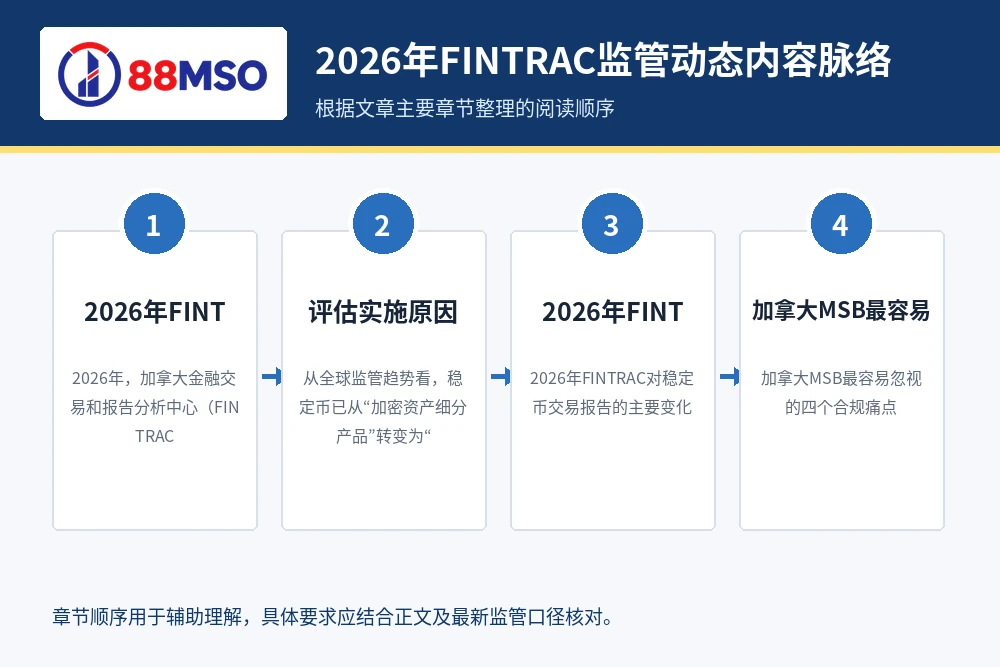
one、Why is 2026 a critical year for stablecoin regulation in Canada?
Looking at global regulatory trends,Stablecoins have transformed from “crypto-asset segment products” to “quasi-payment infrastructure”。Regulators also focus on price fluctuation risks,Turn to the following three core:
- Fund traceability:Who initiated、Who benefits、Is the source of funds legal?;
- On-chain and off-chain mapping capabilities:The degree of binding between wallet address and real identity;
- Cross-border anti-money laundering coordination:Whether the transaction triggers sanctions from other countries、Terrorist financing or exposure to high-risk areas。
FINTRAC emphasizes the trinity logic of "risk basis + data integrity + timely reporting" in 2026,Meaning Canadian MSBs can’t just rely on AML processes from the traditional banking era,It is necessary to establish a "dynamic compliance model" that adapts to stable currency scenarios.。
two、Key changes to FINTRAC’s reporting of stablecoin transactions in 2026
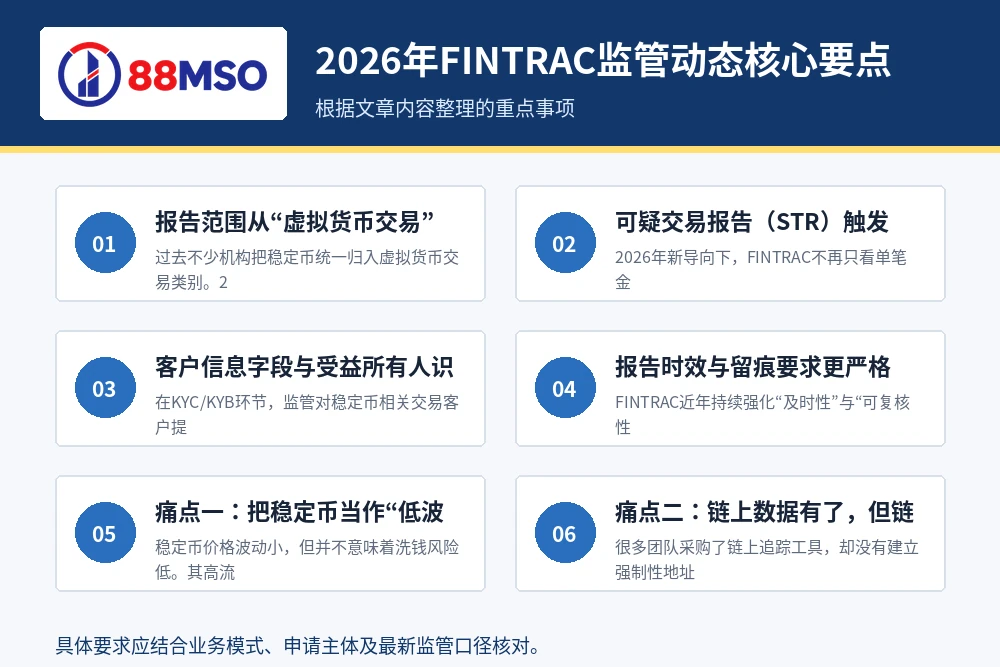
1) The scope of the report is refined from "virtual currency transactions" to "classification of stable currency scenarios"
In the past, many institutions unified stablecoins into the category of virtual currency transactions.。After 2026,Supervision pays more attention to transaction purposes and functional attributes,For example:
- After depositing fiat currency, purchase stablecoins and transfer them to an external wallet.;
- Convert stable currency to legal currency and withdraw money to a local bank in Canada;
- Stablecoins as merchant settlement media (B2B/B2C);
- Cross-border stablecoin clearing and settlement (especially involving high-risk jurisdictions)。
Different scenarios correspond to different report triggering logic and risk scores.,MSB needs to complete scene tagging in the internal system。
2) Suspicious Transaction Report (STR) triggering standards are more “behavioral”
Under the new direction of 2026,FINTRAC no longer only looks at the single amount threshold,And pay more attention to "combination behavioral signals",For example:
- Multiple wallet jumps in a short period of time、Transaction paths are deliberately split;
- The same beneficiary conducts stablecoin trading through multiple accounts;
- and currency mixing services、Anonymous protocols or high-risk addresses continue to interact;
- Client occupation、There is a clear mismatch between income profile and transaction size。
This requires MSB to upgrade the rule engine from "amount threshold type" to "behavior pattern recognition type"。
3) Customer information fields and beneficial owner identification are further strengthened
In the KYC/KYB link,Regulation imposes higher integrity requirements on stablecoin-related trading customers,including but not limited to:
- Proof of wallet control (verification of address ownership);
- Fund source description and supporting evidence (especially for large or frequent trading customers);
- Corporate Customer Ultimate Beneficiary (UBO) Breakthrough Disclosure;
- High-risk country/region association review records。
No auditable customer due diligence file has been established,It will directly affect the quality of subsequent reports and the efficiency of responding to regulatory inquiries.。
4) Stricter reporting timeliness and trace requirements
FINTRAC has continued to strengthen "timeliness" and "reviewability" in recent years。The focus in 2026 is on:
- Internal upgrade after abnormal transaction identification、review、Submission time link;
- Model hit reason、Manual review of comments、Full traces of the basis for decision-making;
- Whether the historical transaction recheck (look-back) mechanism is effectively executed。
Simply put,Supervision not only looks at “whether you reported it or not”,See also “How do you judge and justify the judgment process?”。
three、Four compliance pain points that are most easily ignored by Canadian MSBs
Pain point one:Treat stablecoins as “low volatility crypto assets”,Underestimating AML risks
Stablecoin price fluctuations are small,But it does not mean that the risk of money laundering is low。its high liquidity、cross-border accessibility,Instead, it becomes a common tool for layering and quickly transferring funds.。
Pain point two:The data on the chain is available,But off-chain identity mapping is insufficient
Many teams have purchased on-chain tracking tools,No mandatory address verification process was established,Leads to "seeing money trails",But it cannot effectively respond to real customers”。
Pain point three:Compliance、product、Three lines of technology are out of touch
Stablecoin business iterates quickly,If the product goes online first、Post-compliance documentation,It is easy to cause missing report fields、Alarm noise is too high、Manual review of congestion and other issues。
Pain point four:Cross-jurisdictional license and obligation conflicts
The same group may also involve Canadian MSB、Hong Kong MSO、European VASP and other obligations。In the absence of a unified governance framework,It is extremely easy to have inconsistent reporting standards and risks of duplication/missing reports.。
Four、Implementation Roadmap for Stablecoin Reporting Compliance in 2026 (Practical Version)
first step:Regulatory Gap Analysis (Gap Analysis)
convert existing policy、process、System capabilities are compared item by item with new FINTRAC requirements,Form a red, yellow, and green list。focus on:
- Does the transaction classification and labeling system support stablecoin segmentation scenarios?;
- STR determines whether the logic has behavior recognition capabilities;
- Whether the KYC profile fields meet the beneficial owner penetration requirements。
Step 2:Reconstructing Stablecoin Special Risk Assessment (RA)
put customer type、Product structure、geographical risk、Channel risk、Trading behavior is incorporated into a unified scoring model,Establish dynamic thresholds and hierarchical control mechanisms。
Step 3:Upgrade transaction monitoring and alarm management
- Introducing address risk scoring、path complexity、Indicators such as abnormal transaction frequency;
- Configure the "low false positives + high interpretability" rule,Reduce invalid alarms;
- Establish alarm classification SOP,Clear preliminary review、review、Person responsible for reporting。
Step 4:Strengthen KYC/KYB and continuous due diligence
Establish enhanced due diligence (EDD) for high-risk stablecoin customers,And upgrade "first-time account opening due diligence" to "full life cycle due diligence",Implement data update、Linkage between risk re-evaluation and trading behavior。
Step 5:Reporting mechanisms and audit trail standardization
It is recommended to establish a unified reporting ledger:Trigger reason、Judgment basis、Approval chain、Submission time、Integrated retention for subsequent disposal,Facilitate response to regulatory spot checks and internal audits。
five、Impact on cross-border business enterprises:Not just a Canadian problem
Many overseas companies will ask:Our main markets are in Asia or the Middle East,Why should we attach great importance to Canadian FINTRAC? The answer is straightforward - stablecoin transactions are naturally cross-border,Regulatory upgrades in one jurisdiction,Often spillover to bank cooperation、clearing channel、Due diligence standards of partners。
This is why more and more institutions are beginning to adopt the "multiple licenses + unified compliance center" strategy:Obtain legal access qualifications in different markets,Also manage AML using a consistent framework、KYC、suspicious transaction report、Training and auditing。Based on 88MSO’s long-term service experience,If companies can put Canadian MSB in the early stages、Compliance requirements for Hong Kong MSOs and other key licenses are designed in parallel,Subsequent expansion costs will decrease significantly,Trust between banks and payment partners is also established faster。
six、Three decisions management must focus on
1) Budget decisions:Transform compliance investment from "cost center" to "growth base"
After 2026,Stablecoin compliance capabilities will directly affect business sustainability。No reporting and monitoring system available,The larger the business scale,The more concentrated the risk。
2) Organizational decision-making:Clarify MLRO and cross-department collaboration mechanisms
Compliance officers (including MLROs) should not only have an approval and signing role,Instead, you should be deeply involved in product design.、threshold calibration、Risk review and training system construction。
3) System decision-making:Prefer scalable、explainable、auditable architecture
Regulatory updates won’t stop。If the technical architecture cannot quickly iterate rules and fields,Enterprises will continue to passively “put out fires”。
seven、Enterprise self-examination checklist in 2026 (can be implemented directly)
- policy level:Has the Stablecoin Special AML Policy and Operations Manual been updated?
- customer level:Have high-risk customer stratification and EDD coverage been completed?
- transaction layer:Are there scene-based monitoring rules and thresholds for stablecoins?
- reporting layer:Can the STR process be completed within the time limit and leave traces throughout?
- Personnel level:first line、Risk control、Has special training and assessment been completed for compliance?
- Audit layer:Have backtests and stress tests been conducted?
- Governance:Does the board or management regularly review stablecoin compliance metrics?
Conclusion:Stablecoin supervision enters "refined accountability era"
FINTRAC’s upgrade of Canadian MSB stablecoin transaction reporting requirements in 2026,This marks the transition from “principled compliance” to “data-based accountability” in supervision.。Who can complete the system earlier?、process、system、Four-in-one transformation of personnel,Whoever has a better chance of gaining long-term advantages in cross-border payment and digital finance competition。
For companies planning to develop multi-jurisdictional licenses,The most important thing now is not "temporary patch response",Instead, build a replicable、Scalable global compliance capabilities。Relying on the practical experience of the professional team - including Hong Kong and overseas license applications、AML system construction、Continuous maintenance and regulatory communication – companies can maintain business efficiency without sacrificing business efficiency,Achieve a more robust implementation of globalization。This is exactly the core value that 88MSO and the professional service system behind it have long emphasized.:Make compliance a moat for growth,rather than a brake on expansion。
FAQ:The 4 most frequently asked questions by companies
Q1:We only do small-amount stablecoin exchanges,Will it also be subject to key supervision?
meeting。Supervision increasingly focuses on behavioral patterns and overall risks,rather than a single amount。High-frequency small amounts may also trigger suspicious transaction assessments。
Q2:Rely only on on-chain analysis tools,Is it sufficient to meet FINTRAC requirements?
not enough。KYC/KYB required、Address ownership verification、Internal approval traces and timely reporting mechanism。
Q3:Can Canadian MSB and other regional licenses share the same AML framework?
Can share underlying framework,But localization mapping must be done,Ensure local reporting obligations、Time limits and field requirements match exactly。
Q4:When should the 2026 new regulations be launched?
The sooner the better。It is recommended that a gap assessment be carried out immediately,Set aside at least one full compliance cycle for system modifications、Trial operation and staff training。
Registration status and ongoing reporting obligations should be checked separately
When dealing with FINTRAC regulatory developments in 2026,You should first confirm whether the business falls within the scope of Canadian MSB or foreign MSB。Registration with FINTRAC indicates that the business meets the registration requirements,It does not mean that the regulatory agency endorses the business model.;Compliance plans must still be implemented after doing business、customer identification、Recordkeeping and Applicable Transaction Reporting Obligations。
When it comes to virtual currencies or stablecoins,Exchange should be judged based on the legal and financial structure of the transaction、Transferring and reporting responsibilities,And track the requirements that have taken effect and those that are yet to be taken into effect by supporting rules.。"Latest changes" in the article should indicate the applicable date,Avoid describing proposed or future regulations as if they are currently in place。
Read more:US MSB vs Canadian MSB license:Application threshold、Comprehensive comparison of compliance requirements and costs、US federal MSB license vs state MTL license:Comprehensive comparison of applicable business scope and compliance costs。